


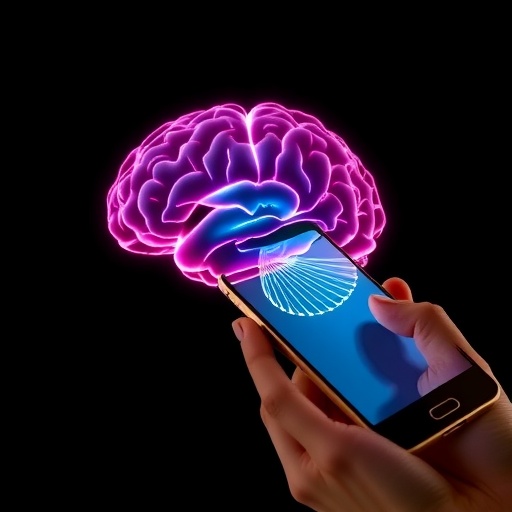
Depression may be measurable not only through interviews and questionnaires, but also through the small decisions people make on their smartphones and the way their brains communicate while resting, according to a new study in Translational Psychiatry. Researchers J.M. Heckel, A. Clouse, D. Klemballa and colleagues examined the relationship between smartphone-assessed executive-function metrics and intrinsic resting-state functional connectivity in depression. The work brings together two rapidly expanding areas of neuroscience: digital phenotyping, which uses everyday technology to capture behavior in real-world settings, and functional neuroimaging, which maps coordinated activity across the brain. Its central premise is that depression-related cognitive changes may leave detectable signatures both in mobile-device interactions and in the brain’s background communication patterns. Rather than treating depression as a condition defined only by mood, the study approaches it as a disorder that can affect attention, working memory, cognitive flexibility, planning and decision-making—functions collectively known as executive control.
Executive function is often discussed as if it were a single mental ability, but it is better understood as a coordinated system of processes that allows people to set goals, hold information in mind, suppress impulsive responses and adjust behavior when circumstances change. In depression, difficulties in these domains can appear as slowed thinking, indecisiveness, impaired concentration or trouble shifting away from negative thoughts. Traditional assessments typically measure these abilities in clinics or laboratories, where participants complete standardized tasks under controlled conditions. Such tests are valuable, but they offer only brief snapshots of cognition. Smartphone-based assessments aim to extend that window. Depending on the design of a study, a phone can present short cognitive tasks, record response times and accuracy, or capture patterns of interaction that reflect how efficiently a person responds to prompts. The resulting metrics are not direct readouts of a particular brain circuit; they are behavioral indicators that may reveal subtle fluctuations in cognitive performance across daily life.
The study’s second major component is intrinsic resting-state functional connectivity, a neuroimaging measure that examines how spontaneous brain activity in one region statistically relates to activity in another while a person is not performing a prescribed task. During a resting-state scan, participants usually lie quietly in a magnetic resonance imaging system. Functional MRI detects changes in blood oxygenation, known as the blood-oxygen-level-dependent or BOLD signal, which serves as an indirect marker of neural activity. Researchers then calculate correlations between signals from different brain areas. Stronger or weaker correlations do not necessarily mean that one region is causing another to activate, but they can indicate how closely their activity is coordinated. This approach is especially useful in depression research because the condition has been associated with changes across distributed networks involved in self-focused thought, emotional regulation, attention and cognitive control, including the default mode, salience and frontoparietal systems.
By placing smartphone-derived executive-function measures alongside resting-state connectivity, Heckel and colleagues address a major challenge in psychiatric neuroscience: connecting brain-level observations with behavior that matters outside the scanner. A connectivity difference can be statistically robust yet difficult to interpret if it cannot be linked to a person’s daily functioning. Conversely, a behavioral measure may show that someone is struggling with attention or flexible thinking without explaining the underlying neural organization. Combining the two creates an opportunity to test whether particular patterns of network coordination correspond to specific cognitive difficulties. For example, communication between prefrontal regions and wider control networks could plausibly relate to planning or working-memory performance, while interactions involving the default-mode network might be relevant to internally focused thought and the persistence of depressive rumination. These possibilities are scientifically important, but they must be tested empirically rather than assumed from the names or locations of brain regions.
The smartphone component also reflects a broader shift toward repeated, low-burden measurement in mental-health research. A single laboratory visit can be affected by sleep, stress, medication timing, motivation or the unfamiliar testing environment. Repeated assessments may help researchers distinguish a stable trait from a temporary change and may reveal patterns that conventional testing misses. In principle, mobile metrics could eventually support earlier detection of cognitive deterioration, identify people who need a more detailed assessment or help clinicians monitor changes during treatment. However, smartphone data are highly context-dependent. Response speed may be influenced by device type, typing familiarity, distractions, fatigue, internet connectivity or whether a participant is using a phone while commuting. Even a seemingly simple measure, such as reaction time, can reflect motor speed and technology habits as much as executive control. For that reason, digital measures require careful validation against established neuropsychological tests and clinically meaningful outcomes.
The brain data present a parallel interpretive challenge. Resting-state functional connectivity is sensitive to preprocessing decisions, head movement, medication status, sleep, scanner differences and the way researchers define networks or regions of interest. A correlation between two BOLD signals is not a direct measurement of synaptic communication, and a group-level association may not accurately predict an individual person’s symptoms. Depression itself is heterogeneous: people diagnosed with the same disorder can differ substantially in mood symptoms, anxiety, cognitive complaints, sleep patterns, treatment history and biological characteristics. A connectivity pattern observed in one sample may therefore not generalize automatically to every patient. The most useful studies in this field are those that report transparent methods, account for potential confounders, test whether findings replicate and distinguish association from prediction. The title of the new paper signals an examination of these relationships, while the practical value of its conclusions will depend on the strength and reproducibility of the reported links.
The research is also part of a larger effort to move psychiatry toward more individualized models. At present, depression is diagnosed primarily through clinical evaluation, and treatment selection often involves trial and error. Biomarkers that could identify distinct cognitive or neural profiles might eventually help match patients with targeted therapies, such as cognitive training, psychotherapy strategies focused on rumination, neuromodulation or medication approaches. A combined digital-neural profile could be more informative than either data source alone, particularly if it captures both how the brain is organized and how cognition operates in everyday contexts. Yet clinical translation is not guaranteed. A predictive model must work across different populations, phones, languages, socioeconomic circumstances and levels of digital access. It must also provide information that improves care beyond what clinicians can obtain through a careful interview and standard testing. Until those standards are met, smartphone and connectivity measures should be viewed as research tools rather than autonomous diagnostic systems.
Privacy and ethics will be central as this technology develops. Smartphone assessments can generate intimate information about cognitive performance, daily routines and periods of vulnerability. Brain imaging adds another layer of sensitive data, even when it is collected for research rather than clinical diagnosis. Participants need to understand what is recorded, how often it is collected, who can access it and whether the data might be used for purposes beyond the original study. Researchers must also guard against algorithms that perform well in one demographic group but misclassify another. The promise of digital psychiatry lies in making mental-health science more precise and responsive, not in turning personal devices into surveillance systems. By examining executive-function metrics together with intrinsic resting-state connectivity, the study published in Translational Psychiatry contributes to a more integrated view of depression—one that links subjective illness, observable behavior and distributed brain networks while underscoring how much work remains before these measurements can become reliable tools in everyday medicine.
Cite Scienmag News
Glenn Wilkins. (August 15, 2026). Smartphone Tests Reveal Links Between Executive Function and Brain Connectivity in Depression. Scienmag. https://scienmag.com/smartphone-tests-reveal-links-between-executive-function-and-brain-connectivity-in-depression/
Glenn Wilkins. "Smartphone Tests Reveal Links Between Executive Function and Brain Connectivity in Depression." Scienmag, 15 August 2026, https://scienmag.com/smartphone-tests-reveal-links-between-executive-function-and-brain-connectivity-in-depression/. Accessed 4 September 2026.
Glenn Wilkins. "Smartphone Tests Reveal Links Between Executive Function and Brain Connectivity in Depression." Scienmag. August 15, 2026. https://scienmag.com/smartphone-tests-reveal-links-between-executive-function-and-brain-connectivity-in-depression/


