


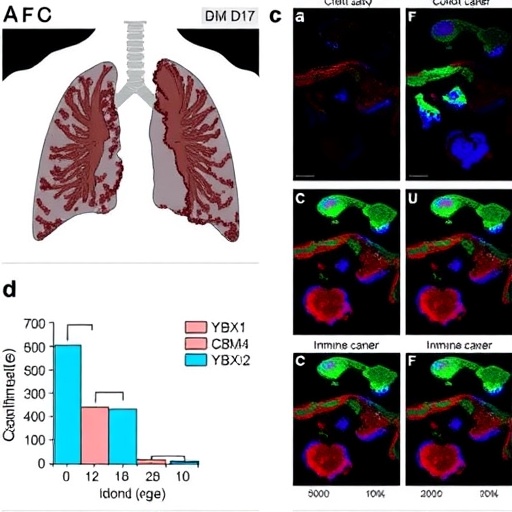
In a groundbreaking study set to redefine our understanding of non-small cell lung cancer (NSCLC) metastasis, researchers have identified the pivotal role of the Y-box binding protein 1 (YBX1) in promoting immunosuppressive traits within bone metastatic environments. This revelation not only illuminates previously obscure pathways but also opens possibilities for targeted therapeutic strategies against NSCLC’s notoriously aggressive progression, especially in bone metastases which significantly deteriorate patient prognosis.
Lung cancer remains one of the leading causes of cancer-related mortality worldwide, with NSCLC accounting for nearly 85% of cases. A critical challenge in the clinical management of NSCLC is its high propensity to metastasize to distant organs, notably the bone. Bone metastases lead to severe complications including pain, fractures, and hypercalcemia, drastically reducing quality of life and overall survival. Understanding the molecular mechanisms driving NSCLC’s colonization of the bone microenvironment has thus been a pressing concern for oncologists and researchers alike.
Zhang, Li, Wang, and their colleagues have directed their investigative lens toward YBX1, a multifunctional DNA/RNA-binding protein traditionally implicated in cell proliferation, drug resistance, and tumor progression. Their research, soon to be published in Nature Communications, meticulously dissects how YBX1 engages in modulating the tumor microenvironment (TME) within bones, asserting an immunosuppressive phenotype that favors metastatic growth. This study brings to light the complex interplay between cancer cells and immune modulation—a duality crucial for the metastatic cascade.
Employing a multifaceted experimental approach combining in vitro cell models, in vivo metastatic mouse models, and comprehensive transcriptomic analyses, the team convincingly demonstrates that YBX1 expression catapults NSCLC cells toward an aggressive, bone-colonizing phenotype. They uncover that elevated YBX1 levels correlate with increased secretion of several immunosuppressive cytokines and chemokines which actively reshape the bone marrow niche to evade immune surveillance. This immune evasion is a key mechanism allowing metastatic cells to thrive and establish secondary tumors.
One of the pivotal findings relates to the crosstalk between NSCLC cells and bone-resident immune cells such as osteoclasts, macrophages, and T lymphocytes. YBX1-driven secretomes appear to suppress cytotoxic T cell activation while promoting the recruitment and expansion of regulatory T cells (Tregs), which are notorious for dampening anti-tumor immune responses. Moreover, the enhanced differentiation of osteoclasts under YBX1 influence fosters bone resorption, facilitating the creation of a permissive niche for tumor growth.
The study delves into the molecular signaling pathways involved, highlighting that YBX1 upregulates PD-L1 (programmed death-ligand 1) on NSCLC cells. PD-L1 is a known immune checkpoint protein that interacts with PD-1 receptors on T cells, delivering inhibitory signals that blunt immune attacks. This upregulation effectively cloaks metastatic cells from T cell-mediated cytotoxicity, enabling unchecked cellular proliferation and metastasis progression. Such immune checkpoint alterations also provide a rationale for combining immune checkpoint inhibitors with therapies targeting YBX1 pathways to potentiate anti-cancer efficacy.
Importantly, the authors explore the epigenetic regulation of YBX1, showing that various oncogenic stimuli, including hypoxia and inflammatory signals within the tumor microenvironment, can elevate YBX1 expression. This suggests that the harsh conditions of the bone metastatic niche itself select or induce cells with an augmented capacity for immune evasion via YBX1-driven mechanisms, highlighting the adaptive nature of metastatic NSCLC cells.
By integrating high-throughput single-cell RNA sequencing data from patient-derived bone metastases, the team validates that NSCLC tumor cells within bone lesions exhibit a distinct transcriptomic signature marked by YBX1 overexpression and immunosuppressive pathway activation. These findings lend strong clinical relevance, suggesting that YBX1 could serve as a biomarker for aggressive, bone-tropic NSCLC and potentially predict response to immunotherapies.
The translational implications of this research are immense. Targeting YBX1 or its downstream effector pathways may provide new avenues to disrupt the establishment and maintenance of immunosuppressive metastatic niches in bone. Therapeutic strategies could include RNA interference technologies, small molecule inhibitors, or monoclonal antibodies specifically designed to counteract YBX1’s pro-metastatic functions.
Furthermore, this study paves the way for combinatorial approaches integrating YBX1 inhibition with existing immunotherapeutic modalities such as PD-1/PD-L1 checkpoint blockade. The synergistic effect might reinvigorate anti-tumor immunity particularly in patients with established bone metastases who often respond poorly to monotherapies due to the highly suppressive microenvironment.
The implications extend beyond NSCLC, as YBX1 is known to play roles in multiple cancers. Understanding its contribution to immune suppression within metastatic niches could revolutionize metastasis treatment paradigms across malignancies, emphasizing the centrality of immune modulation in cancer progression and therapy resistance.
Beyond the biological insights, the authors outline potential challenges for moving YBX1-targeted therapies into clinical trials. The ubiquitous expression of YBX1 in normal tissues necessitates the design of highly specific delivery systems or context-dependent inhibitors to minimize off-target effects. Nevertheless, advances in nanoparticle-based delivery and tumor-targeted therapeutics offer promising solutions.
This work also calls for further research to untangle how YBX1 interacts with other components of the bone microenvironment, including stromal cells and extracellular matrix components. Dissecting these complex interactions will be crucial to fully characterize the metastatic niche and optimize therapeutic interventions.
The discovery of YBX1 as a key immunosuppressive driver in bone metastases underscores the sophisticated strategies employed by tumor cells to colonize distant organs and evade immune destruction. It also exemplifies the power of integrative approaches that combine molecular biology, immunology, and clinical data to address one of oncology’s most formidable challenges.
As this study reaches the scientific community and public, it will undoubtedly generate significant interest due to its potential to influence future lung cancer clinical practices. With lung cancer’s enormous global burden, breakthroughs like this offer hope for more effective treatments and improved patient outcomes, especially for those battling bone metastatic disease.
In summary, the seminal work by Zhang et al. elucidates how YBX1 confers immunosuppressive traits that facilitate NSCLC bone metastasis, providing a molecular blueprint of immune evasion and niche orchestration within the metastatic bone microenvironment. It heralds a new chapter in the fight against metastatic lung cancer, emphasizing precision medicine strategies that target the tumor’s molecular vulnerabilities while empowering the host immune system.
Non-Small Cell Lung Cancer (NSCLC) Bone Metastasis and Immunosuppressive Mechanisms
YBX1 Confers Immunosuppressive Bone Metastatic Traits in Non-Small Cell Lung Cancer
Zhang, K., Li, B., Wang, Q. et al. YBX1 Confers immunosuppressive bone metastatic traits in non-small cell lung cancer. Nat Commun (2026). https://doi.org/10.1038/s41467-026-73931-2
Cite Scienmag News
Nathaniel Bowman. (June 13, 2026). YBX1 Drives Immune Evasion in Lung Cancer Bone Metastases. Scienmag. https://scienmag.com/ybx1-drives-immune-evasion-in-lung-cancer-bone-metastases/
Nathaniel Bowman. "YBX1 Drives Immune Evasion in Lung Cancer Bone Metastases." Scienmag, 13 June 2026, https://scienmag.com/ybx1-drives-immune-evasion-in-lung-cancer-bone-metastases/. Accessed 3 September 2026.
Nathaniel Bowman. "YBX1 Drives Immune Evasion in Lung Cancer Bone Metastases." Scienmag. June 13, 2026. https://scienmag.com/ybx1-drives-immune-evasion-in-lung-cancer-bone-metastases/


