


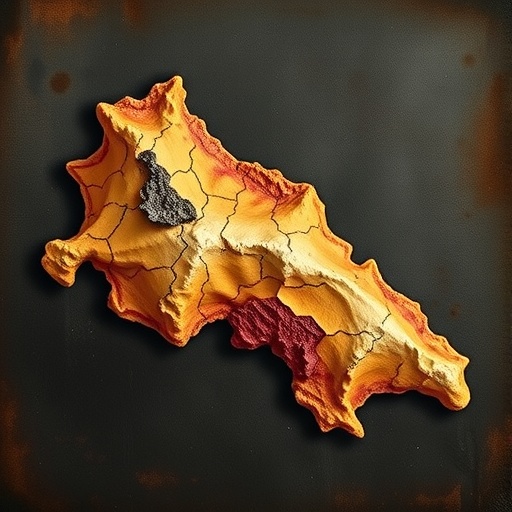
The Ontong Java Plateau, lying on the Pacific Plate, stands as the most voluminous oceanic plateau on Earth, with its formation mostly dated to the Early Cretaceous period. This colossal feature covers an area approximately the size of Alaska and represents an unparalleled episode of magma production in the geological record. For decades, the geological community has sought to unravel the mechanism behind its creation, with the prevailing hypothesis invoking a mantle plume—a rising, hot, and buoyant upwelling from deep within Earth’s mantle—as the primary driver. However, this classic thermal plume model encounters significant challenges, particularly when reconciling the predicted surface uplift associated with such an event with the plateau’s predominantly submarine emplacement.
Traditional mantle plume theories posit that the enormous volumes of magma responsible for plateaus like Ontong Java arise from a hot plume head. Such a plume, heated to temperatures substantially above the ambient mantle, causes extensive partial melting and produces vast flood basalts. Despite the explanatory power of this model regarding magma volumes, it naturally leads to predictions of sufficient crustal thickening and surface uplift to elevate the plateau well above sea level. Yet, Ontong Java’s geological record and bathymetric profiles overwhelmingly show that it was mainly constructed beneath the ocean, presenting a paradox that calls into question whether a purely thermal mechanism can fully account for its genesis.
An alternative hypothesis gaining traction considers the role of rapid seafloor spreading in generating decompressional melting of a mantle domain enriched in dense but fusible components, such as pyroxenite. This model suggests that enhanced spreading rates cause mantle upwelling and melting without necessarily invoking a mantle plume’s excessive thermal anomaly. The presence of fusible pyroxenite—a rock type with lower melting points and higher density than the surrounding peridotite mantle—may facilitate high melt volumes even at moderate temperatures. However, this mechanism’s plausibility hinges on the mantle’s compositional heterogeneity and the mantle potential temperature during the seafloor spreading event.
To rigorously evaluate these contrasting scenarios, Zhang et al. (2026) applied advanced thermodynamic models simulating decompression melting processes of heterogeneous mantle sources. Their approach involved varying mantle potential temperature and proportions of dense fusible materials in the source, aiming to reconcile modeled crustal thicknesses and lava compositions with the geological evidence from the Ontong Java Plateau. The models enable robust predictions about how different mantle reservoirs and temperature regimes influence basaltic magma production, spatial variations in crustal structure, and the resulting surface topography.
The results from these simulations present a compelling narrative: the seafloor spreading model aligns poorly with observed data unless invoking either unrealistically high mantle temperatures or improbably large volumes of dense pyroxenite in the source. Increasing the mantle potential temperature beyond commonly accepted values, or assuming pyroxenite proportions exceeding 20%, pushes the limits of geological plausibility within Earth’s mantle. Hence, while decompressional melting due to spreading may contribute partially, it cannot solely explain the Ontong Java Plateau’s formation.
Conversely, the thermochemical plume hypothesis emerges strongly favored by the model outcomes. Incorporating both temperature anomalies and compositional heterogeneities—specifically, up to 13% dense fusible pyroxenite—the thermochemical plume scenario reconciles the voluminous magmatism, the plateau’s characteristic spatial variations in crustal thickness, and the geochemical diversity of erupted lavas. Crucially, this approach accounts for the plateau’s mostly submarine final emplacement by postulating a buoyant plume head with a temperature anomaly of about 135–200°C above the ambient mantle, generating sufficient magma production without excessive uplift.
This paradigm shift carries profound implications for our understanding of mantle dynamics and large igneous province (LIP) formation. It suggests that mantle plumes should not be seen merely as thermal anomalies but as thermochemical entities, bearing significant compositional heterogeneity that influences their melting behavior and geophysical signatures. Such plumes can produce enormous magma volumes without necessarily resulting in surface uplift to continental elevations, a finding that harmonizes previous conflicting observations.
Moreover, the study’s integration of geochemical constraints alongside physical modeling strengthens its conclusions. Lava compositions sampled across the Ontong Java Plateau exhibit patterns consistent with melting from a source enriched in dense pyroxenite lithologies. These patterns trace variations in mantle source heterogeneity and partial melting extents, intimately linked with the plume’s thermochemical nature. The insight that mantle composition plays a decisive role alongside temperature variations revolutionizes the framework for interpreting plume-related magmatism.
In geological contexts broader than Ontong Java, embracing thermochemical plumes provides a versatile model applicable to other oceanic plateaus and flood basalt provinces worldwide. It underscores the need to consider mantle composition as an equally vital factor as temperature in geodynamic and petrological models of plume generation and mantle melting. This can explain diverse observational signatures ranging from crustal thickness variations to volcanic rock chemistry.
Further, the study touches on the dynamic interactions between spreading centers and mantle plumes, revealing the nuanced interplay that governs melting regimes in oceanic settings. While rapid spreading facilitates decompressional melting, the presence of a thermochemical plume can modulate melt generation processes and the tectonomagmatic evolution of plateaus, leading to the observed heterogeneities in structure and geochemistry.
The methodology implemented by Zhang and colleagues exemplifies the power of marrying thermodynamic modeling with detailed empirical constraints, setting a new benchmark for investigating complex mantle processes. Their approach could inspire similar studies targeting other enigmatic large igneous provinces, refining our grasp of Earth’s interior convection, mantle source complexities, and their surface expressions.
Looking ahead, the implications for mantle plume theories are significant. The existence of thermochemical components within plume heads demands enhanced scrutiny into mantle source compositions through seismic imaging, geochemical analyses, and high-pressure experiments designed to replicate mantle melting conditions. Clarifying the role of dense pyroxenite and other fusible lithologies could unravel the timing, scale, and mechanics behind large magmatic events crucial to Earth’s geological history.
This refined model of the Ontong Java Plateau also invites revisiting the environmental impact assessments associated with LIPs. Understanding the mechanisms controlling magma flux and emplacement depth aids in evaluating their influence on past climate shifts, mass extinctions, and ocean chemistry changes driven by voluminous volcanic degassing and crustal formation.
In essence, the work by Zhang et al. marks a breakthrough in our conceptualization of mantle processes beneath oceanic plateaus. It supports a nuanced view positing that enormous volcanic edifices do not simply arise from thermal anomalies alone but require a more sophisticated understanding of mantle heterogeneity, melting regimes, and their tectonic context. The Ontong Java Plateau stands as a testament to the intricate and dynamic nature of Earth’s interior, embodying forces that continue to shape our planet’s evolving surface.
As research progresses, incorporating thermochemical plume concepts will likely refine Earth system models, influencing disciplines from petrology and geochemistry to geodynamics and climatology. This unified perspective enriches the narrative of how planetary interiors sculpt surface geology and invigorates pursuit toward decoding the mantle’s complex role in Earth’s geological and environmental transformations.
Zhang and colleagues’ landmark investigation powerfully demonstrates that the Ontong Java Plateau’s origin intertwines temperature anomalies with mantle compositional complexity. Moving beyond simple thermal plume models, they chart a new course illuminating the deep Earth processes responsible for some of our planet’s most extraordinary geological features.
Ontong Java Plateau formation mechanisms; mantle plume dynamics; thermochemical heterogeneity in mantle sources; decompression melting processes; oceanic plateau geology.
Ontong Java Plateau formed by a thermochemical mantle plume
Zhang, J., Zhang, X., Chen, S. et al. Ontong Java Plateau formed by a thermochemical mantle plume. Nat. Geosci. (2026). https://doi.org/10.1038/s41561-026-02019-9
AI Generated
https://doi.org/10.1038/s41561-026-02019-9
Cite Scienmag News
Violet Maxwell. (June 11, 2026). Ontong Java Plateau Created by Mantle Plume. Scienmag. https://scienmag.com/ontong-java-plateau-created-by-mantle-plume/
Violet Maxwell. "Ontong Java Plateau Created by Mantle Plume." Scienmag, 11 June 2026, https://scienmag.com/ontong-java-plateau-created-by-mantle-plume/. Accessed 5 September 2026.
Violet Maxwell. "Ontong Java Plateau Created by Mantle Plume." Scienmag. June 11, 2026. https://scienmag.com/ontong-java-plateau-created-by-mantle-plume/


