


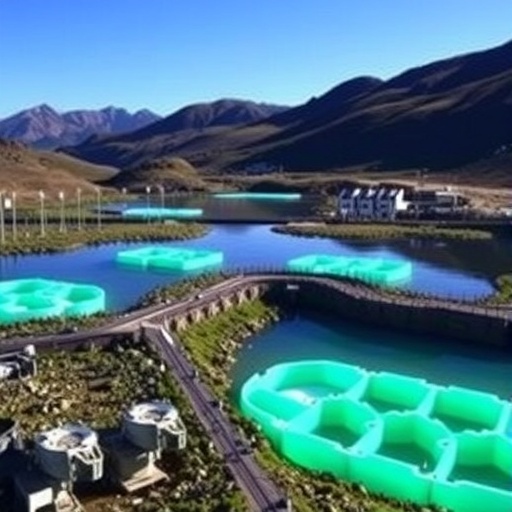
In the face of escalating climate crises and the urgent global need to transition away from fossil fuels, the hidden potential beneath the Earth’s surface is gaining unprecedented attention. Among the vanguards of this transformative energy frontier is Professor Jasmin Raymond of the Institut national de la recherche scientifique (INRS). Recently appointed as the Tier 1 Canada Research Chair in Sustainable Geoenergy Systems Analysis, Professor Raymond is spearheading groundbreaking research at the intersection of geothermal energy, green hydrogen storage, and natural hydrogen exploration. This multidisciplinary endeavor, funded with $1.4 million by the Natural Sciences and Engineering Research Council of Canada (NSERC), aims to chart new pathways for sustainable energy, particularly for remote and Indigenous communities entrenched in fossil fuel dependence.
The core of Professor Raymond’s research is grounded in the sustainable extraction and utilization of geoenergy—energy that is harnessed from the Earth’s crust. Geothermal systems, while traditionally utilized for heating and cooling applications, are now being investigated for more expansive functions including electricity production under environmentally responsible frameworks. Central to this research is the intricate geological characterization and numerical modeling of subsurface environments, coupled with direct field experimentation within natural laboratories. This robust approach enables precise simulation and understanding of thermal and hydraulic behaviors in diverse geological settings, particularly those that have been understudied due to their geographical remoteness.
One of the most compelling aspects of this research initiative involves translating geothermal technologies into tangible solutions for northern Canada’s isolated communities. These regions, often off the main power grid and dependent on diesel generators, face severe environmental and economic challenges linked to fossil fuel consumption. Professor Raymond’s team engages actively with these communities, integrating scientific inquiry with socio-economic realities to foster energy sovereignty. The application of geothermal energy systems here not only reduces greenhouse gas emissions but also enhances energy reliability and affordability—key factors for the sustainable development and resilience of these northern populations.
Expanding the frontiers of geothermal research, the Open Geothermal Laboratory, led by Professor Raymond, extends its investigations into subarctic and Arctic climates, including the harsh conditions of the Franklinian Basin. This extension into extreme environments demands innovative adaptations of geothermal technologies, considering problems of permafrost dynamics, thermal conductivity variations, and geological heterogeneity. The laboratory integrates advanced geophysical surveying techniques and state-of-the-art computational models to decipher the subsurface thermal regime and optimize geoenergy extraction methodologies that can withstand these demanding conditions.
Complementing geothermal exploration, the research program delves into underground green hydrogen storage as a strategic component for energy system stabilization. By utilizing surplus renewable electricity—harnessed primarily from wind and solar installations—excess energy is converted into green hydrogen via electrolysis. This hydrogen can then be stored in subsurface salt caverns, an approach that promises to address the intermittent nature of renewable energy sources. The Magdalen Islands serve as a critical study site where subsurface salt formations are uniquely suited for creating large-capacity storage caverns, enabling continuous and reliable energy supply despite fluctuating renewable generation.
The technical challenges of hydrogen storage underground include understanding geomechanical stability, hydrogen permeability in host formations, and potential chemical interactions with surrounding minerals and fluids. Professor Raymond’s team employs coupled hydro-mechanical-chemical models to predict cavern behavior under cyclic hydrogen injection and withdrawal. This multidisciplinary modeling is pivotal for ensuring storage integrity, preventing hydrogen leakage, and maintaining operational safety. Moreover, field experimentation on the Magdalen Islands validates these simulations, ensuring that theoretical advancements are anchored in practical realities.
Arguably the most pioneering dimension of this research is the exploration of natural geological hydrogen reservoirs—an emergent domain with vast potential for carbon-neutral energy production. Unlike industrially produced hydrogen, natural hydrogen accumulates through geological processes and may exist in substantial quantities, accessible with minimal greenhouse gas emissions. The team focuses on assessing such reservoirs in the Mistassini and Otish basins north of Chibougamau, regions marked by complex lithological structures conducive to hydrogen entrapment.
The geological origin of natural hydrogen involves multifaceted processes including water-rock interactions, radiolysis, and microbial activity, all contributing to hydrogen generation and trapping in crystalline basement rocks or sedimentary layers. Investigating these processes requires integrating isotope geochemistry, petrophysical analyses, and subsurface fluid modeling. The endeavor aims not only to quantify hydrogen reserves but also to elucidate the mechanisms underlying its generation and migration, thereby informing exploration strategies that minimize environmental impact.
In addressing the broader implications, Professor Raymond’s work transcends pure science, injecting vital momentum into climate change mitigation by proposing integrated subsurface energy systems. By holistically exploring geothermal heating and electricity generation, green hydrogen energy storage, and natural hydrogen resource development, this research constitutes a scalable blueprint for achieving energy autonomy in remote areas, aligning with national and international sustainability goals. The approach encapsulates an ambitious vision where subsurface geoenergy systems form the backbone of resilient, low-carbon energy infrastructures.
Critically, this research also fills a conspicuous gap in scientific understanding and societal engagement in northern and isolated regions—domains often sidelined due to logistical and economic challenges. By prioritizing community collaboration and tailored technological solutions, Professor Raymond’s program advocates a participatory model of energy transition. This paradigm empowers local communities, respects Indigenous knowledge, and facilitates equitable access to the benefits of clean energy innovations.
Technological innovations emerging from this chair are expected to generate ripple effects across the energy sector. Advancements in geothermal reservoir characterization, geotechnical engineering for hydrogen storage, and exploration of natural hydrogen geology may catalyze new industries and policies geared towards sustainable resource utilization. Moreover, this initiative fosters a training ground for highly specialized geoscientists and engineers, enriching Canada’s capacity for leadership in the sustainable geoenergy domain.
In sum, the integration of advanced geoscience, engineering, and community-oriented research embodied in Professor Raymond’s Canada Research Chair represents a beacon of hope and innovation. It charts a pathway toward harnessing the Earth’s subsurface as a multifaceted reservoir of clean energy, unlocking opportunities to meet today’s escalating energy demands while respecting planetary boundaries. This ambitious synergy could redefine energy paradigms, revealing the Earth beneath our feet as a cornerstone of the green energy future.
News Publication Date: Not specified in the source content.
Web References:
Keywords
Geothermal energy, Sustainable energy, Green hydrogen, Natural hydrogen, Underground hydrogen storage, Climate change mitigation, Remote communities, Energy transition, Subsurface geoenergy, Canada Research Chair, Renewable energy integration, Arctic energy systems
Cite Scienmag News
Denise Maddox. (June 10, 2026). Harnessing Subsurface Energy to Power the Future of Remote Communities. Scienmag. https://scienmag.com/harnessing-subsurface-energy-to-power-the-future-of-remote-communities/
Denise Maddox. "Harnessing Subsurface Energy to Power the Future of Remote Communities." Scienmag, 10 June 2026, https://scienmag.com/harnessing-subsurface-energy-to-power-the-future-of-remote-communities/. Accessed 7 September 2026.
Denise Maddox. "Harnessing Subsurface Energy to Power the Future of Remote Communities." Scienmag. June 10, 2026. https://scienmag.com/harnessing-subsurface-energy-to-power-the-future-of-remote-communities/


