


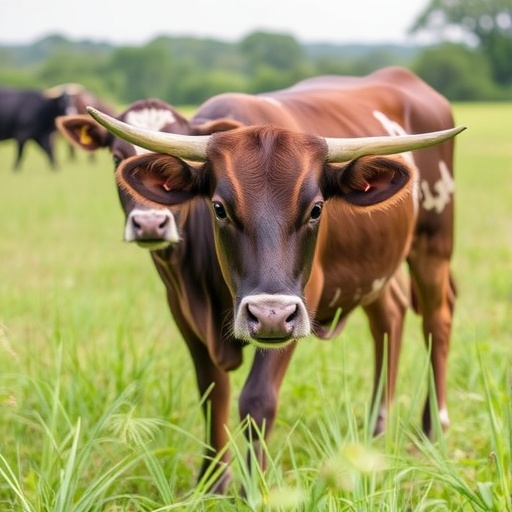
As the cattle industry faces an emerging threat in Arkansas, scientists at the Arkansas Agricultural Experiment Station are intensifying efforts to combat the deadly parasitic disease bovine theileriosis. Caused by the parasite Theileria orientalis Ikeda and transmitted primarily via the invasive Asian longhorned tick, this disease has rapidly escalated across the region, provoking significant agricultural and economic concerns. The increasing prevalence of this parasitic infection in cattle herds has spurred targeted research into effective treatment strategies, funded by a notable grant from the U.S. Department of Agriculture’s National Institute of Food and Agriculture.
Bovine theileriosis manifests with symptoms remarkably similar to anaplasmosis, a bacterial tick-borne disease long recognized in cattle. These overlapping clinical presentations have complicated diagnosis and disease management for ranchers and veterinarians alike. Common signs include weight loss, decreased milk production, anemia, loss of appetite, and reproductive challenges. However, a distinguishing feature of theileriosis is its capacity to affect cattle of any age, in contrast to anaplasmosis, which predominantly impacts older animals. The frequent misdiagnosis has delayed appropriate responses, exacerbating herd losses.
The Asian longhorned tick, an invasive species first documented in Arkansas approximately eight years ago, serves as the principal vector for Theileria orientalis. This tick reproduces parthenogenetically, enabling rapid population expansion with potentially thousands of eggs laid per female. The capacity for swift and extensive infestation underscores the urgency for effective control measures. Recent surveillance has identified established tick populations in numerous Arkansas counties, correlating with a significant spread of bovine theileriosis across the state.
At the core of ongoing research led by assistant professor Emily McDermott and her team is the simultaneous assessment of two commercially available interventions: a prescription anti-tick vaccine developed by Medgene and the parasiticide eprinomectin, used adjunctively with standard acaricides targeting the Asian longhorned tick. These approaches aim to deliver both direct parasiticidal effects and long-term protective immunity to cattle herds. Through rigorous field trials and controlled evaluations, scientists hope to establish treatment protocols that ranchers can readily adopt to mitigate the disease’s impact.
Historical comparisons to the Texas cattle fever epidemic, which wrought devastation throughout the southern United States in the early 20th century, frame the current threat posed by Theileria orientalis Ikeda. Like Texas cattle fever, bovine theileriosis attacks the blood cells of cattle, causing morbidity and mortality rates reminiscent of those earlier outbreaks. Initial research indicates this parasite reduces reproductive efficiency and lowers weaning weights, thereby directly impacting cattle productivity and long-term herd viability. Death rates among infected cattle range from 1 to 5 percent on average but can escalate to 50 percent under severe conditions.
The complexity of Theileria orientalis transmission extends beyond biological vectors to include potential mechanical transmission routes. Mechanical transmission involves blood-borne pathogens being transferred between animals via external agents such as biting flies, which do not host the parasite but physically carry infectious blood from one animal to another. Horse flies and similar biting insects, notorious for quick sequential feeding on multiple animals, present a plausible mechanism for spread independent of ticks. This possibility has prompted educational outreach focused on blood sampling techniques aimed at minimizing accidental pathogen transfer during veterinary procedures.
The novelty and rapid emergence of bovine theileriosis in Arkansas have catalyzed a comprehensive outreach initiative through the Cooperative Extension Service. This program targets county extension agents, veterinarians, and cattle producers, furnishing them with crucial information about tick identification, disease recognition, and integrated management strategies. These educational efforts are critical to slowing disease dissemination, promoting best practices, and encouraging swift adoption of preventive and therapeutic measures across the state’s diverse agricultural communities.
Despite the considerable challenges, the researchers emphasize the availability of immediate tools to address the problem. Both the anti-tick vaccine and parasiticide treatments are currently accessible products, offering a pragmatic bridge while supporting longer-term disease-control innovations. The ongoing research will not only evaluate efficacy but also assess practical aspects such as cost, ease of administration, and compatibility with existing management systems to facilitate widespread producer acceptance.
The Asian longhorned tick’s biology confers significant advantages in its invasive spread, notably its asexual, parthenogenetic reproduction. This reproduction mode allows for rapid population growth independent of male ticks, enhancing its capacity to colonize new territories swiftly. The tick’s broad host range and aggressive feeding behavior complicate control efforts, as do environmental factors promoting suitable habitat conditions. Understanding these ecological parameters is crucial for designing effective control strategies and predicting future risk zones.
Initial discoveries of Theileria orientalis Ikeda cases in Arkansas date back to 2024, with subsequent confirmations in 15 counties, underscoring a geographic expansion that parallels increasing tick populations. Notably, some counties harbor infections despite no detected tick populations, suggesting cattle movement as a vector for disease spread. This highlights the importance of biosecurity measures, including quarantine protocols and vigilant health monitoring during and after livestock transport.
This emerging pathogen’s considerable impact on cattle health, productivity, and agricultural economics warns of a potential crisis reminiscent of historic livestock epidemics. The research spearheaded by McDermott and collaborators exemplifies a rapid, science-driven response to a mounting threat, leveraging cutting-edge parasitology, veterinary medicine, and entomology. Through coordinated efforts involving research, outreach, and on-the-ground implementation, there is hope to curtail the spread of bovine theileriosis and safeguard Arkansas’s cattle industry from further devastation.
News Publication Date: 2026
Web References:
– USDA APHIS Fact Sheet on Bovine Theileriosis: https://www.aphis.usda.gov/sites/default/files/bovine-theileriosis-infosheet.pdf
– Arkansas Cooperative Extension’s Asian Longhorned Ticks & Theileriosis Resource: https://www.uaex.uada.edu/farm-ranch/pest-management/insect/animal-insect-management/asian-longhorned-tick.aspx
Cite Scienmag News
William Thompson. (June 9, 2026). NIFA Grant Fuels Arkansas Research Addressing Bovine Theileriosis Threat from Cattle Ticks. Scienmag. https://scienmag.com/nifa-grant-fuels-arkansas-research-addressing-bovine-theileriosis-threat-from-cattle-ticks/
William Thompson. "NIFA Grant Fuels Arkansas Research Addressing Bovine Theileriosis Threat from Cattle Ticks." Scienmag, 9 June 2026, https://scienmag.com/nifa-grant-fuels-arkansas-research-addressing-bovine-theileriosis-threat-from-cattle-ticks/. Accessed 4 September 2026.
William Thompson. "NIFA Grant Fuels Arkansas Research Addressing Bovine Theileriosis Threat from Cattle Ticks." Scienmag. June 9, 2026. https://scienmag.com/nifa-grant-fuels-arkansas-research-addressing-bovine-theileriosis-threat-from-cattle-ticks/


