

Tuesday, August 18, 2026
Science
No Result
View All Result
  • Login
  • HOME
  • SCIENCE NEWS
  • CONTACT US
  • HOME
  • SCIENCE NEWS
  • CONTACT US
No Result
View All Result
Scienmag
No Result
View All Result
Home Science News Chemistry

Ultrafast Discovery of a Photoinduced Hidden State in Metal-Organic Frameworks

July 28, 2026
in Chemistry
Reading Time: 2 mins read
0
Ultrafast Discovery of a Photoinduced Hidden State in Metal-Organic Frameworks

Ultrafast Discovery of a Photoinduced Hidden State in Metal-Organic Frameworks

65
SHARES
587
VIEWS
Share on FacebookShare on Twitter
ADVERTISEMENT

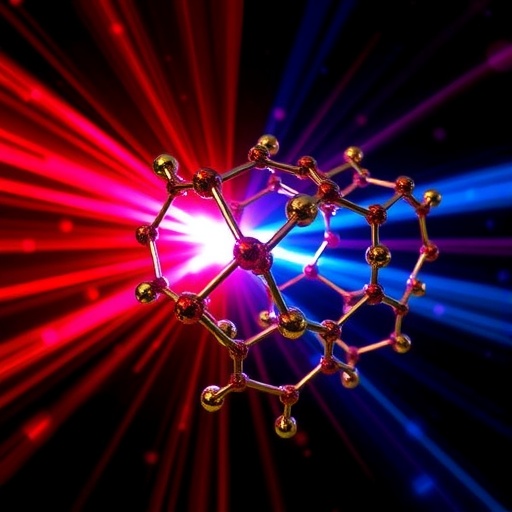
A team of researchers in Japan has observed an ultrafast electronic drama unfolding inside a metal–organic framework (MOF) in just 30 femtoseconds. Their work reveals that a fleeting photoinduced electronic state is not merely a transient curiosity, but a driving step toward a longer-lived “photoinduced hidden state” with distinct optical behavior.

The study addresses a fundamental experimental challenge: the earliest formation of photoinduced states occurs on femtosecond timescales, where direct tracking is exceptionally difficult. By pushing time resolution to the limit, the researchers captured how the MOF’s response evolves immediately after laser excitation—before atomic motion or structural rearrangements dominate.

Using time-resolved reflectance spectroscopy, the team probed changes in the way the material reflects light after excitation by six-femtosecond laser pulses. This approach allowed them to follow rapid modifications to the electronic structure, revealed as the sudden emergence of features consistent with a new optical absorption band. In other words, the optical signature of a hidden state appears almost immediately.

To explain why the reflectance spectrum changes so quickly, the authors combined experiment with theoretical calculations. They identified an intermediate electronic pattern in which bonding interactions between neighboring sites briefly strengthen and weaken in alternation. This transient electronic configuration is known as a bond-order wave state.

The bond-order wave does not persist. It acts as a catalyst: following this ultrafast electronic reorganization, subtle atomic shifts occur, culminating in the formation of the photoinduced hidden state. The researchers’ results therefore connect electronic ordering on femtosecond timescales to the later structural pathway.

Further calculations suggest that the resulting hidden photoinduced state may be polar, implying an uneven distribution of positive and negative charges across the material. If confirmed across similar MOFs, polar hidden states could open new routes for controlling electronic properties with light rather than heat.

Beyond revealing a specific mechanism, the study demonstrates a general strategy: isolate and identify intermediate electronic states that sit between photoexcitation and the emergent phase. Such intermediate-state “roadmaps” may help engineers design photoresponsive materials with faster, more predictable performance.

With ultrashort pulses and model-guided interpretation, the work points toward high-speed optical and optoelectronic technologies where light can switch material functions on demand. Future studies are expected to extend this methodology to other correlated and functional solids where hidden phases may be waiting to be unveiled.

Keywords

  • Ultrafast laser spectroscopy
  • Photoinduced hidden state
  • Metal–organic framework (MOF)
  • Bond-order wave
  • Time-resolved reflectance
  • Femtosecond dynamics
  • Polar photoinduced state

Subject of Research: Metal–organic frameworks (MOFs)

Article Title: Ultrafast formation of a photoinduced hidden state driven by a bond-order wave in a metal–organic framework

News Publication Date: 22-Jul-2026

Web References:
http://dx.doi.org/10.1103/x43y-61c1

References:
10.1103/x43y-61c1

Image Credits: Credit: Assistant Professor Tadahiko Ishikawa from Institute of Science Tokyo, Japan

Tags: bonding interactions in MOFselectronic dynamics in metal-organic frameworksfemtosecond laser excitationfemtosecond timescale spectroscopyoptical behavior of photoinduced statesphotoinduced hidden states in MOFsphotoinduced phase transitionstheoretical modeling of electronic statestime-resolved reflectance spectroscopytransient electronic statesultrafast material responseultrafast spectroscopy
Share26Tweet16
Previous Post

AI-Guided Handheld Cardiac Ultrasound Promises Early Detection and Cost Savings

Next Post

AI Study Shows Cancer Therapy Effectiveness

Related Posts

Freeze-Drying Method Reveals Bacterial Ultrastructure in Scanning Electron Microscopy
Chemistry

Freeze-Drying Method Reveals Bacterial Ultrastructure in Scanning Electron Microscopy

August 18, 2026
From Glass Interfaces to 3D Flow Networks: Engineering Catalysts Across Scales
Chemistry

From Glass Interfaces to 3D Flow Networks: Engineering Catalysts Across Scales

August 18, 2026
Long-range magnetism controls ferrimagnets’ approach to phase transitions
Chemistry

Long-range magnetism controls ferrimagnets’ approach to phase transitions

August 18, 2026
3D-Printed Cellulose Hydrogel Keeps Wearable Sensors Flexible Below Freezing
Chemistry

3D-Printed Cellulose Hydrogel Keeps Wearable Sensors Flexible Below Freezing

August 18, 2026
AI uncovers elemental clues behind persistent free radicals in biochar
Chemistry

AI uncovers elemental clues behind persistent free radicals in biochar

August 18, 2026
Natural leaf coatings could help hydrochar store carbon more effectively
Chemistry

Natural leaf coatings could help hydrochar store carbon more effectively

August 18, 2026
Next Post
AI Study Shows Cancer Therapy Effectiveness

AI Study Shows Cancer Therapy Effectiveness

  • Mothers who receive childcare support from maternal grandparents show more

    Mothers who receive childcare support from maternal grandparents show more parental warmth, finds NTU Singapore study

    27656 shares
    Share 11059 Tweet 6912
  • University of Seville Breaks 120-Year-Old Mystery, Revises a Key Einstein Concept

    1061 shares
    Share 424 Tweet 265
  • Bee body mass, pathogens and local climate influence heat tolerance

    682 shares
    Share 273 Tweet 171
  • Researchers record first-ever images and data of a shark experiencing a boat strike

    546 shares
    Share 218 Tweet 137
  • Groundbreaking Clinical Trial Reveals Lubiprostone Enhances Kidney Function

    531 shares
    Share 212 Tweet 133
Science

Embark on a thrilling journey of discovery with Scienmag.com—your ultimate source for cutting-edge breakthroughs. Immerse yourself in a world where curiosity knows no limits and tomorrow’s possibilities become today’s reality!

RECENT NEWS

  • How AI-Discovered Problem-Solving Strategies Spread and Persist in Human Culture
  • How Application Behavior Drives Undermatching in New York City School Choice
  • Researchers reveal how chronic stress drives immune dysfunction in cold tumors
  • Long-Term Decline of Above-Ground Carbon Sinks in Brazil’s Tropical and Subtropical Forests

Categories

  • Agriculture
  • Anthropology
  • Archaeology
  • Athmospheric
  • Biology
  • Biotechnology
  • Blog
  • Bussines
  • Cancer
  • Chemistry
  • Climate
  • Earth Science
  • Editorial Policy
  • Marine
  • Mathematics
  • Medicine
  • Pediatry
  • Policy
  • Psychology & Psychiatry
  • Science Education
  • Social Science
  • Space
  • Technology and Engineering

Subscribe to Blog via Email

Enter your email address to subscribe to this blog and receive notifications of new posts by email.

Join 5,150 other subscribers

© 2025 Scienmag - Science Magazine

Welcome Back!

Login to your account below

Forgotten Password?

Retrieve your password

Please enter your username or email address to reset your password.

Log In
No Result
View All Result
  • HOME
  • SCIENCE NEWS
  • CONTACT US

© 2025 Scienmag - Science Magazine

Discover more from Science

Subscribe now to keep reading and get access to the full archive.

Continue reading
