

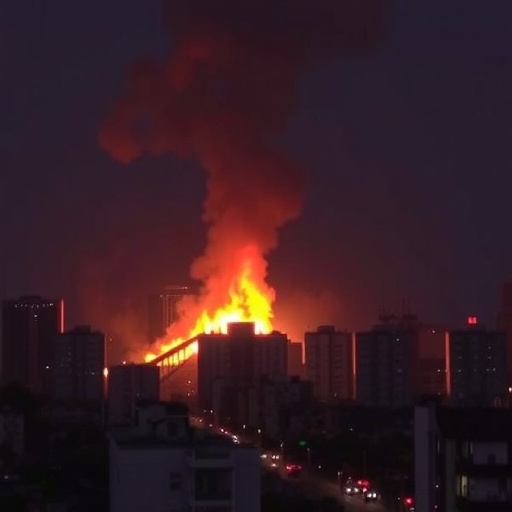
In early 2024, the Noto Peninsula of Japan experienced a devastating magnitude 7.6 earthquake, an event that not only caused significant ground shaking but was followed by an extraordinary and puzzling urban fire in Wajima City. Although the destructive fire razed over 240 buildings and scorched nearly 49,000 square meters, investigators were confounded by the absence of any apparent ignition source. Particularly mystifying were eyewitness accounts and video footage revealing flames erupting spontaneously from areas devoid of typical combustible materials. This phenomenon challenged conventional understanding of earthquake-induced hazards, sparking new scientific inquiry into subterranean processes often overlooked in seismic disaster models.
A groundbreaking study led by Professor Emeritus Yuji Enomoto of Shinshu University presents a novel hypothesis that addresses this enigma. Published in the journal Natural Hazards in April 2026, the research introduces the concept of a “delayed seismic champagne effect.” This mechanism postulates that methane dissolved in groundwater within soft, organic-rich alluvial sediments can undergo exsolution—a transition from dissolved gas to free gas bubbles—induced by intense seismic shaking. Unlike immediate earthquake hazards such as structural collapse or tsunamis, this delayed secondary effect could provoke fires and other hazards substantially after the initial tremors subside.
The research delves into the specific circumstances surrounding the Wajima City fire, which ignited nearly an hour after the principal earthquake event. Despite the widespread power outages and lack of known surface flammable items, the fire’s timing suggested an underground catalyst. Enomoto’s team conducted an interdisciplinary analysis combining seismic waveform data, geological surveys, and groundwater chemical analyses to unpack the sequence of subterranean events. The study revealed that the soft alluvial layers beneath Wajima, rich in organic matter, harbored significant quantities of methane dissolved in groundwater, setting the stage for the hypothesized gas separation triggered by the seismic disturbance.
Further, the study identified an unusually intense aftershock of magnitude 3.5 coincident with the fire’s outbreak. Intriguingly, the seismic signals recorded during this event displayed high-frequency components ranging from 10 to 15 Hz, frequencies atypical for soft sediment resonance patterns, which generally manifest at lower frequencies. This anomalous frequency band aligns with Helmholtz-type resonances, which occur in gas-filled cavities or fractures, suggesting the dynamic interaction of expanding underground gas volumes with seismic energy. This resonance likely played a crucial role in driving rapid methane release from sediment pores.
The “champagne effect” analogy relates to the formation and upward migration of methane bubbles through sediment pore spaces, akin to bubbles rising in a carbonated beverage after opening. The primary earthquake shaking is thought to have brought groundwater methane into a supersaturated state, fostering bubble nucleation within sediment pores. Over the subsequent hour, these bubbles coalesced and migrated upwards, accumulating beneath low-permeability sediment layers. The pressurization eventually exceeded the mechanical integrity of overlying strata, causing ruptures that released methane to the surface.
This rapid gas expulsion would have created localized ground deformation, manifesting as uplifted manholes—some reportedly displaced by over a meter—ground fissures, and seafloor bubble emissions offshore. Standard liquefaction models, which typically explain post-seismic ground deformation, fail to account for such pronounced uplift and gas release phenomena. Enomoto’s study underscores the need to incorporate gas pressure dynamics into seismic hazard assessments, highlighting a critical pathway for secondary disaster development that has been largely overlooked in earthquake science.
The ultimate ignition of methane near the surface remains an area for further investigation; however, Enomoto hypothesizes that sparks from electrical equipment failures, frictional heating from ground faulting, or other minor ignition sources could trigger combustion of the accumulated methane. This delayed and spatially variable process challenges traditional emergency response protocols, which often focus on immediate post-earthquake hazard zones and may neglect secondary hazards emerging in the aftermath.
Importantly, the implications of this newly identified hazard extend beyond Wajima or even Japan. Many coastal urban regions worldwide are constructed atop soft, organic-rich alluvial sediments—conditions conducive to subterranean methane accumulation. Earthquake-prone areas with such geological characteristics could face similar risks, where flammable gas exsolution and delayed release induce fires or explosions long after the initial seismic event. This understanding necessitates a paradigm shift in post-earthquake risk management and urban planning.
Preventative measures derived from this research emphasize the importance of comprehensive gas monitoring in seismically active regions underlain by gas-saturated sediments. Installation of methane sensors, enhanced ventilation in evacuation shelters to mitigate gas accumulation, and refined risk communication to inform the public about delayed hazards are vital components of updated disaster preparedness plans. These strategies aim to reduce vulnerabilities associated with the “delayed seismic champagne effect” and improve public safety during extended post-earthquake periods.
Despite its speculative elements, Enomoto’s study equips disaster scientists and engineers with a rigorous physical framework to investigate and quantify subterranean methane dynamics as a contributing seismic hazard. The multidisciplinary approach integrating seismology, geochemistry, and sedimentology charts a path for future research to validate and elaborate the delayed-exsolution model through laboratory experiments, detailed groundwater sampling campaigns, and more extensive seismic monitoring.
In conclusion, the elucidation of gas-driven secondary hazards following strong seismic shaking unlocks a new frontier in earthquake research. Recognizing and addressing these hidden dangers could transform disaster mitigation worldwide, safeguarding vulnerable urban environments against not only the immediate devastation of earthquakes but also their insidious, time-delayed consequences.
Subject of Research: Not applicable
Article Title: Amplified ground shaking from subterranean gas expansion: A new geohazard in the 2024 Noto earthquake
News Publication Date: 22-Apr-2026
Web References:
- https://doi.org/10.1007/s11069-026-08124-7 (Journal article DOI link)
Image Credits: Dr. Yuji Enomoto from Shinshu University, Japan
Keywords: Geophysics, Natural disasters


