


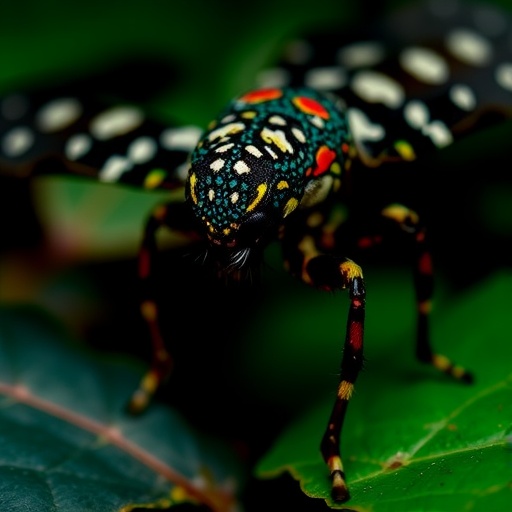
At a thriving vineyard in Maryland, an unexpected new ally in the fight against invasive pests has emerged—not among the ranks of scientists or seasoned field experts, but rather at the side of a spirited Boston terrier named Xephyr. Guided by her devoted owner, Debi Persing, Xephyr demonstrated an extraordinary ability to detect spotted lanternfly egg masses—an invasive species known for its destructive impact on agriculture and ecosystems—outperforming experienced human searchers in the complex, real-world environment of densely vegetated grapevines.
The spotted lanternfly (Lycorma delicatula) poses a significant threat across 19 states in the United States, affecting vineyards, orchards, and local forests with its rapid spread and voracious feeding habits. Early detection of its egg masses is critical to halting infestation, yet these egg clusters are notoriously difficult to spot using traditional methods. The scarcity of professional detection canine teams further complicates mitigation efforts. It is into this challenging landscape that a pioneering study from Virginia Tech’s College of Agriculture and Life Sciences steps, exploring the potential for everyday dogs and their owners, armed with targeted training, to serve as a nimble and scalable frontline detection force against this pest.
In a controlled yet naturalistic trial, the research team sought to move beyond laboratory efficacy and assess canine detection performance in real-world conditions where competing odors and unknown target locations present substantial complexities. Over the course of field searches, trained dog-handler pairs, including Xephyr and Persing, methodically covered half-acre plots where previous human scouts had designated certain vines as free of egg masses. Remarkably, the dogs located egg clusters that experts had overlooked, underscoring not only the animals’ keen olfactory acuity but also their ability to navigate distractions and dense vegetation with precision.
Quantitatively, the study revealed that in vegetation-rich environments, dogs achieved more than double the detection rate of their human counterparts, registering an average of three egg-mass discoveries compared to 1.3 per human searcher. This remarkable performance is attributed partly to the dogs’ ability to detect scents within an effective range of approximately 16 feet, highlighting the importance of closely paced, systematic search patterns by handlers to maximize scent acquisition and detection reliability.
Another critical insight emerged from the capability of dogs, trained solely on non-living egg masses in safekeeping, to successfully identify live egg clusters in the field. This finding has profound implications for biosecurity and training practices, as it permits the formation of new detection teams without the risk of inadvertently facilitating pest spread during the training process. The ability to generalize scent recognition across life stages and conditions substantially broadens the utility and safety of canine detection programs.
The potential applications of this canine detection model extend well beyond the spotted lanternfly. The research team at Virginia Tech is now poised to explore the detection of other agricultural threats, such as Pierce’s disease—a bacterial ailment that devastates grapevines and undermines viticulture. Deploying a distributed network of dog-handler teams could revolutionize early detection and rapid response strategies, leveraging widespread community engagement and the natural capabilities of dogs irrespective of breed.
Erica Feuerbacher, lead researcher and professor in the School of Animal Sciences, emphasizes the transformative nature of this approach. By training ordinary dogs to sniff out elusive invasive species and diseases, communities gain an adaptable and cost-effective surveillance mechanism. This democratization of detection could dramatically amplify efforts to curtail early infestations before they escalate, conserving ecological balance and agricultural productivity.
Moreover, the study highlights the resilience of dogs’ olfactory performance amid the complex sensory backdrop of natural environments. Unlike controlled laboratory settings, the field introduces numerous competing odors and sensory distractions, yet trained dogs consistently maintained their detection capabilities. Such robustness endorses the feasibility of widespread deployment in diverse ecological contexts where odors are intermingled and odor sources unpredictable.
Behind Xephyr’s dynamic search is a foundation of rigorous scent training conducted several times weekly, reflecting the dedication and partnership between owner and dog. This interaction not only enhances detection outcomes but also underscores the importance of sustained engagement and reinforcement to maintain canine alertness and motivation, ensuring their readiness for field challenges.
The research also contributes valuable methodological insights: understanding the effective detection radius informs handler movement strategies, advocating a deliberate and measured pace that keeps dogs within the optimal scent distance. This optimization is crucial for maximizing detection success rates while covering expansive search areas efficiently.
Funding by the U.S. Department of Agriculture’s National Institute of Food and Agriculture underscores the strategic significance and governmental support for advancing biocontrol and invasive species detection technologies. As invasive species and agricultural threats continue to rise globally, such scientific innovations represent critical tools in sustainable environmental management.
Xephyr, now twelve years old, remains a testament to the enduring power of canine scent detection. Her exemplary performance and enthusiasm for scent training epitomize the exciting possibilities that lie at the intersection of science, agriculture, and the human-animal bond—a connection that may prove indispensable in safeguarding ecosystems and livelihoods from the stealthy encroachment of invasive pests.
News Publication Date: 9-Jun-2026
Web References:
- Virginia Tech College of Agriculture and Life Sciences: http://cals.vt.edu
- School of Animal Sciences at Virginia Tech: http://sas.vt.edu
- Study reported on PeerJ: https://peerj.com/articles/21387/
- Related study and news releases available at Virginia Tech news archives.
Cite Scienmag News
Alan Morgan. (June 9, 2026). Could Dogs Be the Next Ally in Battling Spotted Lanternflies? New Study Suggests So. Scienmag. https://scienmag.com/could-dogs-be-the-next-ally-in-battling-spotted-lanternflies-new-study-suggests-so/
Alan Morgan. "Could Dogs Be the Next Ally in Battling Spotted Lanternflies? New Study Suggests So." Scienmag, 9 June 2026, https://scienmag.com/could-dogs-be-the-next-ally-in-battling-spotted-lanternflies-new-study-suggests-so/. Accessed 4 September 2026.
Alan Morgan. "Could Dogs Be the Next Ally in Battling Spotted Lanternflies? New Study Suggests So." Scienmag. June 9, 2026. https://scienmag.com/could-dogs-be-the-next-ally-in-battling-spotted-lanternflies-new-study-suggests-so/


