


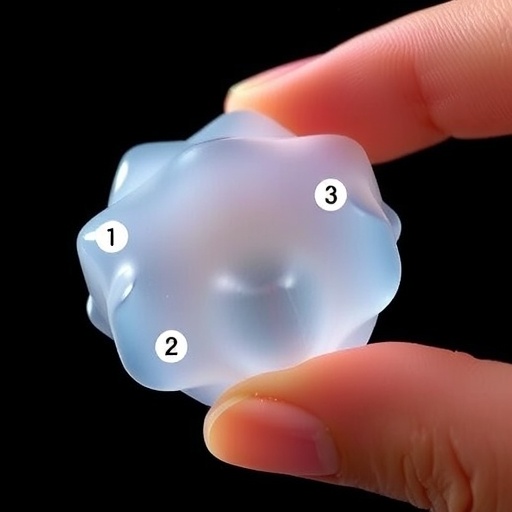
In a groundbreaking advancement poised to reshape the landscape of biomedical materials, researchers at the Korea Advanced Institute of Science and Technology (KAIST) have unveiled a novel hydrogel technology that exploits natural plant-derived compounds to dramatically enhance the mechanical performance and controllable degradation of seaweed-based hydrogels. This innovative strategy hinges on the integration of tannic acid, a polyphenol abundantly found in tea and various fruits, offering unprecedented control over hydrogel adhesiveness, strength, and breakdown rates without the need for complex synthetic chemistry.
Hydrogels — soft, water-rich materials that maintain their three-dimensional form — are pivotal in a broad spectrum of medical and personal care applications, including wound dressings, drug delivery patches, contact lenses, and cosmetic formulations. Their ability to closely adhere to biological tissues and serve as reservoirs for therapeutic agents makes them indispensable in advanced healthcare. However, a persistent challenge has been enhancing the toughness and adhesiveness of these gels while tuning their degradation profiles to meet clinical demands. The KAIST team’s breakthrough addresses these issues by revisiting the chemistry of κ-Carrageenan, a sulfate-rich natural polymer harvested from red seaweed, widely recognized for its thickening properties in food products.
The molecular architecture of κ-Carrageenan carries numerous sulfate groups that inherently repel each other due to negative charges, impeding the formation of tightly cross-linked networks. This electrostatic repulsion has historically limited the mechanical robustness and adhesive capacity of κ-Carrageenan hydrogels, constraining their biomedical utility. Recognizing this barrier, the researchers turned to tannic acid, a polyphenolic compound capable of multivalent binding through its galloyl groups. These multiple binding sites enable tannic acid to act as a molecular bridge, potentially neutralizing sulfate group repulsions and reinforcing the hydrogel’s internal network.
Rigorous experimental analyses confirmed that instead of being a hindrance, the sulfate groups serve as critical binding sites for tannic acid, effectively transforming a molecular vulnerability into an asset. This interaction results in a significantly denser and more cohesive gel matrix. Quantitatively, the hydrogel’s storage modulus—a measure of its elasticity and firmness—increased from approximately 294 pascals in pure κ-Carrageenan gels to nearly 1,632 pascals when tannic acid was introduced. This fivefold enhancement reflects a substantial leap in structural integrity, allowing the hydrogel to resist deformation under mechanical stress, a vital characteristic for materials intended to remain intact on dynamic biological surfaces.
Moreover, the study highlighted the versatility of tannic acid’s reinforcing effect, demonstrating that its introduction at any stage of hydrogel formation consistently bolstered the microscopic gel network architecture. This dynamic cross-linking capacity affords flexibility in manufacturing and application, potentially simplifying processes for producing hydrogel devices that require specific mechanical and adhesive profiles.
Perhaps one of the most compelling aspects of this innovation is the simultaneous achievement of rapid biodegradability and strong adhesion—a combination rarely seen in synthetic or natural hydrogels. Simulating the harsh chemical environments of the human stomach and intestines, researchers observed that the tannic acid-enhanced hydrogels degraded timely, ensuring that they would not persist beyond their therapeutic window. Concurrently, these hydrogels exhibited robust adhesion to skin and irregular tissue surfaces, guaranteeing that they remain securely in place during therapeutic intervention, such as wound healing or targeted drug administration.
This balance is especially significant in medical applications where dressings or drug patches must endure bodily movements and moisture without premature detachment, yet degrade completely once their function is fulfilled to avoid secondary procedures or complications. The tannic acid-κ-Carrageenan composite thus portends a new class of bioresponsive polymers that can be finely tuned without extraneous chemical modifications, relying solely on food-grade, naturally derived components.
The research extends beyond the immediate medical domain, offering promising implications for food technology, cosmetic science, and regenerative medicine. By formulating a material platform that leverages biocompatible, antioxidant-rich natural compounds, there is an opportunity to engineer safer, environmentally friendly products that fulfill rigorous functional criteria. Potential applications include edible coatings that protect food or prolong freshness, skin-adhering cosmetic treatments, scaffolds that support tissue regeneration, and vehicles for controlled nutrient or drug release.
Professor Haeshin Lee, leading the research team from KAIST’s Department of Chemistry, emphasized the broader significance of their findings. He remarked that their work provides a paradigm for designing hydrogels whose mechanical properties, adhesiveness, and degradation pathways can be seamlessly orchestrated via natural polymer chemistry. This approach not only reduces reliance on synthetic materials but also aligns with trends toward biocompatibility and sustainability in material science.
Published in the peer-reviewed journal Biomimetics on April 21st, this study, authored by lead researcher Han-Yeol Yang and colleagues, underscores the transformative potential of polyphenol intervention in hydrogel technology. The findings were made possible with funding support from Polyphenol Factory Inc., a KAIST faculty-led startup, reflecting a successful synergy between academic research and industry.
Beyond the compelling technical advancements, this work invites further exploration into other natural polyphenols and polymer combinations to broaden the functionality and applicability of hydrogels. Its integration into practical healthcare solutions could markedly improve patient compliance and therapeutic efficacy, underscoring the pivotal role of interdisciplinary research bridging chemistry, biology, and materials engineering.
In summary, the KAIST team’s innovative use of tannic acid to overcome longstanding physicochemical challenges in κ-Carrageenan hydrogels heralds a new chapter in the design of soft, adhesive biomaterials. This advancement promises to accelerate the development of next-generation wound care products, drug delivery platforms, and biocompatible scaffolds—ushering in a future where natural polymers and bioinspired chemistry harmonize to meet complex medical needs.
News Publication Date: June 9, 2023
Web References: http://dx.doi.org/10.3390/biomimetics11040290
References: Yang, H.-Y., Seo, J., Choi, W., Kim, E., Yeo, S., Park, S., & Lee, H. (2023). Adhesive κ-Carrageenan Hydrogels by Polyphenol Intervention. Biomimetics, 11(4), 290. https://doi.org/10.3390/biomimetics11040290
Keywords
κ-Carrageenan, tannic acid, hydrogel, adhesion, biodegradation, polyphenols, mechanical strength, biomaterials, wound healing, drug delivery, natural polymers, bioengineering
Cite Scienmag News
Bethany Barker. (June 9, 2026). KAIST Innovates Hydrogel with Enhanced Skin Adhesion and Adjustable Degradation for Advanced Biomedical Applications. Scienmag. https://scienmag.com/kaist-innovates-hydrogel-with-enhanced-skin-adhesion-and-adjustable-degradation-for-advanced-biomedical-applications/
Bethany Barker. "KAIST Innovates Hydrogel with Enhanced Skin Adhesion and Adjustable Degradation for Advanced Biomedical Applications." Scienmag, 9 June 2026, https://scienmag.com/kaist-innovates-hydrogel-with-enhanced-skin-adhesion-and-adjustable-degradation-for-advanced-biomedical-applications/. Accessed 6 September 2026.
Bethany Barker. "KAIST Innovates Hydrogel with Enhanced Skin Adhesion and Adjustable Degradation for Advanced Biomedical Applications." Scienmag. June 9, 2026. https://scienmag.com/kaist-innovates-hydrogel-with-enhanced-skin-adhesion-and-adjustable-degradation-for-advanced-biomedical-applications/


