


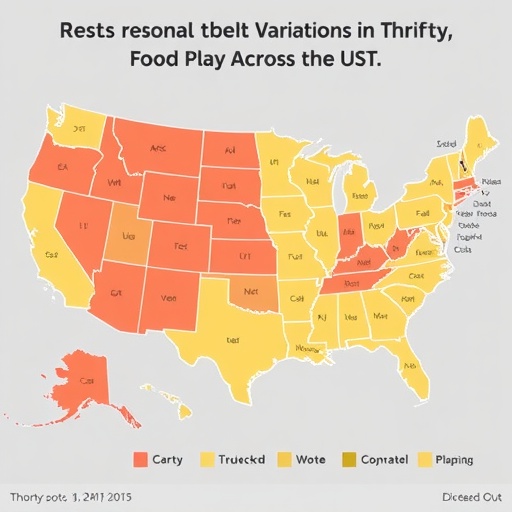
A recent comprehensive study published in the Journal of Nutrition Education and Behavior unveils critical insights into the complex landscape of food affordability across the United States. The research meticulously analyzed geographic and temporal dimensions influencing the cost of the USDA’s Thrifty Food Plan (TFP), a fundamental benchmark used in determining SNAP (Supplemental Nutrition Assistance Program) benefits. This study’s findings underscore how dramatically location and seasonality impact the financial burden of securing a healthy diet, raising pivotal questions about the equity and adequacy of current nutrition assistance frameworks.
The Thrifty Food Plan is designed as an evidence-based dietary model that calculates the minimum cost of an affordable, nutritious diet, compliant with USDA dietary guidelines and nutrient recommendations. It serves as the backbone for setting maximum benefits within SNAP, the nation’s principal food assistance initiative. However, the prevailing national implementation of the TFP presupposes uniform food prices across regions, an assumption disproved by this latest inquiry based on extensive data spanning six years, from 2012 to 2018.
Drawing from USDA Food-at-Home Monthly Area Prices datasets and applying the 2021 TFP market basket specifications, researchers conducted an in-depth assessment of price variability across four major U.S. census regions and ten metropolitan areas. The results reveal pronounced disparities: households in the Northeast, notably in cities like New York and Boston, confront substantially higher weekly costs to meet the TFP standards compared to counterparts in the Midwest and South, where cities such as Detroit and Houston benefit from comparatively lower food prices. This geographical stratification accentuates the challenge of uniform SNAP allotments when ground realities diverge so sharply.
Quantitatively, nearly 90% of the variations in the TFP cost can be attributed to geographic differences, while seasonal fluctuations constitute the remaining variability. The temporal dimension illustrates that the highest diet costs occur during winter months, contrasted with the generally lower prices in the fall. Such seasonal trends were particularly notable for several key food categories integral to the TFP, including whole fruits, vegetables, whole grain staples, poultry, eggs, and dairy products. For instance, whole fruit prices peak in the Northeast during winter, exacerbating the financial strain on families striving to adhere to dietary recommendations.
These findings challenge the efficacy of current SNAP benefit calculations, which typically incorporate geographic price adjustments only for Alaska and Hawaii, leaving the continental United States mostly untreated for regional price variation. The reliance on national average prices means that families residing in high-cost areas may receive insufficient benefits to afford the healthy diet envisioned by the TFP model, thereby undermining the program’s objective of nutritional adequacy.
Parke Wilde, PhD, Professor at Tufts University’s Friedman School of Nutrition Science and Policy and the study’s corresponding author, highlights the policy implications of this research. Wilde stresses that “because SNAP benefits are largely based on national average food prices, regional differences may affect whether households can realistically afford nutritious foods.” The study’s results thus compel reconsideration of benefit calculation methodologies to reflect local and temporal food price realities.
An additional legislative dimension frames the conversation around the TFP and SNAP benefits. Recent federal mandates stipulate that reevaluations of the TFP must maintain cost neutrality when adjusted for inflation. While intended to control program expenditures, this constraint may inadvertently restrict the flexibility to adjust SNAP benefits responsively to shifting food environments, geographic cost burdens, and evolving nutritional science. This underscores a critical tension between fiscal prudence and nutritional adequacy in policy formulation.
The intricate analysis in this study also identifies specific food groups disproportionately driving cost differences geographically and seasonally. Foods like whole fruits and vegetables exhibit significant price volatility, which directly impacts the cost composition of a nutritious diet. This granular understanding is essential for policymakers targeting adjustments either in TFP market baskets or supplementary strategies to ensure food security and diet quality, particularly in high-cost regions.
The study’s temporal analysis adds an important dimension to nutrition assistance policy discourse. Seasonal price peaks challenge consistent access to nutritious foods year-round, potentially amplifying disparities and affecting dietary behaviors. Recognizing such fluctuations is vital for consideration in benefit schedule design and public health interventions to mitigate periods of heightened vulnerability.
By shedding light on these nuanced patterns in food affordability, the research calls for robust, location-sensitive approaches in nutrition assistance programs. Universal application of national averages obscure localized challenges faced by families in diverse economic and geographical contexts and can inadvertently perpetuate nutritional inequities.
In conclusion, this study from the Journal of Nutrition Education and Behavior underscores a critical and often overlooked dimension of food policy: the intersection of geography, seasonality, and diet affordability. As policymakers grapple with the future of SNAP funding, eligibility, and program design, incorporating geographic and temporal price variation into benefit determinations could significantly improve the program’s efficacy in promoting food security and public health across the nation.
This comprehensive assessment serves as a clarion call for future research and policy innovation, urging the integration of detailed price analytics into national nutrition assistance frameworks that can adapt to local realities. Such advancements are imperative for ensuring that SNAP and similar programs truly meet the nutritional needs of all Americans, regardless of where or when they shop for food.
Cite Scienmag News
Daisy Hatcher. (June 8, 2026). Regional and Urban Variations in Thrifty Food Plan Costs Across the US. Scienmag. https://scienmag.com/regional-and-urban-variations-in-thrifty-food-plan-costs-across-the-us/
Daisy Hatcher. "Regional and Urban Variations in Thrifty Food Plan Costs Across the US." Scienmag, 8 June 2026, https://scienmag.com/regional-and-urban-variations-in-thrifty-food-plan-costs-across-the-us/. Accessed 4 September 2026.
Daisy Hatcher. "Regional and Urban Variations in Thrifty Food Plan Costs Across the US." Scienmag. June 8, 2026. https://scienmag.com/regional-and-urban-variations-in-thrifty-food-plan-costs-across-the-us/


