


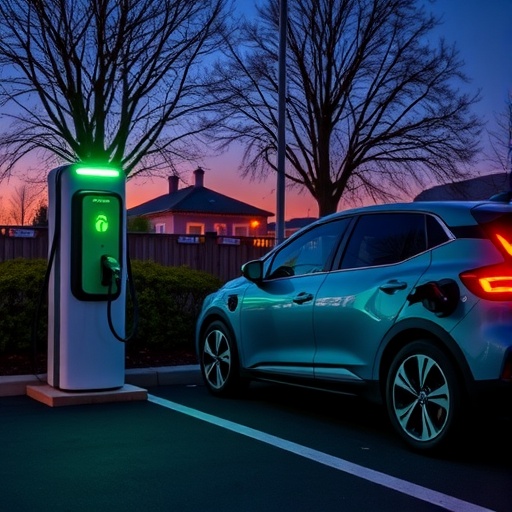
As electric vehicles rapidly become a dominant force in global transportation, the demand for efficient and secure charging infrastructure surges in tandem. This growing reliance on electric vehicle (EV) charging stations not only necessitates advancements in energy management but also presents novel cybersecurity challenges that must be addressed to safeguard the integrity and operation of power grids. Researchers at the University of Malaga’s Network and Information Security (NICS) group have pioneered a groundbreaking solution designed to detect and mitigate cyber-attacks on EV charging stations, marking a significant technological leap towards securing the next generation of energy networks.
EV charging stations comprise a complex ecosystem of interconnected physical and digital components, ranging from power converters and communication modules to software control systems. This intricate architecture inherently expands the attack surface, making these stations vulnerable to diverse cyber threats such as energy theft, operational sabotage, and service disruptions. The University of Malaga’s innovative approach to cybersecurity focuses on leveraging distributed intelligence and advanced monitoring techniques to provide an adaptive and comprehensive defense mechanism tailored for these critical infrastructures.
Central to this solution is the deployment of intelligent software agents embedded within individual charging stations. These agents continuously monitor operational parameters, communication integrity, and device status, enabling real-time detection of anomalies and potential security incidents. Rather than isolated monitoring, the system integrates these agents into a unified, collaborative framework whereby each agent shares its local data with a centralized system and compares findings with neighboring stations. This collaborative situational awareness enhances the accuracy of anomaly detection by integrating broader contextual insights, effectively creating a dynamic, resilient barrier against cyber threats.
The intelligent agents utilize artificial intelligence (AI) algorithms to analyze vast streams of data generated by charging stations. These AI techniques enable the agents to differentiate between benign irregularities and genuine security incidents, thereby reducing false positives and accelerating response times. Importantly, the system incorporates consensus mechanisms that allow distributed agents to validate alerts collectively, enhancing the reliability and trustworthiness of diagnostics and ensuring coordinated cyber defense actions across the network.
In addition to AI and consensus protocols, the solution harnesses blockchain technology to underpin the security and integrity of the diagnostic process. Blockchain’s decentralized ledger system ensures that all data regarding the agents’ assessments and detected anomalies are immutable and transparently recorded. This traceability not only secures the data against tampering but also enables auditability, providing assurance to grid operators and stakeholders that incident reports are accurate and trustworthy.
One of the critical advantages of this distributed intelligence system is its ability to deliver high-fidelity situational awareness. Traditional cybersecurity tools often focus narrowly on isolated events, lacking the contextual breadth necessary to understand comprehensive threats. By contrast, the University of Malaga’s system contextualizes anomalies by identifying affected devices, pinpointing locations, and analyzing temporal patterns. Such detailed situational understanding empowers more efficient mitigation strategies, reducing downtime and protecting the operational integrity of the energy grid against cascading failures induced by cyber-attacks.
The proposal is particularly relevant in the era of smart grids, where interconnected infrastructures require robust security frameworks that can adapt to evolving threat landscapes. The real-time collaboration among software agents ensures that even sophisticated multi-vector attacks can be detected early and isolated swiftly. This proactive posture significantly enhances the resilience of charging stations, preventing attacks before they can propagate and inflict widespread damage.
Moreover, the use of intelligent agents facilitates scalable deployment across large networks of charging stations. Each agent functions autonomously, yet in concert with the broader system, enabling flexible adaptation to diverse infrastructure configurations and energy environments. This modularity aligns well with the heterogeneous nature of EV charging infrastructures, accommodating varying hardware models, communication protocols, and service operators.
This research is published in the esteemed International Journal of Critical Infrastructure Protection under the title ‘Situational awareness for trustworthy charging scenarios.’ It forms part of the University of Malaga’s II Smart-Campus Own Plan and is consonant with the European DUCA project, particularly concerning the application of blockchain in energy contexts. The study’s authors, including Professor Cristina Alcaraz, Professor Javier López, and researcher Alberto García, represent a multidisciplinary effort bridging computer engineering, telematics, and energy systems.
In essence, the University of Malaga’s situational awareness system marks a transformative advancement in securing the electric vehicle charging ecosystem. Through the integration of AI-driven intelligent agents, consensus protocols, and blockchain, the solution offers unprecedented levels of accuracy, transparency, and resilience. It positions future electric mobility networks to withstand the sophisticated cyber threats of tomorrow, ultimately safeguarding the sustainability and reliability of green transportation infrastructures worldwide.
The implications of this work extend beyond EV charging, hinting at broader applications for critical infrastructure protection in sectors increasingly reliant on interconnected digital and physical systems. As cyber threats continue evolving in complexity, innovations like this distributed intelligence framework provide a blueprint for resilient, secure operation in the digital age.
The University of Malaga’s work underscores the vital role of interdisciplinary research in addressing real-world challenges at the intersection of technology, energy, and security. By pioneering intelligent, collaborative defense mechanisms tailored to emerging infrastructures, their solution exemplifies how academia can drive practical innovations that have substantial societal impact.
As electric vehicle adoption accelerates exponentially, the necessity for secure and dependable charging infrastructure becomes paramount. The University of Malaga’s research offers not only a technical breakthrough but also a strategic roadmap for governments, energy providers, and technology developers aiming to protect critical infrastructure against the burgeoning threat of cyber-attacks targeting smart energy systems.
Keywords
Technology, Navigation, Computer Science, Vehicles
Cite Scienmag News
Hailey Crawford. (June 8, 2026). New UMA Technology Developed to Detect and Track Potential Attacks on Electric Vehicle Charging Stations. Scienmag. https://scienmag.com/new-uma-technology-developed-to-detect-and-track-potential-attacks-on-electric-vehicle-charging-stations/
Hailey Crawford. "New UMA Technology Developed to Detect and Track Potential Attacks on Electric Vehicle Charging Stations." Scienmag, 8 June 2026, https://scienmag.com/new-uma-technology-developed-to-detect-and-track-potential-attacks-on-electric-vehicle-charging-stations/. Accessed 3 September 2026.
Hailey Crawford. "New UMA Technology Developed to Detect and Track Potential Attacks on Electric Vehicle Charging Stations." Scienmag. June 8, 2026. https://scienmag.com/new-uma-technology-developed-to-detect-and-track-potential-attacks-on-electric-vehicle-charging-stations/


