

Monday, July 27, 2026
Science
No Result
View All Result
  • Login
  • HOME
  • SCIENCE NEWS
  • CONTACT US
  • HOME
  • SCIENCE NEWS
  • CONTACT US
No Result
View All Result
Scienmag
No Result
View All Result
Home Science News Medicine

Skin-to-skin versus incubator care preserves thermal stability in 22–25 week preemies

July 27, 2026
in Medicine, Pediatry
Reading Time: 2 mins read
0
Skin-to-skin versus incubator care preserves thermal stability in 22–25 week preemies

Skin-to-skin versus incubator care preserves thermal stability in 22–25 week preemies

65
SHARES
587
VIEWS
Share on FacebookShare on Twitter
ADVERTISEMENT

In a striking new study, researchers report that keeping extremely preterm newborns warm through early skin-to-skin contact can be as thermally stable as traditional incubator care. The findings address a long-standing challenge in neonatal medicine: how to maintain a narrow temperature range in babies born at the edge of viability, where even small shifts can affect vital organ function and long-term outcomes.

The research focuses on infants delivered at 22–25 weeks’ gestation, a period when immature thermoregulation makes temperature control especially difficult. In such babies, maintaining skin temperature depends on a balance between heat production and heat loss to the environment—processes that are highly vulnerable in the first days of life.

To test whether early skin-to-skin care could match incubator-based thermal management, the investigators conducted a non-inferiority prospective cohort study. Non-inferiority framing is crucial here: the goal is not necessarily to prove that skin-to-skin is superior, but rather that it performs well enough not to fall below accepted thermal safety margins.

Clinically, skin-to-skin care means placing the infant directly on the parent’s bare chest, supported by careful monitoring and protective measures to limit heat loss. Incubator care, by contrast, relies on engineered warming systems that regulate ambient temperature. Both approaches aim to prevent hypothermia, but they do so through different physical mechanisms—direct maternal heat transfer versus controlled environmental heating.

The study’s emphasis on “thermal stability” highlights that the team likely tracked temperature trends over time, not just single measurements. Continuous or repeated temperature monitoring can reveal whether infants maintain stability during common transitions, such as adjustments in handling, care routines, and early stabilization after birth.

Results indicate that early skin-to-skin contact did not compromise thermal stability compared with incubator care within the study’s non-inferiority framework. This suggests that, when implemented with appropriate safeguards and monitoring, skin-to-skin positioning can support neonatal thermoregulation even at extremely low gestational ages.

Beyond temperature numbers, the implications are broader. Skin-to-skin care is also associated with parent–infant bonding and may influence stress physiology—factors increasingly considered alongside temperature control in modern neonatal pathways.

The authors conclude that early skin-to-skin care can be a viable alternative to incubator-based thermal management for infants born at 22–25 weeks’ gestation, potentially enabling more human-centered care in the earliest hours while maintaining physiologic safety.

Subject of Research: Neonatal thermal management in extremely preterm infants
Article Title: Thermal stability during early skin-to-skin vs incubator care in infants born at 22–25 weeks’ gestation: a non-inferiority prospective cohort study.
Article References: Starke, V., Thernström Blomqvist, Y., Lindhagen, L. et al. J Perinatol (2026). https://doi.org/10.1038/s41372-026-02829-0
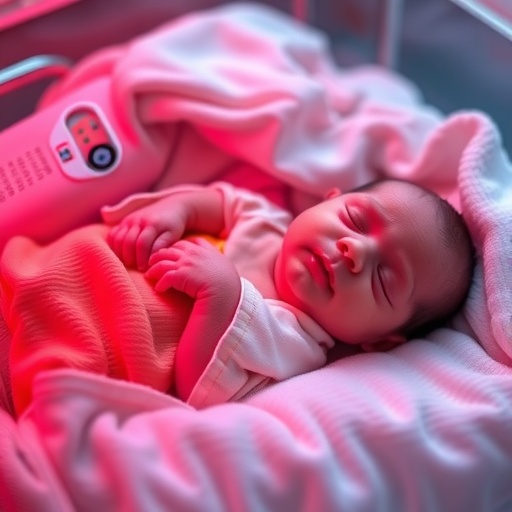
Image Credits: AI Generated
DOI: https://doi.org/10.1038/s41372-026-02829-0
Keywords: (Not provided)

Tags: early neonatal temperature management strategiesimpact of skin-to-skin contact on preterm infant stabilityincubator versus skin-to-skin care in neonatal thermoregulationmaternal-infant skin-to-skinneonatal hypothermia in extremely preterm infantsneonatal intensive care unit temperature control methodsneonatal thermoregulation in preterm infantsnon-inferiority studies in neonatal careskin-to-skin contact benefits for preemiesthermal stability in 22-25 week preterm infants
Share26Tweet16
Previous Post

Taiwan Develops High-Resolution PM2.5 Model Using Low-Cost Sensors and Satellites

Next Post

Age- and sex-dependent retinal degeneration in peripherin-2 mutant mice, a model of central areolar choroidal dystrophy

Related Posts

Microbe Lactic Acid Weakens Interferon by Blocking Antiviral Signaling
Medicine

Microbe Lactic Acid Weakens Interferon by Blocking Antiviral Signaling

July 27, 2026
Age- and sex-dependent retinal degeneration in peripherin-2 mutant mice, a model of central areolar choroidal dystrophy
Medicine

Age- and sex-dependent retinal degeneration in peripherin-2 mutant mice, a model of central areolar choroidal dystrophy

July 27, 2026
Taiwan Develops High-Resolution PM2.5 Model Using Low-Cost Sensors and Satellites
Medicine

Taiwan Develops High-Resolution PM2.5 Model Using Low-Cost Sensors and Satellites

July 27, 2026
Blood metabolomics reveals responses to deep brain stimulation in Parkinson’s disease
Medicine

Blood metabolomics reveals responses to deep brain stimulation in Parkinson’s disease

July 27, 2026
Study Finds Falls Risk Perception Influenced by Multiple Factors in Elderly Hip Fracture Patients
Medicine

Study Finds Falls Risk Perception Influenced by Multiple Factors in Elderly Hip Fracture Patients

July 27, 2026
GC-MS Method Developed and Validated to Measure Ethylene and Diethylene Glycols
Medicine

GC-MS Method Developed and Validated to Measure Ethylene and Diethylene Glycols

July 27, 2026
Next Post
Age- and sex-dependent retinal degeneration in peripherin-2 mutant mice, a model of central areolar choroidal dystrophy

Age- and sex-dependent retinal degeneration in peripherin-2 mutant mice, a model of central areolar choroidal dystrophy

  • Mothers who receive childcare support from maternal grandparents show more

    Mothers who receive childcare support from maternal grandparents show more parental warmth, finds NTU Singapore study

    27656 shares
    Share 11059 Tweet 6912
  • University of Seville Breaks 120-Year-Old Mystery, Revises a Key Einstein Concept

    1061 shares
    Share 424 Tweet 265
  • Bee body mass, pathogens and local climate influence heat tolerance

    682 shares
    Share 273 Tweet 171
  • Researchers record first-ever images and data of a shark experiencing a boat strike

    546 shares
    Share 218 Tweet 137
  • Groundbreaking Clinical Trial Reveals Lubiprostone Enhances Kidney Function

    531 shares
    Share 212 Tweet 133
Science

Embark on a thrilling journey of discovery with Scienmag.com—your ultimate source for cutting-edge breakthroughs. Immerse yourself in a world where curiosity knows no limits and tomorrow’s possibilities become today’s reality!

RECENT NEWS

  • Bulk Acoustic Resonator with Vertical Electrodes Enables Wideband Filters
  • Whole-Exome Sequencing and Structural Brain Imaging Reveal Bipolar Disorder Markers
  • Serpentine Alteration Boosts Water Flow in Cold Subduction Zones
  • Microbe Lactic Acid Weakens Interferon by Blocking Antiviral Signaling

Categories

  • Agriculture
  • Anthropology
  • Archaeology
  • Athmospheric
  • Biology
  • Biotechnology
  • Blog
  • Bussines
  • Cancer
  • Chemistry
  • Climate
  • Earth Science
  • Editorial Policy
  • Marine
  • Mathematics
  • Medicine
  • Pediatry
  • Policy
  • Psychology & Psychiatry
  • Science Education
  • Social Science
  • Space
  • Technology and Engineering

Subscribe to Blog via Email

Enter your email address to subscribe to this blog and receive notifications of new posts by email.

Join 5,146 other subscribers

© 2025 Scienmag - Science Magazine

Welcome Back!

Login to your account below

Forgotten Password?

Retrieve your password

Please enter your username or email address to reset your password.

Log In
No Result
View All Result
  • HOME
  • SCIENCE NEWS
  • CONTACT US

© 2025 Scienmag - Science Magazine

Discover more from Science

Subscribe now to keep reading and get access to the full archive.

Continue reading
