


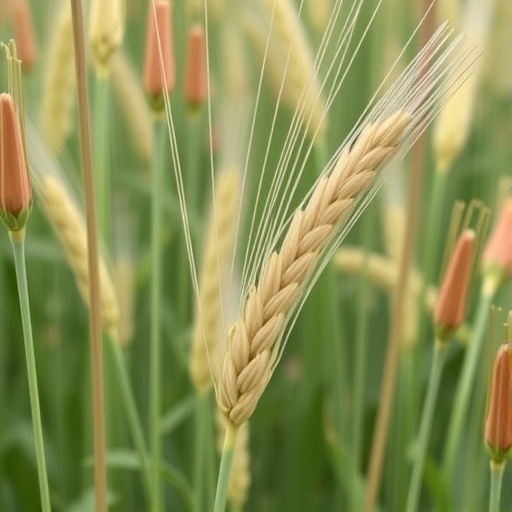
In a groundbreaking study set to reshape our understanding of wheat genetics, researchers have uncovered an active family of Helitron transposons within the wheat genome, revealing new dimensions of genetic mobility and evolutionary potential in one of the world’s most vital crops. This discovery, detailed in a recent publication in Nature Plants, opens up transformative avenues for crop improvement and evolutionary biology, emphasizing the dynamic nature of plant genomes that was previously underestimated.
Helitrons, a class of DNA transposons, operate via a mechanism distinct from many other transposable elements, mobilizing through a rolling-circle replication process. These elements are particularly notable for their ability to capture and mobilize gene fragments, effectively reshuffling genomic content and fostering genetic innovation. Until now, the activity and impact of Helitrons in wheat remained largely speculative due to the enormous complexity and size of its genome. However, the latest findings clearly demonstrate that Helitron elements are not merely genomic fossils but are actively shaping wheat’s genetic landscape.
The research team, led by Peng et al., utilized advanced long-read sequencing technologies alongside refined bioinformatics pipelines to map the distribution and characterize the activity of Helitron transposons across multiple wheat varieties. Their analyses revealed a previously unrecognized family of active Helitrons capable of autonomous transposition, marking a crucial step in understanding how these elements contribute to genome plasticity and evolution in a hexaploid context.
Wheat’s hexaploid genome, comprising three closely related subgenomes, presents a challenging substrate for studying transposable elements. The study illuminated how Helitrons navigate this complexity, exhibiting differential insertion preferences and activity levels among the subgenomes, which may have profound implications on gene expression regulation and phenotypic diversity. The authors demonstrated that certain Helitron insertions are associated with altered transcriptional profiles, suggesting a regulatory role that goes beyond mere genomic disruption.
Further characterization unveiled that the active Helitron family carries conserved protein domains essential for replication and integration, confirming their autonomous nature. The encoded RepHel protein, responsible for initiating rolling-circle replication, was shown to retain crucial enzyme motifs, enabling efficient transposition cycles. This autonomy stands in contrast with non-autonomous elements that require enzymatic functions supplied by other transposons, positioning this Helitron family as a potential driver of genomic dynamism in wheat.
Intriguingly, the study also described the molecular architecture of Helitron termini. The conserved terminal sequences, including specific hairpin structures, are indispensable for the transposase binding and transposition mechanism. These findings contribute to a deeper molecular understanding that may facilitate the future development of genome-editing tools harnessing Helitron machinery, potentially allowing precise and controllable genomic insertions.
Comparative analyses with related grasses indicated that this Helitron family has undergone recent expansions uniquely within wheat, implying a burst of transpositional activity possibly triggered by environmental cues or domestication processes. This observation challenges previous assumptions that wheat’s genome expansion was largely inert and subjected to purifying selection that suppresses transposon activity. Instead, these data demonstrate an evolutionary strategy leveraging transposition to fuel adaptability and diversification.
The discovery bears substantial implications for crop breeding. Helitrons’ capacity to capture gene fragments and redistribute regulatory elements could be harnessed to generate novel genetic variation, accelerating the breeding of wheat varieties with enhanced traits such as increased yield, disease resistance, or climate resilience. By dissecting the preferences and constraints of Helitron activity, breeders may one day employ these transposons as natural mutagens or gene delivery systems, introducing beneficial diversity in a targeted and efficient manner.
Moreover, this research renews interest in the broader role of transposable elements in crop genome evolution. Helitrons may serve as reservoirs of genetic innovation, facilitating rapid adaptation in response to environmental pressures and agricultural practices. Understanding their activity dynamics could inform strategies to manage genome stability, a critical factor in maintaining crop performance and food security.
On a technical front, the study showcases the power of integrating cutting-edge sequencing and computational methods to tackle the long-standing challenges posed by large polyploid plant genomes. The authors’ approach provided unprecedented resolution of Helitron insertion sites and transcriptional impacts, setting new standards for transposon genomics research in complex plant systems.
The research highlights the importance of ongoing surveillance of transposable element activity in the age of modern agriculture. As climate change intensifies and crop demands increase, deciphering the genomic underpinnings of adaptability becomes ever more urgent. Active transposons like the Helitrons detected in wheat embody a natural genomic toolkit that, if properly understood and leveraged, could be pivotal in securing global food supplies.
This study thus marks a milestone by unveiling active Helitron elements in wheat, previously hidden within an intricate genome. It transforms our view of plant genomic architecture from static to fluid, where the continuous interplay of transposable elements catalyzes innovation and adaptability. As research advances, the potential for exploiting these elements in crop science and biotechnology promises to usher in a new era of precision breeding and sustainable agriculture.
In summary, the discovery of active Helitrons in wheat offers compelling evidence of ongoing genetic dynamism within a crop vital to global nutrition. By elucidating the molecular features and evolutionary roles of these transposons, Peng and colleagues have opened novel vistas in understanding genome evolution and engineering crop resilience. This research stands as a testament to the complexity and adaptability encoded deep within plant DNA, and its potential harnessing holds immense promise for the future of food security and agricultural biotechnology.
Cite Scienmag News
Juliet Wilcox. (June 5, 2026). Active Helitron Transposon Family Discovered in Wheat. Scienmag. https://scienmag.com/active-helitron-transposon-family-discovered-in-wheat/
Juliet Wilcox. "Active Helitron Transposon Family Discovered in Wheat." Scienmag, 5 June 2026, https://scienmag.com/active-helitron-transposon-family-discovered-in-wheat/. Accessed 3 September 2026.
Juliet Wilcox. "Active Helitron Transposon Family Discovered in Wheat." Scienmag. June 5, 2026. https://scienmag.com/active-helitron-transposon-family-discovered-in-wheat/


