


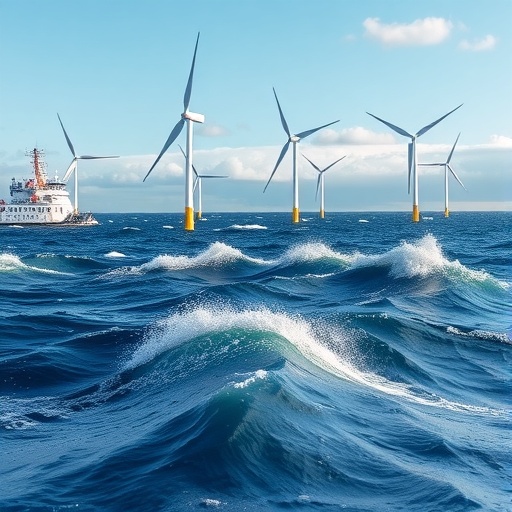
As the global push toward renewable energy intensifies, offshore wind farms have emerged as a powerful solution to meet ever-growing electricity demands while minimizing carbon emissions. However, a breakthrough study recently published in Nature Communications reveals a hidden dimension to the environmental impact of these sprawling installations—one that unfolds beneath the ocean’s surface and challenges current understanding of seabed dynamics. Researchers led by Unsworth, McCarron, Whitehouse, and their colleagues have demonstrated that turbulence induced by offshore wind farms is a principal driver of seabed modification, with implications that ripple through marine ecosystems and future offshore energy planning.
For decades, offshore wind farms have been celebrated for their ability to harness the relentless energy of ocean winds, converting kinetic power into clean electricity. Yet, the intricate marine interactions spawned by turbine foundations and the associated infrastructure have remained shrouded in ambiguity. This new research provides the first comprehensive assessment of how turbulence generated around monopile and jacket-style turbine foundations agitates the seabed, reshaping sediment distribution and potentially altering benthic habitats. The mechanical forcing of water movement instigates sediment entrainment and resettlement processes, effectively rewriting the archaeological and ecological narrative inscribed in marine sediments.
The study deployed a multi-disciplinary approach combining high-resolution in situ measurements, advanced computational fluid dynamics simulations, and sediment transport modeling over multiple wind farm sites in the North Sea. This region serves as an ideal natural laboratory given its strategic importance in offshore wind capacity and well-documented oceanographic frameworks. By capturing turbulence signatures at varying depths and proximities to turbine structures, the team uncovered patterns of vortex generation and wake interactions that operate far beyond previously anticipated spatial scales. These hydrodynamic forces trigger persistent seabed disruptions, particularly in fine-grained sediment regions.
One of the most striking findings is the identification of a turbulence-driven sediment mobilization mechanism linked to the complex wake fields produced between adjacent turbines. As turbine wakes collide and interact, they amplify vertical mixing and bottom shear stresses. This process enhances resuspension of sediments, leading to localized erosion and deposition cycles that can reshape seabed topography over relatively short temporal intervals—on the order of months to years. Such dynamism contradicts the longstanding assumption that seabed morphology beneath offshore wind farms remains largely static following construction stabilization periods.
These turbulent wake-induced sediment dynamics have profound ecological consequences. Benthic organisms, many of which rely on stable sediment structures for habitat and nutrient cycling, face habitat fragmentation and altered sediment characteristics. Biogeochemical fluxes, including nutrient exchange and organic matter decomposition, could be disrupted by these sedimentary changes. Moreover, the modifications to sediment grain size distribution and sediment layering might challenge efforts to use seabed sediment proxies for long-term environmental assessments in regions targeted for large-scale offshore wind development.
The implications of turbulence-driven seabed modifications extend to offshore infrastructure integrity as well. Alterations in sediment compaction and erosion rates could influence foundation scour processes, potentially undermining turbine stability over extended operational lifetimes. Engineering models that currently guide foundation design and scour protection may need refinement to integrate these dynamic seabed interactions induced by wake turbulence. This paradigm shift advocates for a more holistic integration of marine physics and geotechnical considerations in offshore wind farm planning and monitoring.
Furthermore, the study draws attention to the cumulative impact of expanding offshore wind farms. As renewable energy targets push for denser turbine arrays, the overlapping wake fields will intensify seabed turbulence effects across broader marine landscapes. This diffusion of mechanical energy throughout the water column and seabed interface raises questions about the long-term sustainability of marine ecosystems and sedimentary environments subjected to such anthropogenic stirring. It calls for interdisciplinary collaboration between oceanographers, ecologists, and marine engineers to develop adaptive management strategies.
The methodology advances utilized in this study also set a new standard for marine environmental impact assessments. The combination of real-time acoustic Doppler current profilers with large eddy simulations empowers researchers to dissect turbulence structures with unprecedented granularity. Such precision in identifying flow separation, vortex shedding, and wake persistence beneath the ocean surface is instrumental in predicting the reach and intensity of seabed perturbations. This approach could be adapted to evaluate other offshore installations, including oil rigs and tidal energy devices.
Public awareness of offshore wind energy’s environmental footprint typically centers on visual impacts and avian collisions. However, this research illuminates the subsurface narratives of alteration, urging a broader perspective on what constitutes environmental stewardship in marine renewable energy deployment. Engaging stakeholders—from policymakers to coastal communities—in discussions about seabed health and marine biodiversity becomes essential as offshore wind development scales up globally.
As the wind industry moves towards floating platforms to access deeper waters, the dynamics explored in this North Sea study may evolve. Floating turbines, while anchored differently, still generate wake turbulence influencing ocean currents and sediment transport. The interplay of complex hydrodynamics with novel platform designs presents fresh challenges and necessitates continued investigation to anticipate environmental consequences far ahead of maturation deployment.
In essence, the revelation that turbulence drives seabed modification by offshore wind farms underscores the intricate connectivity between human technological pursuits and marine natural processes. Far from passive installations, wind turbines actively sculpt their underwater surroundings through fluid dynamic mechanisms. These insights compel a re-examination of marine spatial planning, environmental monitoring protocols, and turbine array configurations to harmonize renewable energy expansion with ocean health preservation.
Going forward, the integration of turbulence impact predictions into marine ecosystem models will help forecast potential biodiversity shifts and sediment regime changes. Adaptive turbine placement strategies designed to minimize wake overlap and sediment disturbance might emerge as practical mitigation tools. Collaborations bridging ocean physics, marine ecology, and renewable energy engineering are poised to pioneer such innovations.
Ultimately, this study not only enriches scientific understanding of the ocean’s response to anthropogenic structures but also marks a pivotal step in optimizing offshore wind development. By illuminating the turbulent undercurrents shaping the seabed, Unsworth and colleagues chart a path towards sustainable marine renewables that respect the complexity and resilience of ocean ecosystems. This evolution reflects humanity’s growing commitment to energy innovation that recognizes—and reveres—the delicate balances sustaining our planet’s aquatic frontiers.
Cite Scienmag News
Violet Maxwell. (June 5, 2026). Turbulence Alters Seabed Near Offshore Windfarms. Scienmag. https://scienmag.com/turbulence-alters-seabed-near-offshore-windfarms/
Violet Maxwell. "Turbulence Alters Seabed Near Offshore Windfarms." Scienmag, 5 June 2026, https://scienmag.com/turbulence-alters-seabed-near-offshore-windfarms/. Accessed 3 September 2026.
Violet Maxwell. "Turbulence Alters Seabed Near Offshore Windfarms." Scienmag. June 5, 2026. https://scienmag.com/turbulence-alters-seabed-near-offshore-windfarms/


