


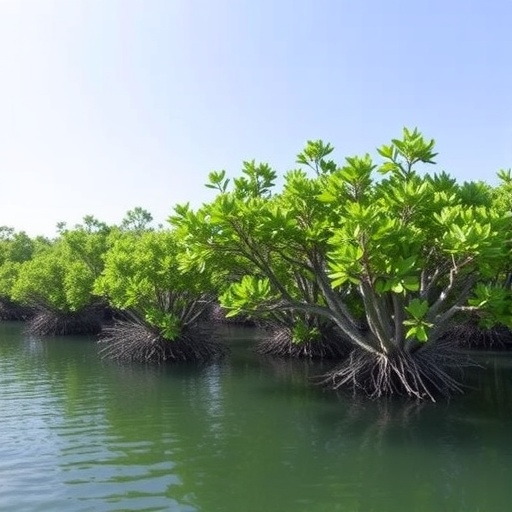
Mangrove forests, once regarded as one of the most threatened and fragile coastal ecosystems on the planet, are experiencing a remarkable resurgence on a global scale. Recent research conducted by Tulane University, leveraging over four decades of satellite imagery and remote sensing technology, reveals a striking reversal in the trend of mangrove loss. Contrary to earlier narratives of continuous decline, this comprehensive study documents a net increase in mangrove coverage worldwide, heralding a paradigm shift in coastal ecosystem dynamics that holds significant implications for climate mitigation and shoreline protection efforts.
The investigation, published in the prestigious journal Science, meticulously assessed changes in mangrove extents from the 1980s through 2023. The data reconstruct a complex but optimistic picture wherein decades of extensive deforestation and coastal development, previously responsible for nearly 2,900 square kilometers of mangrove reduction, have been offset by natural regeneration and anthropogenic restoration activities. Over the past sixteen years, gains in mangrove area have surpassed losses, culminating in an overall net decline of just approximately 1% across four decades, a far less dramatic contraction than earlier estimates suggested.
Mangroves play a pivotal ecological role, not only acting as natural barriers against coastal erosion and storm surges but also serving as critical habitats for a diversity of marine and avian species. Furthermore, mangrove ecosystems are exceptional carbon sinks, sequestering substantial quantities of carbon dioxide and thereby mitigating greenhouse gas concentrations in the atmosphere. The newfound global recovery of mangroves, as demonstrated by Tulane’s study, underscores the resilience of these ecosystems and their emerging potential to contribute more effectively to climate change solutions through carbon storage and ecosystem services enhancement.
Zhen Zhang, the lead author and a postdoctoral researcher at Tulane University’s School of Science and Engineering, characterizes this trend as a global inflection point for mangroves. He emphasizes the intrinsic resilience of mangrove systems and the critical importance of conserving and fostering their regeneration. Zhang highlights that the resurgence is underpinned by both ecological succession processes and large-scale restoration initiatives, which collectively enhance mangrove density and spatial extent, particularly in regions where geomorphological conditions foster sediment deposition and habitat suitability.
Historical declines in mangrove forests during the late twentieth century were driven predominantly by anthropogenic pressures, including land conversion for agriculture, urban expansion, and aquaculture development. These activities led to widespread habitat fragmentation and degradation, severely compromising the structural integrity and ecological functionality of mangrove landscapes. Nonetheless, the research indicates a notable deceleration in degradation rates since the early 2000s, aligning temporally with intensified conservation frameworks, protective legislation, and active restoration projects aimed at rehabilitating mangrove environments worldwide.
The study also documents intriguing regional variances in mangrove trends, exemplified by ecosystems along the U.S. Gulf Coast. Here, warming climatic conditions have facilitated the poleward migration of mangrove species traditionally confined to tropical and subtropical zones. In the Mississippi River Delta, for instance, mangrove cover experienced a modest decline up until the late 1990s but has since expanded markedly, particularly after 2012. Such latitudinal range shifts are indicative of broader climatological influences on biome distributions and emphasize the dynamic nature of mangrove ecosystems under changing global temperatures.
Moreover, beyond mere spatial extent, the research assesses the structural quality and carbon sequestration capacity of mangrove forests by examining changes in vegetation density and canopy closure. Closed-canopy mangrove forests, characterized by robust biomass and enhanced carbon storage, have globally increased, suggesting improvements not only in area but also in the ecological functionality and resilience of mangrove systems. This densification trend is vital as it enhances carbon stock durability and strengthens coastal defenses against increasingly frequent extreme weather events linked to climate change.
Despite this encouraging trajectory, the study readily acknowledges ongoing vulnerabilities and limitations within mangrove recovery. Newly formed mangrove stands typically comprise young successional stages, which currently lack the full ecological complexity and carbon storage potential of mature forests. In addition, localized threats persist, notably in regions where deforestation continues unabated for agricultural expansion or urban infrastructures. Episodes of climatic extremity, such as the severe freeze event in Texas during 2021, underscore the fragility of recent gains and highlight the need for continuous monitoring and adaptive conservation strategies in the face of environmental variability.
The implications of this research extend into conservation policy and ecosystem management frameworks. It brings to light the critical necessity of curtailing deforestation as the most immediate and impactful measure to safeguard existing carbon reservoirs and promote ongoing natural carbon accumulation. When mangroves are destroyed, vast reservoirs of stored carbon are released, exacerbating global carbon emissions and climate change. Conversely, protecting these forests ensures continued carbon sequestration capacity, generating dual benefits for climate mitigation and biodiversity conservation.
Equally important is the maintenance of natural ecological processes, particularly sediment dynamics that facilitate mangrove establishment and growth. Zhang emphasizes the dependency of mangrove expansion on a reliable supply of riverine sediment, which forms the substrate for colonization on newly formed mudflats. Disruptions to sediment transport—whether through dam construction, land use changes, or hydrological alterations—pose significant risks to mangrove habitat viability and must therefore be integral considerations within coastal zone management.
The findings advocate for a nuanced approach to the use of mangroves in global nature-based climate solutions. Rather than focusing solely on total mangrove area, conservation strategies should incorporate assessments of forest quality, age structure, and carbon storage capabilities to fully capture ecosystem services. This multidimensional perspective is essential to optimize the contribution of mangroves toward climate adaptation and mitigation agendas, as well as to ensure the sustainable provision of their protective and ecological functions.
In conclusion, Tulane University’s pioneering study reveals a rare and striking example of global ecosystem recovery, offering a beacon of hope amidst widespread environmental challenges. The unexpected resurgence and densification of mangrove forests highlight their formidable resilience and reinforce their status as a cornerstone of coastal and climate resilience strategies worldwide. Continued investment in restoration, protection from deforestation, and preservation of natural sedimentation processes will be crucial to securing and enhancing these vital blue carbon ecosystems for future generations.
News Publication Date: 4-Jun-2026
Web References: DOI: 10.1126/science.aec9773
Cite Scienmag News
Russell Cooper. (June 4, 2026). Global Mangrove Forests Make a Comeback, Signaling Positive Outlook for Climate and Coastal Resilience. Scienmag. https://scienmag.com/global-mangrove-forests-make-a-comeback-signaling-positive-outlook-for-climate-and-coastal-resilience/
Russell Cooper. "Global Mangrove Forests Make a Comeback, Signaling Positive Outlook for Climate and Coastal Resilience." Scienmag, 4 June 2026, https://scienmag.com/global-mangrove-forests-make-a-comeback-signaling-positive-outlook-for-climate-and-coastal-resilience/. Accessed 3 September 2026.
Russell Cooper. "Global Mangrove Forests Make a Comeback, Signaling Positive Outlook for Climate and Coastal Resilience." Scienmag. June 4, 2026. https://scienmag.com/global-mangrove-forests-make-a-comeback-signaling-positive-outlook-for-climate-and-coastal-resilience/


