


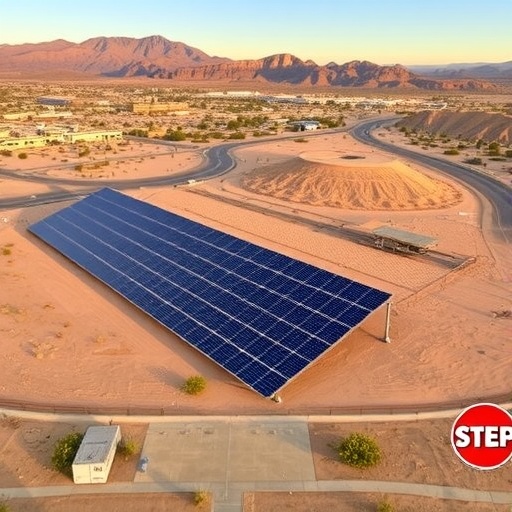
In the sun-soaked expanse of Alamogordo, New Mexico, a groundbreaking study has unveiled encouraging news for solar energy developers aiming to harness the abundant sunshine in the region. Despite the area’s frequent dust storms, propelled by particles from the notorious White Sands gypsum dune field, photovoltaic panels installed at the Brackish Groundwater National Desalination Research Facility demonstrate remarkable resilience. According to research published in the journal Atmosphere in April 2026, these panels experience an unexpectedly low power output loss—only about 2 to 3 percent—due to dust accumulation, a figure that significantly undercuts the soiling rates reported in solar facilities situated in other dusty desert regions across the globe.
This revelation carries profound implications for the economics and operational sustainability of solar energy in arid environments, particularly within the Chihuahuan Desert. Commonly, soiling losses in harsh desert climates can drain solar panel efficiency by anywhere from 10 to a staggering 80 percent, precipitating frequent and costly cleaning regimes. However, the Alamogordo site’s natural conditions appear to inherently mitigate these losses, suggesting that operators could substantially reduce cleaning frequency. This reduction would not only curb water consumption—a critical consideration in water-scarce desert locales—but also decrease labor and operational expenses, enhancing the long-term viability of solar installations.
The study’s lead author, Dr. German Rodriguez Ortiz, a doctoral alumnus of the University of Texas at El Paso’s Environmental Science and Engineering Program, explains that the combination of local meteorology and mineralogy uniquely favors panel performance. “The persistent south-to-southwest winds that sweep over the region directly impact the orientation of south-facing panels, physically dislodging dust particles in a passive yet effective cleaning mechanism,” he stated. Such wind-aided self-cleaning is complemented by sporadic yet sufficient rainfall events, which were observed to restore panel efficiency almost to baseline levels with as little as 2.2 millimeters per hour of precipitation—a much lighter rain threshold than has been documented in other solar markets like California, India, or parts of Asia.
Beyond meteorological influences, the mineralogical composition of the soiling dust plays a pivotal role. The gypsum particles originating from White Sands possess distinct optical properties that limit their interference with photovoltaic energy capture. Unlike the more opaque or chemically aggressive dust types found in Middle Eastern or East Asian deserts, gypsum exhibits higher light transmittance and refractive characteristics that translate into diminished light scattering and absorption on solar surfaces. This intrinsic quality reduces the detrimental impact on solar cell efficiency, making the region’s dust inherently less harmful from a photovoltaic perspective.
To test these multifaceted interactions, the researchers installed six photovoltaic panels and monitored their performance and soiling conditions through a span of three separate sampling periods between late 2022 and spring 2024. During this time, they documented 22 distinct dust events, carefully quantifying the onset, accumulation, and dissipation of particulate matter on the panels. The detailed temporal data elucidated how quickly soiling impacted power output and how effectively natural factors restored functionality without human intervention.
Crucially, the study also explored the influence of the anti-reflective coatings on the panels used. These coatings, integral to modern photovoltaic technology, not only increase light absorption but may also enhance the efficacy of rainwater in washing away dust. The synergy between coating technology and the region’s hydrometeorological conditions suggests that future solar panel designs for dusty deserts might prioritize specialized surface treatments that optimize passive cleaning dynamics, further reducing maintenance demands.
This research underscores the necessity of place-based environmental science in renewable energy deployment. As Dr. Thomas E. Gill, professor of earth, environmental, and resource sciences and co-author of the study, emphasizes, “Our location within the Chihuahuan Desert serves not just as a geographic backdrop but as a dynamic natural laboratory. The localized insights derived here offer critical understanding that can directly inform energy strategies tailored to the specific challenges and advantages of regional climates.”
A key takeaway from this study is the interdependence of site-specific environmental factors that can beneficially influence the operational efficiency of solar energy infrastructure. Prevailing wind directions, rainfall patterns, dust mineralogy, and cutting-edge panel technology all converge to create a uniquely conducive solar energy environment in the southern Tularosa Basin. These insights challenge the prevailing assumption that desert dust universally imperils photovoltaic output, offering a more nuanced perspective on solar viability in marginal environments.
Moreover, the reduced necessity for frequent cleaning not only conserves precious water but also diminishes labor and operational costs, two significant contributors to the total cost of solar energy production. This efficient balance between natural cleaning processes and technological resilience could serve as a model for solar developers evaluating similar sites worldwide.
The study also opens avenues for future inquiries. Extended monitoring through different seasonal phases—especially during the summer monsoon period notorious for fluctuating dust dynamics—will be critical to fully characterizing long-term soiling behavior. Additionally, optimization of cleaning protocols that leverage natural wind and rainfall events could further streamline solar farm maintenance, enhancing both sustainability and profitability.
Collaborators on this research included esteemed faculty and researchers from multiple disciplines, reflecting the study’s interdisciplinary nature. Apart from Dr. Ortiz and Dr. Gill, contributions came from Assistant Professor Jose A. Hernandez-Viezcas specializing in chemistry and biochemistry, research scientist Alejandro J. Metta-Magana, and alumna Dr. Malynda Cappelle from the Bureau of Reclamation. This collective expertise underpins the robust analytical rigor and comprehensive scope of the findings.
The testing grounds for this work—the United States Bureau of Reclamation’s Brackish Groundwater National Desalination Research Facility—highlight the strategic synergies between water management and renewable energy research. Understanding how environmental parameters affect solar power generation within complex arid ecosystems could inform integrated resource management frameworks capable of advancing both water sustainability and clean energy deployment.
As the global push toward renewable energy intensifies, regionally attuned research like that emerging from Alamogordo intensifies the importance of understanding the unique interplay of environmental factors on solar energy infrastructures. Harnessing these insights promises smarter, more efficient solar technology integration, transforming not just the desert landscape but the broader energy paradigm globally.
News Publication Date: June 4, 2026
Web References:
https://www.mdpi.com/2073-4433/17/5/442
http://dx.doi.org/10.3390/atmos17050442
Keywords
Solar energy, Environmental engineering, Renewable energy, Energy resources, Electrical power generation, Climate zones, Soil science
Cite Scienmag News
Faith Mcneil. (June 4, 2026). Southwestern Dust-Prone Desert Revealed as Prime Location for Solar Energy, UTEP Study Shows. Scienmag. https://scienmag.com/southwestern-dust-prone-desert-revealed-as-prime-location-for-solar-energy-utep-study-shows/
Faith Mcneil. "Southwestern Dust-Prone Desert Revealed as Prime Location for Solar Energy, UTEP Study Shows." Scienmag, 4 June 2026, https://scienmag.com/southwestern-dust-prone-desert-revealed-as-prime-location-for-solar-energy-utep-study-shows/. Accessed 3 September 2026.
Faith Mcneil. "Southwestern Dust-Prone Desert Revealed as Prime Location for Solar Energy, UTEP Study Shows." Scienmag. June 4, 2026. https://scienmag.com/southwestern-dust-prone-desert-revealed-as-prime-location-for-solar-energy-utep-study-shows/


