


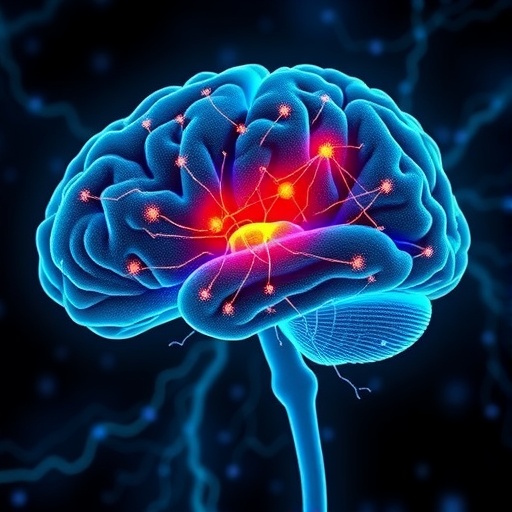
In the unforgiving face of starvation and frigid temperatures, certain animals possess a remarkable physiological strategy to survive: torpor, a state of reduced metabolic activity and lowered body temperature. While it has long been known that the brain’s circadian clock orchestrates many daily rhythms, the intricate neural circuits governing the timing of torpor remained elusive—until now. Groundbreaking research from Nagoya University in Japan has elucidated the precise brain pathways that regulate this critical survival mechanism, shedding light on how mammals finely tune the initiation and suppression of torpor in response to environmental stressors.
At the core of this discovery lies the suprachiasmatic nucleus (SCN), a diminutive yet pivotal cluster of neurons situated within the hypothalamus. Renowned as the master circadian clock, the SCN synchronizes myriad physiological processes to the day-night cycle. Employing sophisticated tools such as optogenetics, researchers identified GABAergic projections from the SCN directing inhibitory signals to the preoptic area (POA), a crucial brain region responsible for thermoregulatory control. This neural conduit effectively modulates the initiation of torpor, dictating when mice enter this hypometabolic state.
Circadian regulation of torpor unfolds in a striking temporal pattern. Experimental observations revealed that torpor in mice predominantly occurs during the dark phase—from midnight to dawn—while being actively suppressed during daylight hours. This nocturnal torpor aligns with evolutionary adaptations to optimize energy conservation when environmental conditions make foraging futile or dangerous. Activation of the SCN-to-POA circuit demonstrably inhibits torpor entry, while disruptions to the clock’s signaling yield erratic or diminished torpor bouts, highlighting the indispensability of this axis.
At the cellular level, a subpopulation of SCN neurons expressing arginine vasopressin (AVP) emerges as a critical inhibitory player. These AVP neurons exert GABAergic suppression on the POA, ensuring that thermoregulatory neurons remain dampened during the daytime and only release their inhibitory grip as night falls. Genetically or pharmacologically disturbing this AVP-POA pathway induced dysregulated torpor timing, confirming the specificity and necessity of this circadian inhibitory mechanism.
Interestingly, the POA is not a passive recipient but exhibits dynamic fluctuations in activity. During the night, reduced inhibition from the SCN allows POA neurons to engage thermoregulatory pathways that facilitate hypothermia and metabolic suppression intrinsic to torpor. Thus, rather than actively triggering torpor, the circadian clock orchestrates permissive windows wherein the organism’s thermoregulatory and metabolic control systems can engage this energy-saving state optimally.
Methodologically, the study employed optogenetic manipulation to selectively activate or inhibit neurons within this pathway, an approach that offers unparalleled temporal and spatial precision. These light-mediated controls demonstrated causality: stimulating the SCN’s inhibitory projections curtailed torpor, whereas silencing them permitted torpor to manifest outside normal parameters. The compelling electrophysiological and behavioral analyses establish a causal nexus between circadian neural circuits and survival strategies modulating energy expenditure.
The implications of this research extend beyond rodents to broader biological and biomedical realms. Understanding how the brain times and regulates metabolic shutdown opens new frontiers in medical therapeutics, such as controlled hypothermia to mitigate tissue damage following trauma or surgery. Moreover, where long-duration spaceflight looms on the horizon, inducing controlled hypometabolic states akin to natural torpor may offer a gateway to preserving astronaut health during extended interplanetary missions. These findings provide a foundational blueprint for engineering safe metabolic reduction in humans.
Despite the tantalizing prospects, it is critical to recognize that humans do not naturally undergo torpor. Nevertheless, elucidating the neural mechanisms governing metabolic suppression in mammalian models can reveal conserved molecular and circuit-level principles. Such insights pave the way for translational approaches aimed at creating artificial hypometabolic states, potentially revolutionizing critical care medicine and space exploration alike. Indeed, sporadic historical reports of humans surviving extreme cold hint at latent capacities that remain to be fully understood.
This paradigm-shifting study charts a path from fundamental neuroscience to futuristic applications, illustrating how circadian biology interweaves with metabolic regulation in life-or-death scenarios. Ongoing research will need to disentangle the molecular signaling downstream of the AVP neurons and POA targets, as well as assess the interplay with peripheral metabolic tissues. The discovery underscores the elegance of the brain’s timekeeping in synchronizing physiology to external pressures, ensuring survival through precise temporal orchestration of energy conservation.
Furthermore, the study exemplifies the power of integrative approaches combining molecular genetics, neuroanatomy, and in vivo functional interrogation. The identification of discrete neural circuits that govern complex behaviors highlights nuances in brain organization previously obscured by the multifaceted nature of circadian and metabolic systems. Such insights fuel the broader quest to decode the neural substrates of adaptive physiological states and may inspire innovative biomedical technologies.
In summary, the groundbreaking work from Nagoya University illuminates the delicate neural choreography that times torpor in mammals, revealing a critical GABAergic pathway from the SCN to the POA. By suppressing torpor during the day and permitting it at night, this circuit equips animals with the ability to strategically reduce metabolic demands in challenging environments. This pivotal advance not only deepens our understanding of circadian regulation and survival biology but also heralds promising avenues for medical innovation and spaceflight. As research continues to unravel these complex mechanisms, the dream of harnessing torpor-like states in humans inches closer to reality.
News Publication Date: 22-May-2026
Web References: https://www.nature.com/articles/s41467-026-73374-9
References: Rahaman et al., 2026
Keywords
Circadian clock, torpor, suprachiasmatic nucleus, preoptic area, arginine vasopressin neurons, GABAergic inhibition, metabolic suppression, thermoregulation, optogenetics, hypothermia, neural circuits, survival physiology
Cite Scienmag News
Cassandra Pierce. (June 4, 2026). Scientists Uncover Brain Circuit Regulating Torpor Timing, Opening New Frontiers in Medicine and Space Exploration. Scienmag. https://scienmag.com/scientists-uncover-brain-circuit-regulating-torpor-timing-opening-new-frontiers-in-medicine-and-space-exploration/
Cassandra Pierce. "Scientists Uncover Brain Circuit Regulating Torpor Timing, Opening New Frontiers in Medicine and Space Exploration." Scienmag, 4 June 2026, https://scienmag.com/scientists-uncover-brain-circuit-regulating-torpor-timing-opening-new-frontiers-in-medicine-and-space-exploration/. Accessed 4 September 2026.
Cassandra Pierce. "Scientists Uncover Brain Circuit Regulating Torpor Timing, Opening New Frontiers in Medicine and Space Exploration." Scienmag. June 4, 2026. https://scienmag.com/scientists-uncover-brain-circuit-regulating-torpor-timing-opening-new-frontiers-in-medicine-and-space-exploration/


