


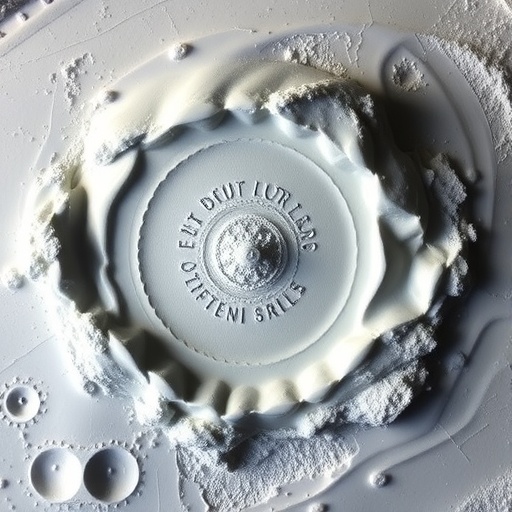
The icy moon Enceladus, one of Saturn’s most intriguing celestial bodies, has long captivated scientists with its dynamic geophysical activity and persistent plumes of water vapor emanating from its south pole. These features suggest a subsurface ocean beneath its frozen crust, raising compelling questions about the mechanisms driving its geodynamic evolution. Recent research by Villavicencio-Valero and Mondavi-Sobby, published in Scientific Reports in 2026, sheds new light on the early geodynamic processes that shaped Enceladus’s south polar ice shell, focusing particularly on the role of ammonia hydrates and thermal gradients.
Enceladus is distinguished from other icy moons by the remarkable activity localized at its south pole. This region exhibits “tiger stripe” fractures — linear fissures that vent water vapor and ice particles spectacularly into space. Understanding the origin and evolution of these features requires delving deep into the physical and chemical properties of the moon’s ice shell and underlying ocean. The study by Villavicencio-Valero and Mondavi-Sobby offers a sophisticated model incorporating ammonia hydrates and variable thermal environments to explain the early structural dynamics of the ice shell.
Ammonia, known for its antifreeze properties in planetary ices, plays a critical role in controlling the phase behavior and mechanical properties of icy shells. By forming ammonia hydrates—chemical structures where ammonia molecules are encaged within water ice—the melting point of Enceladus’s internal ice is significantly depressed. This depression of melting point allows for more extensive liquid phases at lower thermal inputs, potentially facilitating a thinner ice shell and creating zones of partial melt. The authors propose that such ammonia-induced melting is central to the destabilization and eventual fracturing of the south polar ice shell in the moon’s early history.
Thermal gradients within the ice shell further complicate the scenario. Enceladus’s internal heat, generated by a combination of radioactive decay and tidal heating from its complex gravitational interactions with Saturn and neighboring moons, creates zones of uneven temperature distribution. These gradients generate stress within the ice, contributing to convective motions and structural rearrangements. The study employs advanced numerical simulations to model how these thermal variations interact with the presence of ammonia hydrates to promote localized weakening and fracturing at critical depths.
The interplay between compositional effects and thermal stress gives rise to a dynamic ice shell characterized by zones of melting, refreezing, and recrystallization. Such processes lead to differential density regions and buoyancy-driven convection, mechanisms that may explain the anomalously thin south polar crust compared to the thicker equatorial and northern ice. The research sheds light on how these conditions evolved over time, gradually sculpting the geophysical landscape we observe today.
Significantly, the presence of ammonia hydrates modifies the ice rheology—its deformation behavior under stress. Ammonia-laden ice becomes less viscous and more ductile, allowing for flow and deformation at cooler temperatures than pure water ice would permit. This property makes the ice shell more responsive to tidal stresses, enhancing the potential for fracturing and vent formation that drive active plume eruptions. The authors’ simulations indicate that ammonia incorporation is essential for replicating the observed extent of tectonic features in Enceladus’s southern region.
Another crucial aspect explored is the thermal conductivity of the ammonia-enriched ice shell. Variations in thermal conductivity affect the ice shell’s ability to transport heat, influencing the stability of subsurface oceans and the longevity of liquid reservoirs. The study finds that ammonia hydrates lower thermal conductivity, effectively insulating the ocean beneath and preserving its liquid state over geological timescales. This insulating effect supports the hypothesis that Enceladus has maintained a subsurface ocean for millions of years, if not longer.
Moreover, the research integrates the timing of ice shell development with the broader evolutionary context of Enceladus’s orbital dynamics. Early geodynamic activity influenced by ammonia and thermal gradients likely interacted with tidal forces in a feedback loop, intensifying internal heating and further promoting melt zones. Such synergistic processes could have set the stage for the persistent cryovolcanic activity observed today, making Enceladus a prime candidate in the search for extraterrestrial habitability.
Implications of this study reach beyond Enceladus itself. The mechanisms detailed by Villavicencio-Valero and Mondavi-Sobby have potential parallels in other icy moons harboring subsurface oceans, like Europa, Titan, and Ganymede. The insights into the combination of compositional complexity and thermal variations provide a framework for interpreting diverse geodynamic phenomena across the outer solar system. This adds a vital piece to the puzzle of how icy worlds evolve and sustain environments that may support life.
Furthermore, these findings paint a more complex picture of the geochemical cycles active within Enceladus’s ice shell. The dynamic melting and refreezing driven by ammonia’s influence and thermal gradients could enable complex chemical exchanges between the ocean and the surface. Such processes might transport nutrients and energy sources crucial for hypothetical microbial ecosystems, further elevating Enceladus’s astrobiological significance.
From an observational standpoint, this work highlights critical parameters for future missions aiming to probe Enceladus’s interior structure. Understanding ammonia concentrations and ice mechanical properties will refine models for ice thickness, ocean depth, and heat fluxes. Upcoming missions equipped with more sensitive gravimetric, spectrometric, and seismological instruments can leverage these models to target key areas for detailed study and sampling.
In summary, the study by Villavicencio-Valero and Mondavi-Sobby elucidates the intricate dance between chemistry and physics that underpins the early geodynamic evolution of Enceladus’s south polar ice shell. By emphasizing the critical role of ammonia hydrates in shaping thermal and mechanical conditions, the research reveals previously unrecognized pathways that led to the extraordinary geological activity of this icy moon. As humanity continues its exploration of the solar system’s ocean worlds, such comprehensive investigations are vital to unraveling the unique stories these alien landscapes hold.
This groundbreaking research not only advances the fundamental understanding of Enceladus as a geophysical system but also strengthens its position as a prime candidate in the quest to find extraterrestrial life. The complex interplay of ammonia and thermal gradients detailed in this study offers a compelling narrative for the moon’s ongoing activity and provides a rich tapestry for future studies to unravel. Enceladus’s frozen south pole reveals itself not as a static wasteland but as a dynamic and chemically diverse environment, possibly teeming with the conditions necessary for life to thrive beneath its icy crust.
Cite Scienmag News
Denise Maddox. (June 4, 2026). Ammonia Hydrates Shape Enceladus’s South Polar Ice. Scienmag. https://scienmag.com/ammonia-hydrates-shape-enceladuss-south-polar-ice/
Denise Maddox. "Ammonia Hydrates Shape Enceladus’s South Polar Ice." Scienmag, 4 June 2026, https://scienmag.com/ammonia-hydrates-shape-enceladuss-south-polar-ice/. Accessed 3 September 2026.
Denise Maddox. "Ammonia Hydrates Shape Enceladus’s South Polar Ice." Scienmag. June 4, 2026. https://scienmag.com/ammonia-hydrates-shape-enceladuss-south-polar-ice/


