


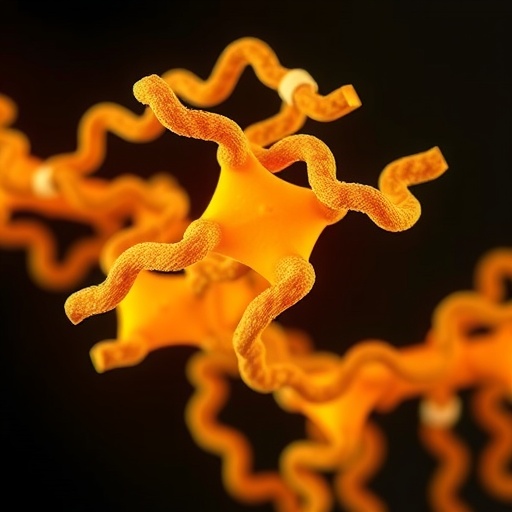
In a groundbreaking study published in Cell Death Discovery in 2026, researchers unveiled a novel mechanism by which adenosine triphosphate (ATP) interacts with amyloid fibrils formed by lysozyme and superfolder green fluorescent protein (sfGFP), fundamentally altering their structure and reducing their toxicity. This research sheds unprecedented light on the multifaceted biological roles of ATP, extending far beyond its classical function as the cellular energy currency. The study demonstrates that ATP not only binds to amyloid aggregates but also promotes a remodeling process that could pave the way for innovative therapeutic strategies targeting amyloid-related diseases.
Amyloid fibrils, notorious for their association with debilitating disorders such as Alzheimer’s, Parkinson’s, and systemic amyloidoses, arise from the misfolding and aggregation of proteins into insoluble, beta-sheet-rich structures. These aggregates disrupt cellular homeostasis and induce cytotoxicity, leading to tissue damage and cell death. Among various amyloidogenic proteins, lysozyme has served as a model amyloid precursor due to its well-characterized folding pathways and propensity to form fibrils under denaturing conditions. Superfolder GFP, an engineered variant of green fluorescent protein with enhanced folding properties, has recently emerged as a versatile reporter in amyloid studies, further expanding the experimental repertoire available for probing aggregation phenomena.
The research team led by Stepanenko and collaborators meticulously investigated the interaction dynamics between ATP molecules and the amyloid fibrils formed by lysozyme and sfGFP. Using a combination of spectroscopic, microscopic, and biochemical assays, they discovered that ATP binds specifically to the fibrillar structures, inducing a conformational rearrangement within the aggregates. This remodeling effect was evidenced by alterations in the fibril morphology, evidenced through high-resolution imaging techniques, and changes in the biophysical properties assessed via fluorescence and circular dichroism spectroscopy. Importantly, this ATP-mediated remodeling correlated strongly with a marked decrease in the cytotoxic potential of the fibrils when tested in cultured cell models.
The findings indicate that ATP exerts a dual role in amyloid biology: it functions not only as a metabolic nucleotide but also as a regulatory molecule capable of modulating protein aggregate architecture and stability. This dual functionality represents a paradigm shift in understanding the interplay between cellular metabolites and pathological protein assemblies. The direct binding of ATP to amyloid fibrils suggests a previously underappreciated endogenous mechanism that cells might employ to manage proteotoxic stress and maintain proteostasis. The study advances the notion that ATP-binding can serve as a natural amyloid remodeling trigger, helping to alleviate cellular damage by detoxifying harmful aggregates.
Mechanistically, ATP appears to act as a molecular chaperone-like effector that engages non-covalently with amyloid fibrils, destabilizing rigid beta-sheet interactions and promoting structural rearrangements. This remodeling process may facilitate the generation of smaller, less ordered aggregates or alternatively induce conformations that exhibit reduced interactions with cellular components responsible for cytotoxicity. Understanding the precise molecular details of these interactions opens novel avenues for the rational design of therapeutic molecules inspired by ATP’s binding properties. Such therapeutics could harness the intrinsic ability to reshape and detoxify amyloid aggregates, offering hope for diseases currently lacking effective treatments.
The impact of this study reverberates beyond fundamental biochemistry, calling attention to energy metabolites as potent modulators of pathological protein assemblies. It challenges the existing dogma that amyloid formation and clearance are governed primarily by chaperone proteins and proteolytic mechanisms, proposing instead that endogenous metabolites play active roles in aggregate regulation. This insight compels a reevaluation of metabolic pathways in neurodegenerative contexts and the potential cross-talk between cellular energetics and protein aggregation homeostasis. The role of ATP as a structural modulator of amyloid fibrils thus enriches our molecular understanding of disease etiology.
Furthermore, this research leverages sophisticated experimental models including recombinant amyloidogenic proteins and advanced fluorescence reporters to systematically chart ATP-amyloid interactions. Superfolder GFP amyloids serve as a particularly elegant model due to their fluorescent properties, enabling real-time observation of conformational dynamics and aggregate behavior in response to ligand binding. This innovative approach underscores the importance of model system versatility in dissecting complex molecular phenomena and facilitates translation to more clinically relevant amyloid systems in future studies.
Crucially, the reduction in cytotoxicity following ATP-mediated remodeling was quantitatively demonstrated in cell viability assays, underscoring the biological relevance of the biochemical findings. Cells exposed to ATP-treated aggregates exhibited increased survival rates compared to those treated with native amyloids, establishing a direct link between physicochemical changes in aggregates and functional outcomes. This observation is instrumental for therapeutic development, as it validates aggregate remodeling as a meaningful intervention point to mitigate cellular damage in amyloid diseases.
The broader implications of ATP’s amyloid remodeling function might extend to physiological processes where transient aggregate formation occurs, such as stress granule dynamics, phase separation, and normal protein quality control mechanisms. By modulating aggregate stability, ATP may influence the delicate balance between functional compartmentalization and pathological aggregation. This regulatory potential enriches the conceptual framework of intracellular organization and proteinopathy and suggests an evolutionary advantage conferred by nucleotide-mediated control of protein assembly.
Future research inspired by these findings will likely focus on elucidating the structural basis of ATP binding to diverse amyloid species and determining the universality of this remodeling mechanism across different protein aggregates. High-resolution structural methods such as cryo-electron microscopy and nuclear magnetic resonance spectroscopy will be essential for mapping interaction interfaces and conformational changes at the atomic level. Additionally, in vivo studies will be critical to validate physiological relevance and explore therapeutic feasibility in animal models of amyloid diseases.
This pioneering work by Stepanenko et al. challenges long-held assumptions about the biological roles of fundamental metabolites, showcasing ATP as a multifunctional molecule that transcends its energetic duties. The revelation that ATP can revert amyloid aggregates to less toxic forms promises a new conceptual avenue for the fight against neurodegeneration and systemic amyloidopathies. As the scientific community continues to untangle the complexity of proteostasis networks, this discovery serves as a beacon for exploring metabolic regulators as underrecognized yet vital contributors to cellular health.
In summary, the 2026 study profoundly advances our understanding of amyloid biology by uncovering ATP’s capacity to bind, remodel, and detoxify lysozyme and superfolder GFP amyloid fibrils. It broadens the conceptual landscape of amyloid modulation, integrating metabolite interactions into the fold and highlighting a promising therapeutic target. This research not only illuminates a novel facet of ATP’s molecular versatility but also inspires hope that manipulating ATP-amyloid interactions can one day translate into clinical benefit for patients afflicted by devastating protein aggregation diseases.
Cite Scienmag News
Ophelia Keating. (June 4, 2026). ATP Binding Remodels Amyloid Fibrils, Reduces Toxicity. Scienmag. https://scienmag.com/atp-binding-remodels-amyloid-fibrils-reduces-toxicity/
Ophelia Keating. "ATP Binding Remodels Amyloid Fibrils, Reduces Toxicity." Scienmag, 4 June 2026, https://scienmag.com/atp-binding-remodels-amyloid-fibrils-reduces-toxicity/. Accessed 3 September 2026.
Ophelia Keating. "ATP Binding Remodels Amyloid Fibrils, Reduces Toxicity." Scienmag. June 4, 2026. https://scienmag.com/atp-binding-remodels-amyloid-fibrils-reduces-toxicity/


