


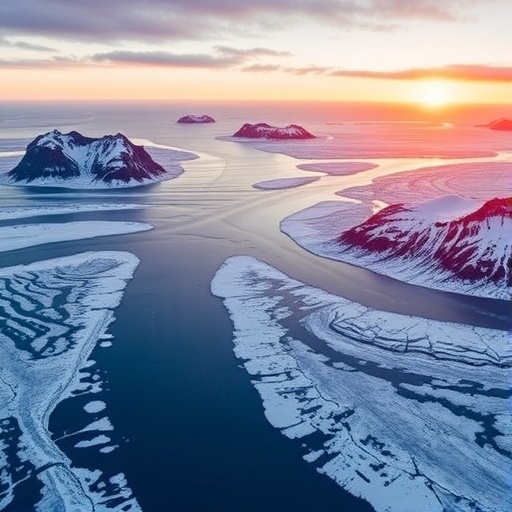
In a groundbreaking study published in Nature Communications, researchers from the Alfred Wegener Institute, Helmholtz Centre for Polar and Marine Research (AWI), have delivered the first comprehensive quantification of carbon stored within the permafrost soils of Arctic river deltas. This internationally led effort underscores the immense vulnerability and critical importance of these unique landscapes, which act as substantial carbon reservoirs but are increasingly imperiled by the escalating impacts of climate change.
Arctic river deltas, situated where large rivers meet the Arctic Ocean, constitute a distinctive biome characterized by frozen organic-rich soils and sediments. These deltas, found within the Arctic Circle along rivers such as Siberia’s Lena and Canada’s Mackenzie, concentrate significant amounts of carbon in permafrost strata. The carbon is sequestered mainly as frozen organic matter derived from millennia of accumulated dead plant material. Until recently, scientific understanding of the carbon storage capacity and stability of these deltas remained fragmentary and limited to a handful of mega-deltas.
The new study, spearheaded by AWI postdoctoral researcher Matthias Fuchs and his colleagues, brings clarity and urgency to this situation. Delving deeply into over 1,600 soil samples from 17 Arctic deltas, the team synthesized a vast array of published and unpublished data. Their analysis reveals that these river deltas alone harbor an astonishing 57.5 gigatonnes of permafrost-bound organic carbon—across an area just shy of 100,000 square kilometers, roughly the size of South Korea. This magnitude accounts for about 5 percent of the organic carbon found in global permafrost soils, despite these deltas occupying merely one percent of the total permafrost area.
This remarkable concentration of carbon indicates that Arctic river deltas function as hotspots within the global carbon cycle. With permafrost thaw accelerating due to rising Arctic temperatures, there is an increasing risk that these reservoirs may transition from carbon sinks to sources. Thaw-induced microbial activity within soils mobilizes the decomposition of previously frozen organic carbon, releasing substantial quantities of greenhouse gases, notably carbon dioxide and methane, into the atmosphere. Such emissions can amplify global warming through positive feedback loops, rendering permafrost thaw a critical climate challenge.
The dynamics impacting these deltas are complex and multifaceted. Thawing from atmospheric warming combines with coastal disturbances induced by sea-level rise and diminishing sea ice cover. Meanwhile, subsidence of delta lands exacerbates exposure to marine influences, further complicating permafrost stability. Seasonal thaw periods are lengthening, while river water temperatures increase, intensifying soil warming and disrupting perennial frozen layers. This unprecedented cascade of environmental pressures threatens to destabilize a carbon-storing equilibrium that has persisted through millennia.
Understanding Arctic river delta carbon stocks necessitates refined spatial and temporal resolution in observational data—a gap this study has addressed by tripling the number of analyzed soil cores compared to prior efforts. Previously, research focused on limited locales within major deltas, limiting extrapolation potential. The expanded dataset from 17 distinct delta systems enhances the robustness of carbon stock estimates and fosters improved parameterization for climate models.
Indeed, this improved quantification bears crucial implications for climate projections. Arctic permafrost thaw remains one of the largest uncertain factors in forecasting future atmospheric greenhouse gas concentrations. By highlighting the disproportionate carbon density and vulnerability of river deltas, the study advocates for intensified scientific focus on these transition zones between terrestrial and marine environments. Future modeling efforts can integrate these data to more accurately simulate permafrost carbon feedbacks at regional and global scales.
Even within the context of global terrestrial carbon stocks, Arctic river deltas emerge as critical players. The study emphasizes that these deltas sequester about 2 percent of the planet’s total soil carbon while occupying less than a tenth of a percent of Earth’s land area. Such efficiency in carbon storage underscores their unique ecological importance and justifies prioritizing these ecosystems for research funding and climate mitigation considerations.
Moreover, the findings resonate beyond carbon cycling alone. The thaw and degradation of permafrost soils influence broader Arctic ecosystem dynamics, including nutrient availability, hydrology, and habitat structures. These shifts may have cascading effects on biodiversity, indigenous communities, and global climate feedbacks. Consequently, the stewardship of Arctic river deltas encompasses intertwined environmental, social, and atmospheric dimensions.
The collaborative nature of this study, combining expertise and datasets from polar research centers across continents, sets a model for future interdisciplinary investigations. It also reflects the urgent necessity to monitor these sensitive environments amid rapid Arctic climate transformation. With permafrost thaw advancing faster than many models previously assumed, real-time empirical data and region-specific analyses are indispensable.
In conclusion, this seminal research provides a pivotal advancement in our understanding of permafrost carbon reservoirs, pinpointing Arctic river deltas as major yet previously underappreciated carbon stores—now under extreme threat from climate-induced thaw and environmental change. Rapid warming, shifting hydrological patterns, and ocean interactions are poised to degrade these frozen carbon vaults with significant repercussions for global carbon budgets and climate stability. As scientific attention escalates on these critical zones, the integration of detailed field data into predictive frameworks will be vital for anticipating future climate trajectories and guiding mitigation strategies.
News Publication Date: 29-May-2026
Web References: DOI: 10.1038/s41467-026-73092-2
Cite Scienmag News
Russell Cooper. (June 3, 2026). Mounting Pressures Threaten Arctic River Deltas. Scienmag. https://scienmag.com/mounting-pressures-threaten-arctic-river-deltas/
Russell Cooper. "Mounting Pressures Threaten Arctic River Deltas." Scienmag, 3 June 2026, https://scienmag.com/mounting-pressures-threaten-arctic-river-deltas/. Accessed 4 September 2026.
Russell Cooper. "Mounting Pressures Threaten Arctic River Deltas." Scienmag. June 3, 2026. https://scienmag.com/mounting-pressures-threaten-arctic-river-deltas/


