


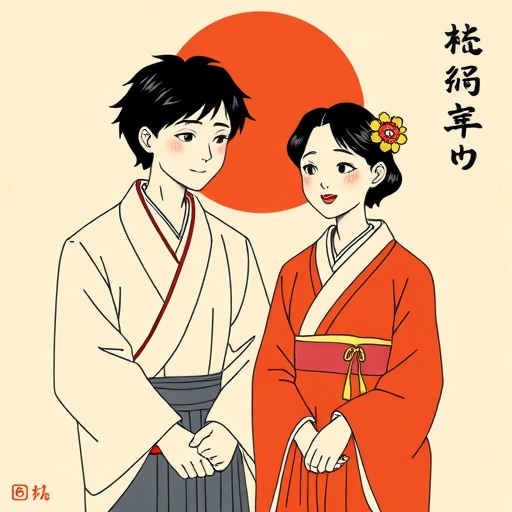
In a groundbreaking study poised to challenge prevailing assumptions about language and gender bias, researchers Ri Nin and Kazuo Mori from Tokyo University of Agriculture and Technology have delved deeply into the psychological underpinnings of traditional Japanese spousal terms. Published in the open-access journal PLOS One on June 3, 2026, their experimental investigation reveals a complex landscape where centuries-old terminology retains nuanced gendered connotations, even as its original literal meanings fade from everyday use.
Historically, the Japanese language included terms such as “shujin” for husband, literally translating to “master,” and “kanai” for wife, meaning “inside-the-house.” These words have long been emblematic of Japan’s patriarchal social structure, encapsulating a hierarchical framework where the husband is positioned as head and the wife as the domestic subordinate. Despite growing societal shifts and advancing gender equality, these terms remain ingrained in common parlance, prompting concerns about their role in perpetuating outdated gender roles.
To move beyond anecdotal evidence, Nin and Mori employed a rigorous experimental methodology involving 246 undergraduate Japanese speakers. Participants completed a paper-and-pencil Implicit Association Test (IAT) designed to measure unconscious attitudes. This test gauged automatic associations between the traditional terms “shujin” and “kanai” and the more neutral terms “otto” (husband) and “tsuma” (wife). The IAT allowed the researchers to capture subtle, subconscious reactions rather than overt, self-reported attitudes, providing a more authentic assessment of how these words function in the cognitive framework of contemporary speakers.
Results showed that both traditional and neutral spousal terms elicited remarkably similar implicit attitudes. This suggests that the deeply patriarchal, male-centric literal meanings of “shujin” and “kanai” have largely eroded in modern usage. Instead, these words appear to have been semantically neutralized, assimilating into everyday language as more neutral identifiers for husband and wife, rather than as symbols of power dynamics.
However, the study unearthed a salient gender difference in these implicit associations. Male participants consistently ranked terms for “husband” — both traditional and neutral — more positively than terms for “wife.” Female participants did not exhibit the same bias. This disparity points to the persistence of subconscious gender asymmetries among men, even as broad semantic shifts have neutralized the literal meanings of these words. Such findings illuminate subtle psychological mechanisms that may underlie enduring gender-based perceptions and biases in Japanese society.
The implications extend beyond linguistics. Given that language shapes thought and social reality, the relative neutralization of “shujin” and “kanai” might indicate changing cultural narratives about gender roles within marriage. Yet, the persistence of male-centered biases in male speakers hints that ingrained social hierarchies may still exert influence via unconscious cognitive channels, even when overt language use suggests equality.
By harnessing the Implicit Association Test, traditionally applied in social psychology to probe racial and gender biases, Nin and Mori venture into uncharted territory by applying it specifically to language use. This innovative approach highlights how implicit cognitive patterns can be detected through language, providing a powerful tool to parse the intersection of linguistics, psychology, and cultural studies.
The findings carry meaningful implications for ongoing debates around language reform and gender equality in Japan. Advocates for change often view terms like “shujin” and “kanai” as relics of a patriarchal past that reinforce harmful stereotypes. Yet, this research reveals a more complex picture where language evolves dynamically, and traditional terms may no longer wield the overt hierarchical force they once did.
Nevertheless, the study’s limitations invite caution and spark avenues for further inquiry. The sample was confined to Japanese-speaking undergraduate students, a demographic that may not capture generational or regional variations in language perception. Additionally, broader sociocultural factors—such as educational backgrounds, occupational roles, and exposure to gender debates—remain unexplored variables that might shape implicit associations.
Future research might expand the demographic scope to include older adults, rural populations, and international speakers of Japanese, assessing how implicit associations vary across age groups and social strata. Longitudinal studies could track whether semantic neutralization continues over time or if emergent societal pressures reinfuse traditional terms with renewed gendered significance.
Moreover, comparative cross-cultural studies could explore analogous phenomena in other languages grappling with gendered terminology, such as the English use of “master” and “mistress” or gendered occupational titles. Such research could elucidate universal versus culture-specific mechanisms driving implicit linguistic biases.
Nin and Mori conclude that while their findings suggest an encouraging trend toward semantic neutrality in traditionally gendered spousal terms, subtle subconscious gender biases linger, primarily among male speakers. This duality underscores the intricate interplay between language, cognition, and social structures, highlighting the importance of multifaceted approaches in unraveling contemporary gender dynamics in language.
In summary, this study provides a nuanced portrait of how language embodies and mediates gender perceptions within Japanese society. As “shujin” and “kanai” transition from literal symbols of male dominance to more neutral everyday terms, underlying cognitive biases persist unequally across genders. These insights contribute critical empirical evidence to discussions about language, identity, and social change, emphasizing the role of implicit cognition in shaping and reflecting evolving cultural norms.
As societies worldwide continue to grapple with gender equality and inclusive language usage, this research exemplifies the vital importance of examining not only overt words but also the subconscious associations they evoke. Nin and Mori’s pioneering application of implicit association measures to language usage opens a promising pathway for future interdisciplinary scholarship at the crossroads of linguistics, psychology, and gender studies.
News Publication Date: June 3, 2026
Web References: https://doi.org/10.1371/journal.pone.0330816
References: Nin R, Mori K (2026) Are Japanese spousal terms as gender-biased as they seem? An examination using implicit association measures. PLoS One 21(6): e0330816.
Cite Scienmag News
Alan Morgan. (June 3, 2026). Traditional Japanese terms for husband and wife, once seen as patriarchal, are now viewed as neutral. Scienmag. https://scienmag.com/traditional-japanese-terms-for-husband-and-wife-once-seen-as-patriarchal-are-now-viewed-as-neutral/
Alan Morgan. "Traditional Japanese terms for husband and wife, once seen as patriarchal, are now viewed as neutral." Scienmag, 3 June 2026, https://scienmag.com/traditional-japanese-terms-for-husband-and-wife-once-seen-as-patriarchal-are-now-viewed-as-neutral/. Accessed 6 September 2026.
Alan Morgan. "Traditional Japanese terms for husband and wife, once seen as patriarchal, are now viewed as neutral." Scienmag. June 3, 2026. https://scienmag.com/traditional-japanese-terms-for-husband-and-wife-once-seen-as-patriarchal-are-now-viewed-as-neutral/


