


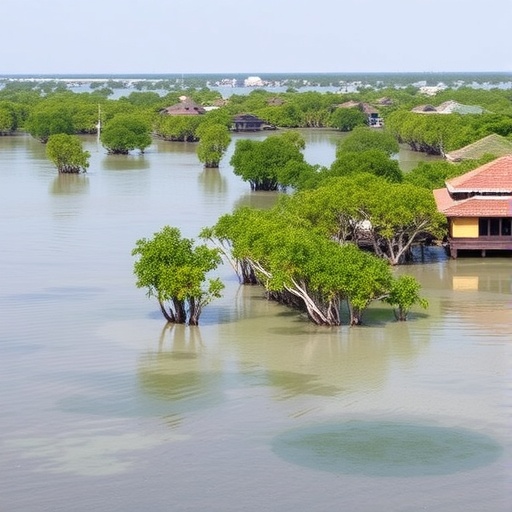
Mangroves, coastal salt-tolerant forests celebrated for their unparalleled ability to sequester carbon, face a precarious future under accelerating sea-level rise, according to groundbreaking research led by a team from the University of Exeter in collaboration with colleagues in Colombia and the United States. These ecosystems, which blanket less than one percent of the Earth’s surface yet account for roughly fifteen percent of oceanic carbon storage, are pivotal not only in the battle against climate change but also in protecting coastlines and supporting biodiversity. However, emerging evidence now challenges the long-standing assumption that rising sea levels will invariably enhance their carbon capture capabilities.
Historically, field studies have suggested that incremental sea-level increases could stimulate mangrove growth and, by extension, carbon sequestration. Yet, this new research, published in Earth’s Future, reveals that while some localized areas within mangrove forests may experience increased carbon accumulation initially, the larger, landscape-scale response is likely more complex and potentially detrimental. By integrating multiple dynamic processes into a sophisticated, composite model, the researchers have illuminated how the fate of mangrove carbon storage hinges crucially on spatial scale and the nuanced interplay between sea-level rise and ecosystem response.
The innovative model synthesizes hydrodynamic factors including water flow and sediment transport, alongside biological processes such as mangrove growth, mortality, and dieback, while simultaneously tracking sediment composition changes in the muddy substrates where mangroves thrive. This tri-modal integration uniquely captures the feedback loops that govern mangrove resilience or decline in a rapidly changing coastal environment. Contrasting with simplistic assumptions, the findings underscore that as sea levels continue to rise, increased flooding beyond tolerable thresholds may lead to plant mortality and soil erosion, ultimately transforming mangroves from vital carbon sinks into significant sources of atmospheric carbon dioxide.
Mangroves possess an extraordinary specialization, requiring precise inundation patterns tuned to tidal cycles for optimal physiological function. Researcher Luisa Fernanda Gómez Vargas emphasizes that disruptions in these flood regimes—specifically, excessive and prolonged submersion—can suffocate root systems, prevent sediment deposition, and induce dieback. Consequently, landscape patches currently serving as robust carbon reservoirs are vulnerable to sinking below critical elevation thresholds. The subsequent loss of mangrove vegetation combined with microbial decomposition and physical erosion releases previously sequestered carbon back into the atmosphere or adjacent waters, exacerbating climate change in a feedback loop.
Sea-level rise projections employed in this study follow diverse scenarios articulated by the Intergovernmental Panel on Climate Change (IPCC), allowing a nuanced appraisal of potential futures. The research demonstrates a compelling correlation between the magnitude of sea-level rise and the severity of adverse impacts on carbon storage at the forest scale. Under high-emission trajectories, mangrove ecosystems risk experiencing substantial reductions not only in biomass but also in the stability and thickness of their carbon-rich deposits, raising urgent concerns about the resilience of these ecosystems under continued global warming.
Beyond carbon dynamics, mangroves’ multifunctional roles amplify the stakes of their decline. Barend van Maanen, leader of the mangrove and carbon project at Exeter, highlights that these ecosystems also furnish critical services by buffering shorelines against storm surges, supporting fisheries through nursery habitats, and underpinning the livelihoods of coastal communities. The interplay of these social-ecological systems underscores the necessity for a holistic approach to managing coastal landscapes. By understanding the spatial heterogeneity and mechanistic drivers unraveled in this study, policymakers and conservationists can better prioritize interventions that enhance mangrove adaptive capacity.
These novel insights emerged against a backdrop where mangroves are increasingly threatened not only by climate change but also by anthropogenic pressures such as coastal development, river damming, and sediment supply disruption. The model presented advocates for reconceptualizing mangrove management through a landscape-scale lens that integrates geomorphological, ecological, and hydrodynamic factors. Recognizing the limits of small-scale field observations, this research champions the application of predictive modeling to anticipate future trajectories, guiding conservation strategies that robustly address the spatial complexity and long-term sustainability of blue carbon ecosystems.
The study, funded by the Natural Environment Research Council, marks a significant advance in ecosystem modeling by bridging physical and biological sciences to capture the emergent behavior of coastal wetlands under climate stressors. It serves as a clarion call to the global scientific community to refine predictions about coastal carbon sinks and incorporate scale-dependent responses when designing climate mitigation pathways. As mangroves teeter on the frontline of environmental change, understanding their nuanced responses will prove critical not only in conserving biodiversity but also in meeting international climate goals.
Ultimately, while mangroves have long been heralded as nature’s frontline allies against climate change, this research cautions against complacency. The delicate balance they maintain with tidal cycles and sediment dynamics means that unchecked sea-level rise threatens to undermine their carbon storage potential dramatically. The findings compel a reevaluation of current conservation narratives and underscore the urgent need for integrated coastal management practices. By leveraging advanced models and embracing landscape-scale complexity, the scientific community can better chart a course toward safeguarding these vital ecosystems for future generations.
News Publication Date: 3-Jun-2026
Web References: http://dx.doi.org/10.1029/2025EF006984
Cite Scienmag News
Margaret Porter. (June 3, 2026). Rising Sea Levels Threaten Mangroves, Risking Carbon Release. Scienmag. https://scienmag.com/rising-sea-levels-threaten-mangroves-risking-carbon-release/
Margaret Porter. "Rising Sea Levels Threaten Mangroves, Risking Carbon Release." Scienmag, 3 June 2026, https://scienmag.com/rising-sea-levels-threaten-mangroves-risking-carbon-release/. Accessed 4 September 2026.
Margaret Porter. "Rising Sea Levels Threaten Mangroves, Risking Carbon Release." Scienmag. June 3, 2026. https://scienmag.com/rising-sea-levels-threaten-mangroves-risking-carbon-release/


