


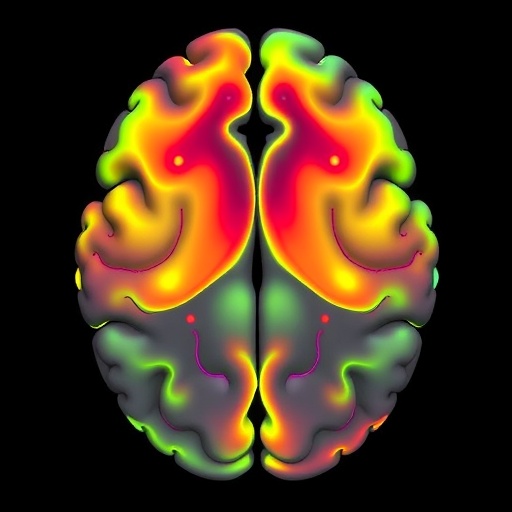
In a groundbreaking study published in Nature Neuroscience, researchers have unveiled new insights into how the basolateral amygdala (BLA), a critical brain structure implicated in emotional processing, organizes and represents diverse emotional states. This discovery marks a significant advancement in our understanding of the neural substrates of emotion, highlighting complex geometric patterns underlying emotional representation within the BLA that challenge traditional, simplistic conceptions of emotional coding.
The amygdala has long been recognized as a hub for processing emotions, particularly those related to fear and threat, yet the intricacies of how it encodes a spectrum of emotional experiences have remained elusive. O’Neill, Posani, Meszaros, and colleagues have now employed cutting-edge neurophysiological techniques combined with sophisticated computational analyses to decode the ‘representational geometry’ of emotions within the basolateral amygdala. Their work moves beyond observing broad neural activation levels, revealing a nuanced multidimensional structure in which emotional states are embedded.
This representational geometry framework conceptualizes emotion encoding not as isolated, categorical signals but as a continuum structured in a high-dimensional space. Here, emotional states are mapped as points or trajectories that reflect their relational properties and shared features. For example, states like anxiety and fear may cluster closely, exhibiting similar neural patterns, while more divergent emotions such as joy and disgust occupy distinct regions within this neural configuration. This spatial metaphor allows for a richer characterization of emotional information processing.
To achieve these insights, the researchers recorded neuronal activity from populations of neurons within the BLA in animal models undergoing controlled emotional stimuli related to various affective states. Utilizing advanced dimensionality reduction and representational similarity analysis (RSA), they visualized how these multidimensional patterns emerge dynamically in response to emotional inputs. This approach enables decoding of not only which neurons are activated but also how their collective firing patterns organize to shape emotional perception.
Crucially, the study reveals that the representational space is both stable and flexible: stable in maintaining identifiable emotional landscapes and flexible enough to adapt to contextual nuances or changes in emotional intensity. This dual characteristic suggests a sophisticated neural mechanism balancing consistency with adaptability, potentially explaining how the same brain region can support a wide array of affective behaviors across different environmental and internal conditions.
Their findings challenge oversimplified models that treat emotional encoding as uniform or binary and underscore the importance of geometric and computational perspectives in neuroscience. By framing emotional processing in terms of geometry, the research provides a powerful language for describing how the brain constructs subjective experiences from neural activity and how these experiences can be systematically studied and manipulated.
Furthermore, this framework holds promise for elucidating dysfunctions in emotional processing associated with psychiatric disorders such as anxiety, depression, and post-traumatic stress disorder (PTSD). If specific maladaptive emotional states correspond to aberrant geometrical patterns within the BLA, then therapeutic interventions might be designed to reshape or normalize these representations, leveraging neurotechnology or pharmacological agents.
The use of representational geometry also advances the field toward bridging microscopic neural mechanisms with macroscopic psychological phenomena. It offers a quantitative and visualizable method for understanding how complex emotional experiences emerge from the interplay of neural circuits. This integrative approach could accelerate the development of computational models that accurately simulate affective processing in health and disease.
O’Neill and colleagues’ methodology exemplifies the synergy between experimental neuroscience and computational modeling, reinforcing the notion that future breakthroughs will rely on interdisciplinary collaborations. By combining high-throughput neural recordings with sophisticated mathematical tools, they have opened a novel window into the elusive domain of emotion representation.
In addition to its theoretical impact, the research prompts a reevaluation of how emotional experiences are categorized clinically and experimentally. Rather than fixed emotion labels, the authors suggest a dimensional continuum that more accurately reflects the fluid and often overlapping nature of human feelings, as mirrored in neural data. This perspective could transform diagnostic frameworks and therapeutic strategies.
The study’s comprehensive approach also highlights the importance of population-level neural dynamics over single-cell analyses in understanding brain function. Emotions appear to emerge from distributed patterns rather than isolated neurons, emphasizing the collective coding principles operating within the amygdala circuits. This insight reinforces the complexity of brain networks subserving affective states.
Moreover, the findings draw attention to the basolateral amygdala’s role not merely as a passive recipient of emotional signals but as an active organizer that structures emotional information into coherent representations. This role might explain its central positioning within broader limbic and cortical circuits that mediate emotion-guided behavior.
While the experimental work was conducted in animal models, the implications extend to human neuroscience and psychology. The study lays a foundation for future research aimed at mapping emotional representational spaces in humans using noninvasive techniques such as functional MRI combined with multivariate pattern analysis, potentially uncovering homologous geometries underlying human affect.
Looking ahead, integrating these findings with other modalities, including molecular profiling and neuromodulatory influences, could further elucidate how emotional states are encoded and regulated at multiple biological scales. Such integrative work will be essential for translating basic science into clinical and technological innovations for mental health.
This pioneering research into the representational geometry of emotional states in the basolateral amygdala exemplifies the power of converging neuroscientific tools and theoretical frameworks. It sets a new standard for how emotions can be decoded, understood, and ultimately influenced through a neural geometric lens, promising a new era in the science of affective brain function.
Cite Scienmag News
Cassandra Pierce. (June 3, 2026). Mapping Emotional States in Basolateral Amygdala. Scienmag. https://scienmag.com/mapping-emotional-states-in-basolateral-amygdala/
Cassandra Pierce. "Mapping Emotional States in Basolateral Amygdala." Scienmag, 3 June 2026, https://scienmag.com/mapping-emotional-states-in-basolateral-amygdala/. Accessed 4 September 2026.
Cassandra Pierce. "Mapping Emotional States in Basolateral Amygdala." Scienmag. June 3, 2026. https://scienmag.com/mapping-emotional-states-in-basolateral-amygdala/


