


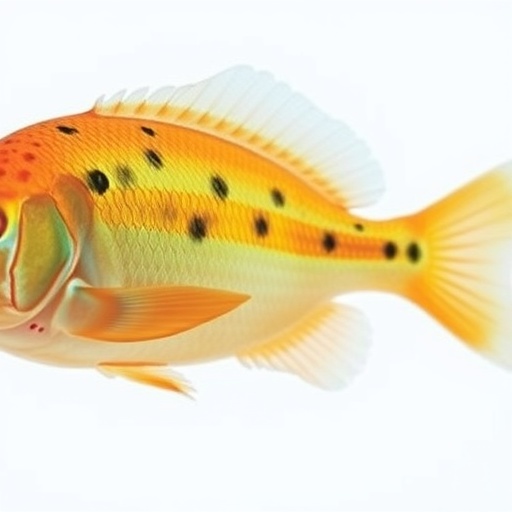
In a groundbreaking study emerging from Stockholm University, researchers have unveiled compelling evidence that the nature of social interaction plays a critical role in brain development in young guppies. The investigation, recently published in the prestigious journal Biology Letters, reveals that guppies raised with the ability to engage in live, reciprocal social exchanges develop significantly larger and more complex brains compared to their counterparts exposed only to passive visual stimuli, such as video images of other fish or minimal social contact. These findings not only deepen our understanding of neural plasticity in vertebrates but also raise profound questions about the impact of digital and passive screen-based social exposure on the developing brains of higher organisms, including humans.
The researchers designed an experimental setup that meticulously controlled the social environment of juvenile guppies over a 20-day developmental window. The three distinct groups comprised fish that interacted in real time with live conspecifics, fish that were exposed only to video recordings of other fish—thus lacking any actual reciprocal interaction—and fish with severely limited social contact. Through this careful stratification, the study sought to disentangle the effects of passive social observation from active social engagement on neural architecture.
Remarkably, guppies participating in live social exchanges demonstrated brains nearly six percent larger than those merely exposed to screens displaying other fish. Particularly notable was the enlargement of the olfactory bulbs, crucial neural regions associated with processing social olfactory cues, which suggests that real-time interaction enhances not only general brain growth but also the development of areas pivotal for complex social processing. In contrast, guppies restricted to video exposure exhibited brain sizes akin to socially deprived counterparts, underscoring that passive visual stimuli alone are insufficient to foster typical neural maturation.
The implications of these results resonate far beyond ichthyology. By employing guppies—a species whose brains continue to grow and adapt throughout life—the study leverages an exemplary vertebrate model to rigorously probe the causative links between social experience and brain plasticity. This methodological rigor circumvents the ethical and experimental limitations of human research, allowing precise manipulation of social environments unfeasible in clinical or epidemiological studies on child development.
Senior author Professor Niclas Kolm emphasizes that while the neurodevelopmental dynamics of fish and humans diverge considerably, the fundamental biological principle that brain development is sensitive to quality and mode of social interaction appears deeply conserved across vertebrates. This conservation implies that insights from guppies may shed light on the nuanced ways that social deprivation or altered social stimuli, such as those presented through screens, might influence neural trajectories in human children.
Interestingly, despite clear differences in brain morphology, the study reports no detectable variation in cognitive performance among the groups when subjected to object permanence tasks—an assessment of the ability to track objects through temporary occlusion. This finding suggests that not all cognitive domains or neural functions are equally susceptible to social modulation during early life stages, highlighting the complexity of disentangling which aspects of brain development are most vulnerable to environmental influences.
Lead author Olivia Carmstedt stresses that these results should not be misconstrued as a blanket indictment of screen time usage. Instead, they accentuate the irreplaceable role of interactive social experiences in normal neurodevelopment. Unlike passive observation, real-time engagement involves reciprocal feedback mechanisms, sensory integration, and dynamic neural stimulation, all crucial for shaping the synaptic connectivity underpinning cognitive and social capabilities.
The study also arrived amid burgeoning public discourse about the effects of burgeoning screen use in early childhood, a phenomenon marked by extensive exposure to video and digital media often lacking interactive features. Current human studies indicate associative, though not causative, links between media consumption and brain development metrics. By isolating and experimentally manipulating social interactivity, the guppy model offers an innovative approach to dissecting these relationships with unprecedented precision.
Technically, the methods employed included volumetric brain analyses using advanced imaging techniques to quantify differential growth patterns across treatment groups. Specialized interest was directed toward the olfactory bulbs due to their integral function in fish social communication, mediated through chemical signaling—a modality analogously significant in mammalian social interactions. The study’s rigorous experimental design enhances its validity, controlling for confounding variables and permitting robust conclusions about causality.
Beyond the immediate results, this research prompts urgent inquiries into how evolving social environments and technology-mediated interactions may impact brain development trajectories in a range of species. It beckons neurobiologists, psychologists, and educators to rethink the qualitative aspects of social exposure critical for nurturing cognitive and emotional well-being, especially in developmental stages characterized by rapid neuroplasticity.
In conclusion, this pioneering study illustrates with remarkable clarity that social interaction is a dynamic, reciprocal, and biologically essential catalyst for brain development. By demonstrating that live social contact promotes substantial neuroanatomical growth beyond what passive screen exposure can achieve, it underscores the evolutionary importance of interactive social experiences and offers a crucial foundational model for interpreting analogous processes in humans.
—
Subject of Research: Animals
Article Title: Streaming for fish? Screen-based social exposure disrupts brain development
News Publication Date: 3-Jun-2026
Web References: https://doi.org/10.1098/rsbl.2025.0830
References: Carmstedt, O., Kolm, N. (2026). Streaming for fish? Screen-based social exposure disrupts brain development. Biology Letters. DOI: 10.1098/rsbl.2025.0830
Image Credits: Arezo Shamsgovara
Keywords: brain development, social interaction, guppies, neural plasticity, screen exposure, neuroanatomy, vertebrate biology, olfactory bulb, cognitive development, digital media, reciprocal interaction, developmental neurobiology
Cite Scienmag News
Cassandra Pierce. (June 3, 2026). Social Interaction Boosts Brain Growth in Young Fish. Scienmag. https://scienmag.com/social-interaction-boosts-brain-growth-in-young-fish/
Cassandra Pierce. "Social Interaction Boosts Brain Growth in Young Fish." Scienmag, 3 June 2026, https://scienmag.com/social-interaction-boosts-brain-growth-in-young-fish/. Accessed 3 September 2026.
Cassandra Pierce. "Social Interaction Boosts Brain Growth in Young Fish." Scienmag. June 3, 2026. https://scienmag.com/social-interaction-boosts-brain-growth-in-young-fish/


