


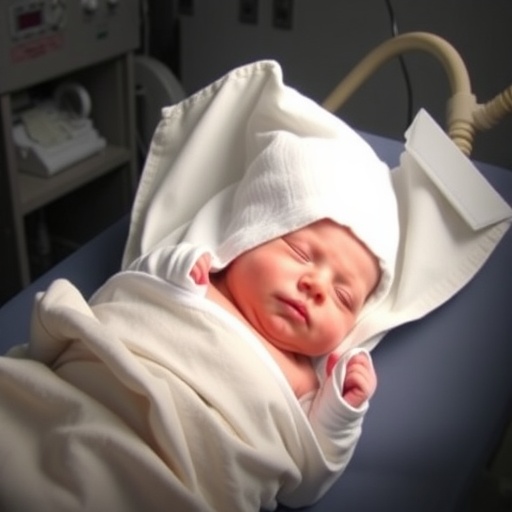
In the ever-evolving landscape of neonatal care, a recent publication by T.M. Slusher brings to the forefront an intriguing exploration of brief intensive phototherapy as a treatment for newborns grappling with jaundice. Presented in the esteemed journal Pediatric Research, this 2026 article delves deep into the therapeutic potential and inherent controversies surrounding this neonatal intervention. Phototherapy, a mainstay in neonatal medicine, involves exposing infants to specific wavelengths of light to mitigate hyperbilirubinemia—a condition where elevated bilirubin levels can pose serious neurological risks if untreated. While conventional phototherapy has been standard practice for decades, the notion of applying it intensively but for shorter durations introduces a promising paradigm shift that warrants rigorous examination.
The underlying mechanism of phototherapy capitalizes on the photochemical alteration of bilirubin molecules in the skin, converting lipophilic unconjugated bilirubin into water-soluble isomers that can be excreted via bile and urine without requiring hepatic conjugation. This process significantly curtails the risk of bilirubin crossing the blood-brain barrier, thereby preventing kernicterus, a severe form of bilirubin-induced neurological dysfunction. Traditional phototherapy typically extends over several days, carefully balancing effectiveness with the physiological tolerance of fragile newborns. However, the proposition of brief intensive phototherapy aims to amplify the light dose delivered in a reduced timeframe, hypothesizing enhanced bilirubin clearance with potentially fewer complications related to prolonged therapy.
Within this framework, Slusher’s article navigates the nuanced benefits that brief intensive phototherapy may offer. One compelling advantage posited is the reduced duration of hospitalization, which alleviates economic burdens on families and healthcare systems alike. Shortened treatment time may also diminish parental anxiety and the emotional toll associated with extended neonatal intensive care unit (NICU) stays. Moreover, the method’s feasibility in resource-limited settings where prolonged phototherapy is impractical might revolutionize neonatal care accessibility globally. The intensification hypothesis predicates on the phototherapy tools’ spectral power output and irradiance, variables critical in determining the transformation efficiency of bilirubin molecules.
Yet, alongside these enticing benefits, Slusher meticulously addresses the ambiguities and potential risks that brief intensive phototherapy entails. Elevated irradiance levels pose concerns regarding thermal regulation of neonates, as excessive heat exposure could augment metabolic demands and disrupt delicate homeostasis. Furthermore, intensive light exposure might provoke oxidative stress, exacerbating cellular damage, or instigate photo-oxidation of skin components leading to erythema or photodermatitis. The risk-benefit calculus must, therefore, navigate these biological intricacies to avoid unintended sequelae. Crucially, the article points out gaps in understanding concerning the long-term neurodevelopmental outcomes associated with this intensified approach.
The interplay between phototherapy intensity, wavelength specificity, and treatment duration emerges as a central theme. Slusher underscores that while blue light (wavelengths around 460–490 nm) remains the gold standard for bilirubin photochemical reactions, emerging devices and protocols propose leveraging additional wavelengths to optimize the efficacy and safety profile of intensive phototherapy. This spectral tuning, combined with precise calibration of irradiance dosages, underpins ongoing experimental and clinical investigations. Such fine-tuning could mitigate adverse effects while maximizing therapeutic yield, but the challenge lies in establishing standardized guidelines supported by robust evidence.
Expanding on clinical trials and observational studies, the article scrutinizes recent data that compare conventional and intensive phototherapy modalities. Although preliminary results indicate rapid reduction in serum bilirubin levels with intensive protocols, variability in study designs, patient populations, and outcome measures complicate direct comparisons. Slusher advocates for large-scale randomized controlled trials to elucidate definitive efficacy markers and safety endpoints. Particularly emphasized is the imperative to stratify newborns by risk factors such as prematurity, hemolytic disorders, and genetic predispositions to ensure personalized treatment approaches that optimize benefit while minimizing harm.
Slusher’s discourse also touches upon the technological advancements driving this therapeutic evolution. Innovations in LED lighting technology have dramatically enhanced the precision and compactness of phototherapy devices, facilitating the delivery of higher irradiance without exacerbating heat emitted to neonates. Integration of sensors monitoring skin temperature and bilirubin levels in real-time paves the way for dynamic therapy adjustments, reducing overtreatment risks. These technological strides enable clinicians to test brief intensive phototherapy protocols in controlled environments, accumulating pivotal data that underpin safety protocols.
The ethical dimensions of adopting brief intensive phototherapy are not overlooked. The article prompts reflection on informed consent processes with parents, given the novel nature of treatment and remaining uncertainties regarding long-term safety profiles. Furthermore, equitable access to advanced phototherapy technologies raises questions about healthcare disparities, especially in lower-income regions where bilirubin-induced neurotoxicity disproportionately affects newborns. These social considerations emphasize a holistic approach to research and implementation, ensuring that clinical benefits translate into real-world improvements cross-culturally.
A particularly innovative aspect discussed is the potential interplay between brief intensive phototherapy and adjunctive treatments, such as pharmacological agents that enhance bilirubin clearance or hepatobiliary function. Combining methods might potentiate therapeutic impact, shorten treatment duration further, and reduce the cumulative light exposure neonates endure. However, Slusher highlights that rigorous pharmacodynamic and safety investigations remain preliminary, underscoring the infancy of integrative treatment paradigms in neonatal jaundice management.
The article concludes by delineating a research agenda aimed at resolving the outstanding questions that envelop brief intensive phototherapy. Priorities include delineating optimal dosing regimens that balance efficacy and toxicity, understanding the systemic physiological effects of elevated irradiance exposure, and exploring the impact on diverse neonatal subpopulations. Furthermore, long-term neurodevelopmental surveillance will be critical to establish safety benchmarks requisite for widespread clinical adoption. Slusher envisions multidisciplinary collaborations among neonatologists, biomedical engineers, and pharmacologists as essential drivers of future discoveries.
Scientifically, this work pierces through previous conventions in neonatal phototherapy, provoking reconsideration of long-held treatment paradigms. The article’s meticulous synthesis of existing knowledge paired with critical inquiry into emerging practices renders it a cornerstone reference for clinicians and researchers alike. With newborn jaundice remaining a global public health challenge, innovations in phototherapeutic strategies could reshape prognoses and optimize neonatal outcomes on a worldwide scale.
In the broader context of pediatric medicine, such studies illuminate the dynamic nature of seemingly well-established modalities. The trajectory from broad-spectrum phototherapy to refined, intensive, and personalized approaches embodies the continuous pursuit of precision medicine tailored to the most vulnerable patients. Slusher’s contribution hence resonates beyond neonatal care, exemplifying how technological refinements combined with clinical rigor unlock fresh horizons in medical treatment.
Ultimately, this article underscores the delicate balance between innovation and caution in neonatal interventions. By interrogating both the promise and pitfalls of brief intensive phototherapy, Slusher catalyzes vital discourse essential for ethical advancement in pediatric health. Neonatal clinicians and healthcare policymakers will find indispensible insights here as they navigate evolving standards for managing neonatal hyperbilirubinemia.
This comprehensive examination of brief intensive phototherapy sets the stage for future breakthroughs that may radically condense treatment timelines, reduce neonatal morbidity, and alleviate healthcare burdens globally. As the research community rallies to fill remaining knowledge gaps, the neonatal field stands on the cusp of a transformative leap in how jaundice is managed, emphasizing speed, safety, and efficacy. In this exciting frontier of pediatric science, the glow of innovation shines as brightly as the therapeutic lights bathing vulnerable newborns.
Cite Scienmag News
Harold Sullivan. (June 2, 2026). Brief Intensive Phototherapy for Newborns: Benefits, Risks. Scienmag. https://scienmag.com/brief-intensive-phototherapy-for-newborns-benefits-risks/
Harold Sullivan. "Brief Intensive Phototherapy for Newborns: Benefits, Risks." Scienmag, 2 June 2026, https://scienmag.com/brief-intensive-phototherapy-for-newborns-benefits-risks/. Accessed 3 September 2026.
Harold Sullivan. "Brief Intensive Phototherapy for Newborns: Benefits, Risks." Scienmag. June 2, 2026. https://scienmag.com/brief-intensive-phototherapy-for-newborns-benefits-risks/


