


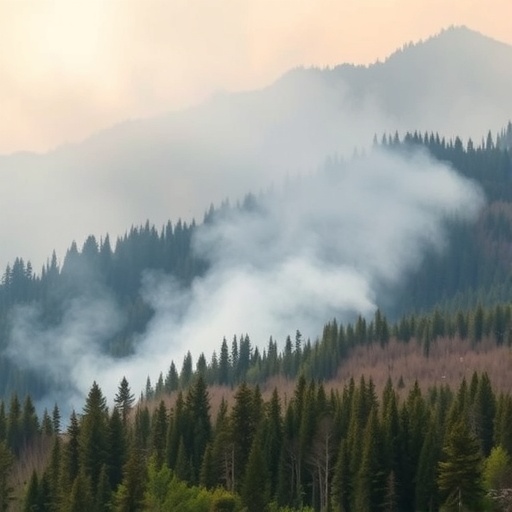
In the evolving climate dynamics of the Earth’s boreal forests, new research reveals a troubling shift in the natural feedback mechanisms that have historically tempered global warming following wildfire events. Scientists from McMaster University, VU Amsterdam, and the Woodwell Climate Research Center have published findings indicating that diminishing snow cover duration in northern forests is critically undermining a natural climate-cooling process known as the snow-albedo effect. This effect, which once partially offset carbon emissions from forest fires by reflecting solar radiation, is now being compromised, triggering an alarming positive feedback loop that could accelerate climate warming and intensify wildfire regimes.
The fundamental process behind this natural cooling mechanism involves the interplay between wildfire scars and snow coverage. When northern forests experience fire, vast areas of charred ground are exposed beneath the canopy, drastically darkening the landscape. In the ensuing winter months, snow typically accumulates over these burnt areas, creating a starkly brighter surface compared to unburnt tree-covered forests. This increased surface brightness, or albedo, results in a higher proportion of incoming solar radiation being reflected back into space instead of being absorbed by the Earth, thus cooling the atmosphere. Historically, this albedo-driven cooling has served as a vital counterbalance to the release of carbon dioxide (CO₂) and other greenhouse gases from fires.
However, the steady retreat of spring snow cover – a direct consequence of global warming – diminishes the window during which snow can settle on post-fire landscapes and exert its reflective cooling influence. This reduction in snow cover duration means that the surface remains darker for longer periods, absorbing more solar energy instead of reflecting it, which amplifies regional and potentially global warming trends. The research delineates how this shift erodes the efficacy of albedo feedback, transforming what was once a stabilizing climatic process into a contributor to warming, thereby creating a vicious cycle of increasing fire intensity and climate disruption.
Recent wildfire seasons in Canada have underscored the urgency of understanding these processes. The 2023 wildfire season was unprecedented, burning an area larger than ever recorded and releasing carbon emissions surpassing the annual fossil fuel emissions of nearly every nation on the planet. The following 2025 season, recording the second-largest burned area in decades, further illustrates the escalation in wildfire extent and intensity in the boreal region. These events highlight not only the direct emissions but also the complex interactions between fire dynamics, snow cover, and climate regulation.
The study’s lead author, Max van Gerrevink, a PhD candidate specializing in Earth and Climate science at VU Amsterdam, emphasizes that wildfire impacts on climate transcend carbon emissions alone. Vegetation changes caused by fires, modifications in surface brightness due to altered land cover, and effects on soil properties collectively form a multifaceted influence on atmospheric processes. In particular, the research identifies the critical role that postfire snow cover has played over decades in moderating warming through enhanced albedo – a natural climate stabilizer now endangered by global warming.
Quantitative analysis reveals a troubling trend: historically, nearly half of Canadian wildfire events reached a climatic “break-even” point where the cooling effect of snow-covered burn scars effectively balanced the warming caused by carbon emissions from these fires. Contemporary observations, however, indicate this balance is rapidly shifting. Currently, only about one in four to five fires achieves such an offset, indicating more frequent net warming effects following wildfire events. This shift is particularly pronounced for the largest and most carbon-intensive fires, where the albedo cooling mechanism has declined by almost 30% compared to the 1960s.
These findings suggest a compounding disadvantage for climate regulation: the very fires that emit the greatest quantities of carbon are the ones experiencing the most significant reduction in snow-driven cooling effects. As global temperatures climb, earlier snowmelt and shorter snow seasons mean that burn scars remain dark and heat-absorbing for longer periods, exacerbating local warming and potentially influencing broader climate systems through feedback loops. This dynamic marks a transition from a historical climate buffer to a present and future climate amplifier.
Alemu Gonsamo, associate professor of Earth, Environment, and Society at McMaster University and co-author of the study, highlights the implications for climate mitigation strategies. While global greenhouse gas reductions remain paramount, these results underscore an urgent need for adapting boreal fire management. Strategic interventions could target suppression efforts and forest stewardship in areas where they yield the greatest climatic benefit by preserving or enhancing albedo effects. Such tailored approaches could buy valuable time by maintaining the cooling influence of snow cover while longer-term climate solutions are developed and implemented.
The research team advocates for investment in smarter boreal fire management that accounts not only for carbon emissions but also for surface albedo dynamics. These integrated strategies might include controlled burns, targeted suppression in high-albedo regions, and promoting forest compositions that maximize reflective snow accumulation. Given the growing frequency and severity of northern wildfires, proactive management has become essential to mitigate the compounding climatic risks posed by weakened snow-albedo feedbacks.
Moreover, the study stresses the necessity of continued monitoring and improved modeling to understand the complex interplay of fire emissions, vegetation recovery, soil changes, and snow dynamics. Accurate data and robust projections are critical for refining forest management practices and climate policy. The work was made possible through funding by the European Research Council under the European Union’s Horizon 2020 research and innovation program, reflecting the global importance of understanding and responding to the changing climate-fire nexus.
In conclusion, the diminishing climate-cooling influence of postfire snow albedo represents a profound and underappreciated shift in the Arctic and boreal climate system. This research uncovers a critical feedback loop whereby climate change erodes a natural brake on warming, potentially escalating fire severity and enhancing carbon emissions in a self-reinforcing cycle. Addressing this challenge demands an integrated approach combining aggressive greenhouse gas mitigation and adaptive, landscape-scale fire management to safeguard one of the planet’s key climate regulation mechanisms before it is irreversibly lost.
News Publication Date: June 1, 2026
Web References:
https://www.pnas.org/doi/10.1073/pnas.2600434123
References:
van Gerrevink, M., Gonsamo, A., Zhong, Z., Veraverbeke, S. et al. Canadian wildfires are losing their climate-cooling influence from postfire snow albedo. Proceedings of the National Academy of Sciences, 2026.
Cite Scienmag News
Sloane Callahan. (June 2, 2026). Canadian Forest Fires Are Losing Their Ability to Cool the Climate. Scienmag. https://scienmag.com/canadian-forest-fires-are-losing-their-ability-to-cool-the-climate/
Sloane Callahan. "Canadian Forest Fires Are Losing Their Ability to Cool the Climate." Scienmag, 2 June 2026, https://scienmag.com/canadian-forest-fires-are-losing-their-ability-to-cool-the-climate/. Accessed 5 September 2026.
Sloane Callahan. "Canadian Forest Fires Are Losing Their Ability to Cool the Climate." Scienmag. June 2, 2026. https://scienmag.com/canadian-forest-fires-are-losing-their-ability-to-cool-the-climate/


