


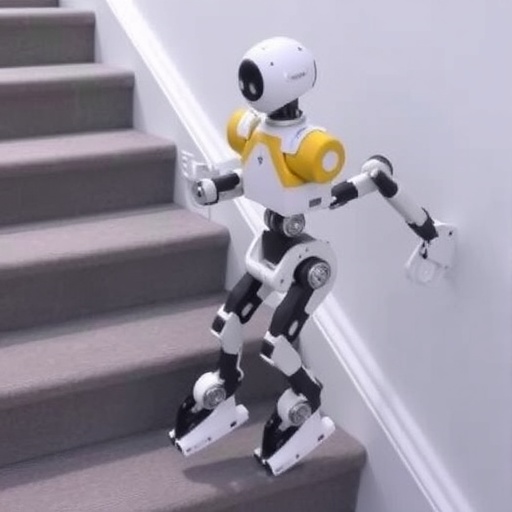
Navigating staircases poses one of the most formidable challenges for mobile robots. Unlike level ground, where balance and movement are relatively predictable, stairs introduce uneven terrain and abrupt elevation changes. A comprehensive multi-year field study revealed that robots designed to climb stairs experience failures at a rate at least thirty-five times greater than those operating on flat surfaces. The repercussions of such failures are severe; a robot that loses its balance and topples on a staircase can gain dangerous momentum during its fall. This cascade effect threatens not only the robot’s operational integrity but also the safety of the environment and any humans present nearby. These risks underscore the pressing need for advanced systems to safeguard robot operation in stairwell settings.
Traditional fall prevention strategies for robots, including sophisticated path-planning algorithms and balance control mechanisms, aim to avoid hazards and maintain stability. However, these approaches have inherent limitations—especially in dynamic environments where unpredictable collisions may occur. One particularly vexing problem is the residual risk arising from unforeseen impacts, such as a person accidentally colliding with the robot from above on a staircase. No matter how refined the prevention algorithms, this element of uncertainty remains. Consequently, deployment of autonomous robots in stairwells has been met with hesitancy, as operators prioritize safety and liability concerns over the benefits of automation.
This persistent challenge takes a compelling turn in the work spearheaded by Professor Mohan Rajesh Elara of the Robotics and Automation Research (ROAR) Laboratory at the Singapore University of Technology and Design. He highlights the critical distinction between fall prevention and fall mitigation. While prevention focuses on avoiding falls, mitigation addresses the aftermath—minimizing damage and regaining stability once a fall has begun. Professor Elara asserts that until robotics industries can effectively tackle this residual risk with robust fall mitigation solutions, heavy autonomous platforms will remain liabilities rather than reliable labor-saving instruments in complex environments like stairwells.
In their groundbreaking study, titled “A reinforcement-learning-based fall mitigation system for stair-traversing service robots,” Professor Elara and his team harness the power of artificial intelligence and innovative design to confront fall risks. They outfitted a commercial-grade tracked robot with a specialized three-jointed articulated arm, the movements of which were governed by a control policy learned entirely through reinforcement learning in a simulated environment. This approach enabled the robot to dynamically engage its arm to counteract destabilizing forces and halt falls induced by external perturbations.
A thorough analysis of fall scenarios on stairs led the researchers to identify five primary fall modes: a direct backward topple, two pivot-based fall variants, and two types of lateral falls—each presenting distinct mechanical challenges. Armed with this classification, the team explored the simplest structural configuration capable of counteracting all five modes effectively. The solution coalesced into an arm with three degrees of freedom, mounted on the rear of the robot. This configuration proved critical for constraining the control problem to a manageable complexity while still ensuring comprehensive fall mitigation coverage.
Professor Elara elaborates that the choice of three degrees of freedom for the arm strikes a balance between mechanical versatility and control tractability. By geometrically enveloping the spectrum of fall scenarios with a relatively minimal structure, the system creates conditions under which an AI-driven controller can operate effectively. Crucially, the AI component drives the arm in real time, calculating precise joint movements—a feat that would be prohibitively complicated to achieve through manual programming or heuristic control strategies.
During each simulated trial, a randomly generated force was applied to knock the robot backward or sideways, mimicking real-world disturbances like accidental collisions or uneven footing. The reinforcement learning controller monitored the robot’s state several times per second, deciding how to position each arm joint to arrest the fall. Utilizing a proximal policy optimization algorithm, the system refined its control strategy by rewarding outcomes where the robot returned to a stable, upright stance, and penalizing failures such as continuing to flip, falling off the stairs, or excessive arm movement that wasted energy or exacerbated instability.
The empirical results from five trained controller variants are impressive. The reinforcement learning system achieved an average success rate of 69.4 percent at arresting falls and restoring balance. This performance substantially outstripped a hand-coded heuristic counterpart, which succeeded only 38.6 percent of the time and frequently destabilized the robot further by erratic arm action. Notably, when the AI controller succeeded, it accomplished stabilization in an average of just 4.25 seconds—comfortably within the team’s predefined goal of a 10-second recovery window. This rapid response capacity is vital to minimizing damage and maintaining operational continuity.
One of the most impactful aspects of the study was the controller’s robustness testing. Although initially trained on a single robot design and stair geometry, the same controller was tested without additional training on robots that were ten percent larger or smaller and on staircases with altered step dimensions. The system exhibited remarkable adaptability. On a larger robot, the fall mitigation success rate improved to an impressive 87 percent, whereas on a smaller, inherently less stable platform, the controller still performed adequately despite a reduction in effectiveness. This generalization capability indicates that the trained policy is not merely memorizing specific conditions but has learned an abstract recovery strategy applicable across different morphologies.
Professor Elara emphasizes the broader implications: “The controller is not memorising one geometry. It is learning a recovery strategy that generalises.” This means that the same module could be deployed across various robotic platforms with similar mechanical configurations, bypassing the need for retraining each time. This modularity significantly accelerates adoption and scalability of fall mitigation technologies in diverse service robotics applications.
However, the team acknowledges that achieving a near-70 percent success rate, while promising, does not yet meet stringent safety standards like IEC 61508, which dictate much higher reliability for critical safety functions. To transition from laboratory demonstration to real-world deployment, several advances are required. These include enhancing the controller’s performance ceiling, integrating mechanical fail-safes such as brakes, layering additional fall-prevention systems upstream, and developing surrogate models to provide explainability and auditability of the AI’s decision-making processes. Physical validation will begin with simplified test rigs before progressing to full-scale robot integration and real-world testing across a variety of staircases with differing architectures.
This research forms part of a larger initiative at SUTD’s ROAR Lab aimed at advancing the safe operation of versatile, reconfigurable mobile robots. The program aligns with national priorities in Singapore that emphasize translating cutting-edge research into practical, deployable robotics solutions that can safely augment human labor in challenging environments. Professor Elara’s vision is to establish fall mitigation as a credible, integral layer within broader robot safety architectures, paving the way for autonomous stair-traversing platforms to gain trust rather than evoke concern among operators and users.
“Our ultimate goal is to embed this system as a reliable defense layer,” notes Professor Elara. “By demonstrating that the fall mitigation mechanism operates dependably and transparently, we take a decisive leap toward transforming stair-climbing robots from potential liabilities into tools that effectively support human work.” The implications of this work are significant, foreshadowing a future where autonomous robots safely and seamlessly navigate complex built environments, expanding the frontier of automation into spaces once considered too hazardous.
News Publication Date: [Not provided]
Web References: https://doi.org/10.1016/j.rineng.2026.110413
Keywords
Robotics, Artificial Intelligence, Reinforcement Learning, Fall Mitigation, Stair Traversal, Robot Safety, Autonomous Robots, Robot Navigation, Human-Robot Interaction
Cite Scienmag News
Denise Maddox. (May 29, 2026). Stair-Climbing Robot That Self-Catches During Falls Revolutionizes Robotics Safety. Scienmag. https://scienmag.com/stair-climbing-robot-that-self-catches-during-falls-revolutionizes-robotics-safety/
Denise Maddox. "Stair-Climbing Robot That Self-Catches During Falls Revolutionizes Robotics Safety." Scienmag, 29 May 2026, https://scienmag.com/stair-climbing-robot-that-self-catches-during-falls-revolutionizes-robotics-safety/. Accessed 3 September 2026.
Denise Maddox. "Stair-Climbing Robot That Self-Catches During Falls Revolutionizes Robotics Safety." Scienmag. May 29, 2026. https://scienmag.com/stair-climbing-robot-that-self-catches-during-falls-revolutionizes-robotics-safety/


