


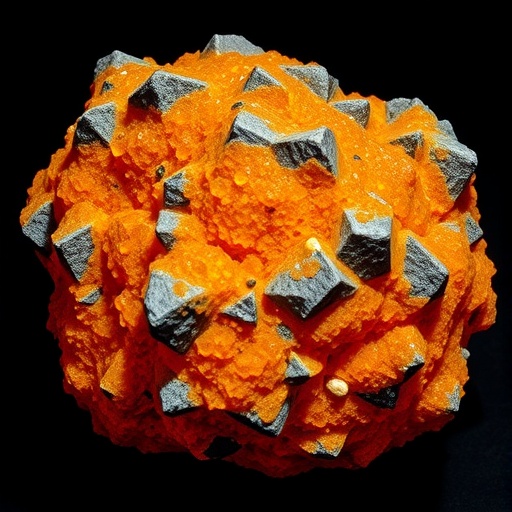
A groundbreaking study has unveiled unprecedented insights into the earliest stages of terrestrial alteration processes affecting extraterrestrial materials, specifically focusing on Ryugu asteroid grains. Published in Nature Communications in 2026 by Miyahara, Noguchi, Matsumoto, and their colleagues, this research highlights the pivotal role of pyrrhotite, an iron sulfide mineral, in initiating chemical transformations as asteroid grains interact with Earth’s environment. These findings not only reshape our understanding of the post-arrival evolution of spaceborne materials but also reveal the delicate interplay between extraterrestrial minerals and terrestrial influences.
The Ryugu asteroid, a near-Earth object explored by the Japanese Hayabusa2 mission, has long been a subject of intrigue due to its primitive composition and carbonaceous chondrite classification. The samples returned from Ryugu provide a pristine record of solar system formation and early planetary processes. However, once these materials make terrestrial contact, they begin a process called terrestrial alteration, during which Earth’s atmospheric moisture, oxygen, and other agents alter the chemical and mineralogical characteristics of the grains. Studying these early modifications offers a window into the dynamic interface between space and Earth environments.
Pyrrhotite, a magnetic iron sulfide mineral, plays a surprisingly active role in kickstarting terrestrial alteration in Ryugu grains. The researchers employed a suite of advanced microscopic and spectroscopic techniques to identify and characterize pyrrhotite’s reaction pathways upon exposure to Earth’s humid and oxygen-rich atmosphere. Their data revealed that pyrrhotite undergoes oxidation, yielding secondary mineral phases such as iron oxides and sulfates, thereby catalyzing broader chemical changes within the meteorite matrix. This oxidation process fundamentally transforms the grains, creating new textures and compositional heterogeneities previously undocumented.
One of the critical implications of the study lies in refining the protocols for asteroid sample curation and analysis. Since the Hayabusa2 mission returned Ryugu samples in a meticulously controlled environment designed to minimize contamination, this research underscores the rapid kinetics of pyrrhotite alteration even under controlled terrestrial exposures. It suggests that any delay or compromise in handling extraterrestrial materials post-return could significantly modify their native chemistry. Therefore, investment in immediate and ultra-clean storage conditions is paramount to preserving the scientific integrity of these invaluable samples.
The chemical reactivity of pyrrhotite also sheds light on broader geochemical cycles in early solar system bodies. Pyrrhotite’s ability to rapidly oxidize and transform helps explain certain enigmatic mineral assemblages found in asteroids, comets, and meteorites on Earth. By modeling such alteration processes, planetary scientists gain a more accurate framework to interpret remote sensing data and laboratory analyses, linking mineralogical signatures to environmental histories. This improved comprehension has repercussions for constructing the timelines and environmental conditions of solar system evolution.
Moreover, the oxidation of pyrrhotite is not only a local surface reaction but triggers subsequent alterations across adjacent mineral phases. The study reveals that as pyrrhotite oxidizes, it releases sulfur and iron ions into the surrounding matrix, promoting secondary mineral formation and recrystallization. These cascade effects can influence the mechanical integrity and spectral properties of the grains, which are crucial parameters when correlating sample data with remote asteroid observations. Thus, pyrrhotite acts as a nexus within early alteration pathways.
Spectroscopic analyses, including synchrotron-based X-ray absorption and electron microscopy, were instrumental in resolving the nanoscale textures and chemical states of pyrrhotite and its alteration products. The fine-grained nature of Ryugu materials requires such high-resolution tools to precisely delineate alteration stages. The findings demonstrate variations in oxidation states of iron and sulfur, providing direct evidence of ongoing redox reactions. These experimental approaches set new benchmarks for extraterrestrial material characterization.
Furthermore, the study explores the temporal scale of pyrrhotite alteration. Experimental simulations mimicking Earth’s atmospheric conditions indicate that oxidative transformation commences within hours to days of exposure. This rapid onset challenges previous assumptions about meteorite weathering rates and demands reevaluation of how terrestrial contamination might mask or overwrite primordial signatures. The study thereby lays a foundation for standardizing time scales in sample handling and analysis.
Aside from its geochemical implications, the pyrrhotite-driven alteration mechanism may have astrobiological relevance. Sulfur cycling plays a notable role in prebiotic chemistry, and iron-sulfur minerals are hypothesized to influence early biochemical pathways on Earth and potentially other planetary bodies. Understanding the stability and transformation of sulfides like pyrrhotite in extraterrestrial environments can elucidate the conditions conducive to life’s precursors. Consequently, Ryugu sample studies bolster interdisciplinary connections linking planetary science and origins-of-life research.
The research team also addresses the broader astromaterials community, advocating for enhanced collaboration focused on terrestrial alteration effects. Given the expanding volume of returned samples—from Ryugu, Bennu, and future missions—the community must adopt unified frameworks for tracking and quantifying terrestrial modifications. Such standardization will enable cross-comparison among various sample sets and ensure the fidelity of planetary science inferences drawn from laboratory investigations.
The multidisciplinary nature of the study, integrating mineralogy, geochemistry, planetary science, and advanced microscopy, exemplifies the new era of space materials research. By combining observational data with experimental validation, the team elucidates the fundamental processes that blur the lines between extraterrestrial and terrestrial domains. Their work exemplifies how meticulous examination of individual mineral components can unravel complex, macroscale outcomes affecting entire sample suites.
Looking forward, the implications for planetary protection are significant. Recognizing that minerals such as pyrrhotite can rapidly alter and potentially release hazardous compounds upon terrestrial exposure necessitates revisiting sample handling guidelines. The insights gained empower mission planners and curators to refine containment strategies that safeguard both scientific value and terrestrial environments. Ensuring responsible stewardship of extraterrestrial materials is central to the sustainable development of space exploration.
In conclusion, the discovery of pyrrhotite as a key driver of early-stage terrestrial alteration in Ryugu grains revolutionizes the understanding of post-return meteorite modification. Through detailed chemical and structural analysis, the study reveals how fundamental mineralogical reactions unfold shortly after Earth’s contact, influencing chemistry, microstructure, and interpretative context. This work paves the way for more accurate reconstructions of solar system processes, advances methodologies in sample analysis, and inspires multidisciplinary ties spanning geochemistry to astrobiology.
The detailed knowledge gained from the Ryugu samples highlights the intricate and rapid transformations that occur when extraterrestrial materials intersect with Earth’s environment. Such revelations are critical as humanity expands its reach into space, continuously returning samples that serve as time capsules from the early solar system. Decoding alteration mechanisms enhances not only scientific understanding but also informs the practical challenges of sample curation and planetary protection, marking a milestone in space material research.
As space missions continue to gather momentum, the importance of unraveling terrestrial alteration pathways becomes ever more urgent. This landmark research sets a precedent for the study of spaceborne materials, emphasizing the necessity of combining sophisticated analytical techniques with rigorous experimental design. The pyrrhotite-centric alteration model stands as a testament to how focused mineralogical investigations can yield transformational insights into planetary science.
Ultimately, the pioneering work of Miyahara and colleagues on pyrrhotite in Ryugu grains serves as a clarion call for the scientific community to deepen its understanding of extraterrestrial material interactions with Earth. It heralds a new chapter in the saga of solar system exploration, where the smallest mineral changes inform grand cosmic narratives, bridging the gap between extraterrestrial origins and terrestrial realities.
Cite Scienmag News
Grant Pearson. (May 29, 2026). Pyrrhotite Sparks Early Alteration in Ryugu Grains. Scienmag. https://scienmag.com/pyrrhotite-sparks-early-alteration-in-ryugu-grains/
Grant Pearson. "Pyrrhotite Sparks Early Alteration in Ryugu Grains." Scienmag, 29 May 2026, https://scienmag.com/pyrrhotite-sparks-early-alteration-in-ryugu-grains/. Accessed 4 September 2026.
Grant Pearson. "Pyrrhotite Sparks Early Alteration in Ryugu Grains." Scienmag. May 29, 2026. https://scienmag.com/pyrrhotite-sparks-early-alteration-in-ryugu-grains/


