


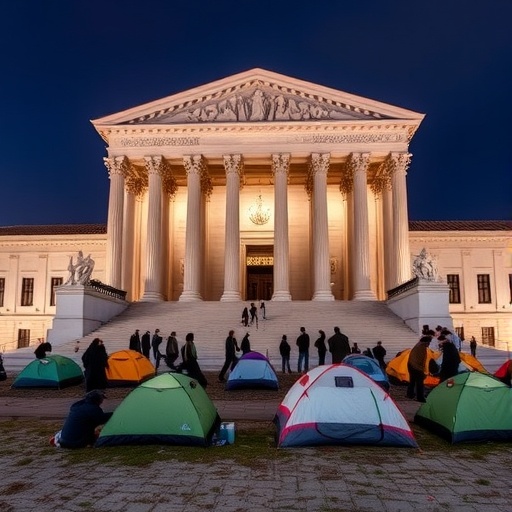
In the wake of the landmark 2024 U.S. Supreme Court ruling in City of Grants Pass v. Johnson, a significant shift has emerged in how municipalities manage homeless encampments. UC Berkeley researchers have unveiled a comprehensive analysis demonstrating that in Oakland, California, local authorities dramatically increased the frequency and scope of encampment clearances. This surge comes directly after the court’s decision, which effectively sanctioned the enforcement of camping bans and authorized punitive measures against individuals experiencing homelessness who sleep outdoors, even when there are insufficient shelter options available.
The study meticulously scrutinized 785 official encampment closure records spanning from January 2021 through December 2024, marking a period shaped decisively by new judicial policy. By leveraging a public database managed by Oakland city officials, the research team was able to geocode vague location data into precise spatial coordinates. This technical approach allowed the team to track the temporal distribution and intensity of municipal sweeps with unprecedented detail. Notably, the data revealed that the monthly average number of camps cleared more than doubled, from 14.4 camps pre-ruling to 32.2 camps post-ruling within six months of the Supreme Court’s decision.
One striking finding from the research was the repetitive nature of these encampment closures. Over the four-year window, researchers identified 156 camps that had been swept multiple times, with one location subjected to 18 clearances alone. This repetitive displacement did not resolve homelessness but merely reshuffled the affected populations across the urban landscape. Spatial analysis shows a seismic shift in the “statistical center” of sweeps: prior to June 2024, operations clustered several blocks southeast of the iconic Lake Merritt area. Post-ruling, sweeps expanded approximately 1.5 miles southeast, displacing people toward East Oakland, a region characterized by greater poverty rates and higher proportions of Hispanic residents.
This relocation phenomenon highlights a critical social and spatial dynamic. Rather than alleviating homelessness, encampment sweeps appear to exacerbate geographic and socio-economic segregation. The researchers suggest two plausible mechanisms: the Supreme Court ruling emboldened municipal authorities to expand enforcement jurisdiction into historically less-policed neighborhoods, or repeated displacements triggered the formation of new encampments as a reaction to forced removals. These insights emphasize how legal frameworks shape urban management practices, often unintentionally perpetuating systemic inequalities.
The health implications of these practices also demand urgent attention. Jamie Chang, a UC Berkeley associate professor of social welfare and the senior author of the study, underscores that the ephemeral nature of encampment closures engenders severe consequences for individuals experiencing homelessness. The cycles of displacement undermine access to essential healthcare, disrupt medication regimes, and exacerbate both psychological and physical traumas. Chang’s previous work underscores the cascading health toll these disruptions impose, spotlighting the complex, multidimensional harms wrought by outreach practices prioritizing clearance over care.
The study’s data science component was spearheaded by first author Prabhleen Kaur, who brought advanced analytical techniques to bear on the challenge of interpreting municipal records. Kaur, now a medical student at the University of Wisconsin-Madison, noted that the core challenge lies in addressing not the visible manifestation—encampments—but the underlying structural issues fueling homelessness. The research points to a fundamental failure in current policies: displacement is not a solution but a mere relocation of the problem, often shifting vulnerable populations into even more precarious environments.
Notably, the study’s findings resonate with growing national trends. Following the Supreme Court’s decision, numerous California counties and cities enacted new anti-camping statutes directly targeting homeless populations. These legislative waves mark a significant expansion of the legal landscape governing public space usage and homelessness. Researchers caution that these laws often multiply distress and instability among displaced individuals rather than assisting in housing placement or social integration.
The erosion of protective policies highlights an urgent need for a paradigm shift in municipal and state-level strategies. The researchers advocate reallocating resources away from punitive sweeps toward the expansion of safe, adequate shelter and affordable housing initiatives. Such a redirection promises not only to improve health outcomes but also to foster community stability and dignity for populations experiencing homelessness.
Transparency remains paramount in this discourse. If encampment closures continue as a practice, municipalities are urged to monitor and publicly report comprehensive outcomes, including health impacts, economic consequences, and displacement patterns. Without robust data transparency and accountability, policymakers and advocates cannot fully assess the efficacy or ethical implications of such measures.
The study enriches academic and public conversations about urban governance, law, and public health by providing empirical evidence countering assumptions about the benefits of encampment sweeps. This research challenges communities to consider deeper systemic reforms rather than superficial fixes, emphasizing the human costs embedded in current enforcement paradigms.
Ultimately, the UC Berkeley research contributes a crucial perspective during a pivotal moment in U.S. homelessness policy. It reveals how judicial decisions ripple through local governments, reshaping enforcement strategies with profound social and spatial consequences. These findings call for urgent reevaluation of policies that prioritize legal sanctioning of homelessness visibility over foundational support systems aimed at sustainable housing and holistic care.
News Publication Date: 28-May-2026
Web References:
- https://ajph.aphapublications.org/doi/10.2105/AJPH.2026.308473
- https://news.berkeley.edu/2024/06/28/supreme-court-has-greenlighted-the-criminalization-of-homelessness-berkeley-experts-say/
- https://www.law.berkeley.edu/article/homelessness-service-project-grants-pass-supreme-court-crackdown-california-student-led/
References: The article references a newly published research brief in the American Journal of Public Health (May 28, 2026), alongside prior academic work by Jamie Chang on health impacts of encampment sweeps and recent law student analyses on California anti-camping legislation.
Cite Scienmag News
Courtney Benton. (May 29, 2026). Supreme Court Ruling Correlates with Sharp Increase in Homeless Encampment Sweeps. Scienmag. https://scienmag.com/supreme-court-ruling-correlates-with-sharp-increase-in-homeless-encampment-sweeps/
Courtney Benton. "Supreme Court Ruling Correlates with Sharp Increase in Homeless Encampment Sweeps." Scienmag, 29 May 2026, https://scienmag.com/supreme-court-ruling-correlates-with-sharp-increase-in-homeless-encampment-sweeps/. Accessed 3 September 2026.
Courtney Benton. "Supreme Court Ruling Correlates with Sharp Increase in Homeless Encampment Sweeps." Scienmag. May 29, 2026. https://scienmag.com/supreme-court-ruling-correlates-with-sharp-increase-in-homeless-encampment-sweeps/


