


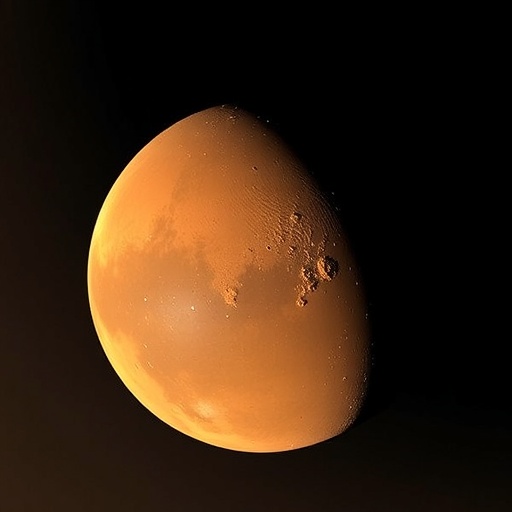
In a groundbreaking advancement in planetary science, data transmitted from NASA’s MAVEN spacecraft orbiting Mars has revealed compelling evidence of the Zwan-Wolf effect, a phenomenon previously thought to exist only above planets with intrinsic magnetic fields. This discovery fundamentally alters our understanding of how solar wind—a relentless stream of charged particles emitted by the sun—interacts with celestial bodies lacking strong magnetospheres, such as Mars. The findings, spearheaded by Christopher Fowler, a planetary scientist at West Virginia University (WVU), unearth new dimensions in solar-planetary interactions and space weather effects on unmagnetized atmospheres.
Mars, unlike Earth, boasts only a patchwork of weak magnetic anomalies instead of a global magnetic field, which makes it an ideal natural laboratory to study solar wind’s behavior in the absence of traditional planetary magnetospheres. MAVEN’s sensitive instruments captured peculiar magnetic signatures during a powerful solar event in December 2023, known as a coronal mass ejection (CME). CMEs are colossal expulsions of magnetized plasma from the sun’s corona, spreading across the solar system and triggering intense solar storms. It was during one such disturbance that researchers detected fluctuations in Mars’ ionosphere consistent with the Zwan-Wolf effect—an electromagnetic phenomenon reliant on the presence of magnetic flux tubes to modulate plasma flow.
The Zwan-Wolf effect, named after scientists J.A. Zwan and R. Wolf who first described it decades ago, involves the “squeezing” of plasma—ionized gases of charged particles—through magnetic flux tubes, which are bundles of aligned magnetic field lines operating as dynamic channels in space. On magnetized planets like Earth, these flux tubes organize the solar wind around the planet, creating a protective magnetic bubble known as the magnetosphere. This containment alters plasma flow densities in critical ways. Until now, this effect was perceived as exclusive to such magnetospheres, but MAVEN’s unprecedented detection demonstrates its presence within the Martian ionosphere, where Mars’s weak fields had been thought insufficient to generate such behavior.
“This is a remarkable revelation,” Fowler remarks. “Identifying the Zwan-Wolf effect within Mars’ atmosphere challenges long-standing assumptions about plasma interactions in space environments devoid of strong global magnetic fields. It expands our horizon in planetary physics and brings to light new mechanisms by which the sun influences planetary atmospheres.” The solar storm’s intensity acted as a natural amplifier, enhancing subtle plasma modulations vital for detecting this elusive effect with MAVEN’s instrumentation.
Solar wind dynamics are complex, as they involve charged particles traveling at supersonic speeds through the near-vacuum of space, governed predominantly by electromagnetic forces rather than collisional interactions typical of fluids on Earth. Fowler draws a vivid analogy: “Imagine a river flowing around a rock—water molecules physically bump and interact with one another, shaping the flow pattern. In the tenuous environs surrounding Mars, however, solar wind particles rarely collide; instead, their trajectories are dictated by electromagnetic fields.” These magnetic interactions can generate intricate plasma structures influencing atmospheric escape and space weathering processes, which are crucial for comprehending Mars’s evolutionary history.
The detection of the Zwan-Wolf effect within the Martian atmosphere holds substantial ramifications for understanding atmospheric erosion mechanisms. Mars is believed to have lost much of its early, thicker atmosphere due to solar wind interactions over billions of years. Discovering that magnetic flux tubes modulate plasma flow even in unmagnetized ionospheres introduces a new piece to the puzzle explaining how solar storms may exacerbate atmospheric stripping. It suggests that during intense solar events, Mars’ atmosphere experiences heightened electromagnetic disturbances, potentially accelerating ion escape into space.
Fowler’s team meticulously analyzed MAVEN data spanning various altitudes, finding the Zwan-Wolf signatures extending to the lowest atmospheric layers sampled. “This implies the effect is not confined to just the upper ionosphere but penetrates deeper,” he explains. How far these magnetic flux tube influences reach into Mars’s atmospheric column remains an open question that future missions and modeling efforts will need to address. Clarifying this vertical extent is essential for refining simulations of Martian atmospheric loss and for planning protective measures for robotic explorers and future human missions on the surface.
The discovery also enriches comparative planetology. Other solar system bodies lacking global magnetic fields, such as cometary comas, Saturn’s moon Titan, and Venus, may host analogous plasma phenomena. By extending our knowledge of the Zwan-Wolf effect beyond classical magnetospheres, researchers can better predict solar wind interactions across a diverse array of planetary environments. This has profound implications for space weather forecasting, satellite protection, and understanding the habitability potential of exoplanets exposed to hostile stellar winds.
MAVEN’s serendipitous observation underscores the critical importance of continuous solar system monitoring during dynamic solar events. Large-scale eruptions on the sun can propagate disturbances across millions of miles, influencing planetary atmospheres and space weather conditions in real time. By capturing the detailed magnetic and plasma parameters during such events, MAVEN provides invaluable data to unravel the subtle electromagnetic processes operating millions of kilometers away from our home star.
Fowler emphasizes the practical stakes of these findings: “Understanding how intense space weather impacts Mars ensures we can safeguard our technological assets in orbit around the planet and prepare for the challenges human explorers will face. Electromagnetic disturbances can damage electronics and compromise communications, so predicting the dynamics of solar wind-plasma interactions is essential.” Protective strategies for surface habitats, rovers, and satellites will hinge on interpreting phenomena like the Zwan-Wolf effect and its atmospheric reach.
This research, published in the esteemed journal Nature Communications on May 18, 2026, not only pioneers a new frontier in space plasma physics but also exemplifies the power of innovative exploration missions like MAVEN. As humanity pushes the boundaries of interplanetary exploration, insights into solar-planet interactions will be pivotal in shaping the future of planetary science and the sustainable presence of humans beyond Earth.
The revelation of Mars hosting the Zwan-Wolf effect in its atmosphere illuminates a transformative narrative in our understanding of the solar system’s dynamics. It serves as a testament to the intricate and often unexpected ways the sun’s influence permeates planetary environments, inspiring continued curiosity and deeper investigation into the delicate balance sustaining planetary atmospheres in the vast expanse of space.
News Publication Date: 18-May-2026
Web References:
https://www.nature.com/articles/s41467-026-72251-9
References:
Christopher Fowler et al., Nature Communications, 2026, DOI: 10.1038/s41467-026-72251-9
Keywords
Mars, MAVEN, Zwan-Wolf effect, solar wind, coronal mass ejection, planetary ionosphere, plasma physics, magnetic flux tubes, space weather, unmagnetized planets, atmospheric escape, space exploration
Cite Scienmag News
Grant Pearson. (May 28, 2026). WVU Researcher Discovers Unexpected Phenomenon in NASA’s Mars Data. Scienmag. https://scienmag.com/wvu-researcher-discovers-unexpected-phenomenon-in-nasas-mars-data/
Grant Pearson. "WVU Researcher Discovers Unexpected Phenomenon in NASA’s Mars Data." Scienmag, 28 May 2026, https://scienmag.com/wvu-researcher-discovers-unexpected-phenomenon-in-nasas-mars-data/. Accessed 3 September 2026.
Grant Pearson. "WVU Researcher Discovers Unexpected Phenomenon in NASA’s Mars Data." Scienmag. May 28, 2026. https://scienmag.com/wvu-researcher-discovers-unexpected-phenomenon-in-nasas-mars-data/


