


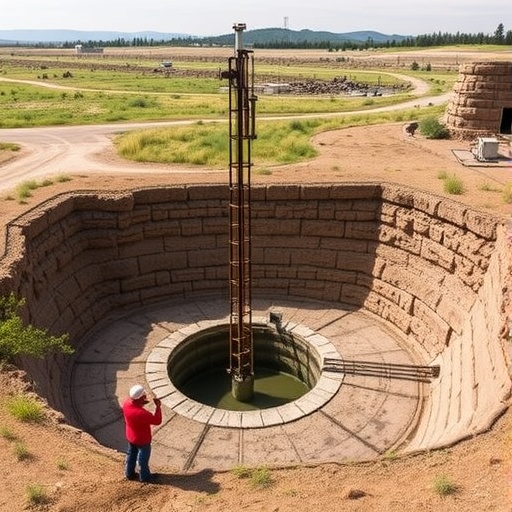
In an ambitious stride toward achieving net-zero emissions, a team of researchers has unveiled groundbreaking insights into repurposing legacy wells across the United States for carbon storage and geothermal energy extraction. The study, recently published in Communications Earth & Environment, leverages advanced screening technologies and novel assessment frameworks to evaluate the viability of these dormant wells not merely as relics of past energy extraction but as pivotal infrastructures in the nation’s transition to sustainable energy.
Legacy wells, often abandoned after their productive lifespan, scatter the geological landscapes of the United States with untapped potential. Traditionally viewed as environmental liabilities due to risks of leakage and contamination, these wells are now being reexamined through the lens of climate-positive applications. The research spearheaded by Rajput, Zhang, and Nie marks a paradigm shift, framing legacy wells as assets that can simultaneously mitigate carbon emissions and harness geothermal heat—a dual opportunity critical to a carbon-constrained future.
Central to the investigation is the detailed screening methodology employed to identify wells with optimum characteristics for secure carbon capture and storage (CCS). Criteria such as geological seal integrity, depth, permeability, and proximity to carbon sources were meticulously analyzed with state-of-the-art seismic and subsurface imaging technologies. This precision vetting ensures the selection of wells with minimal leakage risk, positioning them as safe geological repositories capable of sequestering vast quantities of CO2 underground for centuries.
Complementing the carbon storage potential is the exploration of geothermal energy viability. Many legacy wells reach depths and traverse strata conducive to geothermal gradients that can be exploited for renewable energy. The potential to convert residual heat into power or heating solutions offers an innovative path to integrate renewable generation within existing energy infrastructures. This promising synergy amplifies the wells’ utility, reducing reliance on fossil fuels while providing baseload energy.
The study further contextualizes the nationwide distribution and density of such wells, revealing hotspots ripe for immediate pilot projects. States rich in oil and gas extraction histories, including Texas, Oklahoma, and California, emerge as prime candidates for deploying CCS and geothermal repurposing technologies. The geographic clustering aligns well with industrial CO2 emission centers, creating economically compelling corridors for carbon transport and storage networks.
Addressing the engineering challenges inherent to repurposing legacy wells, the researchers delve into the integrity assessments required to retrofit older well casings and mitigate risks such as leakage pathways or wellbore failures. Innovations in materials science and monitoring technologies enable real-time surveillance of well conditions, reinforcing safety assurances critical for regulatory approval and public acceptance.
Environmental implications are thoroughly examined, emphasizing the dramatic reduction in potential surface disturbances compared to drilling new injection or geothermal wells. Reusing existing wells minimizes ecological footprints, preserves land use, and reduces the carbon cost associated with constructing new infrastructure. This environmental prudence is paramount in aligning energy transition activities with broader sustainability goals.
The policy ramifications of these findings resonate deeply within energy governance circles. The possibility of leveraging existing well infrastructure reduces capital expenditure and accelerates deployment timelines, factors essential for meeting stringent decarbonization deadlines. Moreover, the research underscores the need for updated regulatory frameworks that recognize the dual utility of legacy wells, offering incentives and clear guidance for their repurposing.
Social dimensions are not overlooked, as the study highlights community engagement and economic revitalization opportunities. Regions historically dependent on fossil fuel extraction face uncertain futures; repurposing legacy wells for CCS and geothermal energy can catalyze new industries and jobs, fostering economic resilience amid the energy transition.
Technological advancements detailed within the study showcase integration with digital twin models and machine learning algorithms, which enhance predictive capabilities for well behavior under carbon injection and thermal cycling. These tools afford continuous optimization of operational parameters, maximizing storage efficiency and geothermal energy output while mitigating risks.
The global implications of this research extend beyond U.S. borders, presenting a scalable blueprint for countries rich in legacy hydrocarbon wells. As the world grapples with the urgency of climate change, the ability to repurpose existing subsurface assets rather than initiating extensive new drilling campaigns offers a cost-effective and expedient route to augment low-carbon energy portfolios.
In their comprehensive evaluation, the authors also analyze the economic factors influencing uptake, including carbon pricing scenarios, infrastructure investment, and market mechanisms for carbon credits. Their models suggest that with appropriate financial incentives and policy support, legacy well repurposing could become commercially viable within the next decade, driving significant reductions in national carbon footprints.
Through multidisciplinary collaboration combining geology, engineering, economics, and environmental science, this study represents a pioneering convergence of knowledge aimed squarely at actionable climate solutions. The vision articulated by Rajput and colleagues is clear: legacy wells are not merely remnants of a fossil-fueled past but represent fundamental stepping stones toward a sustainable, net-zero future.
As energy systems evolve, the integration of carbon capture and geothermal technologies into a single platform exemplifies innovative systems thinking. This dual approach not only tackles emissions but also supplies clean energy, embodying the circularity necessary for resilient and adaptive energy infrastructure.
The research community and industry stakeholders alike are poised to build on these findings, accelerating pilot projects and fostering public-private partnerships that can turn the theoretical promise of legacy well repurposing into tangible climate action. The comprehensive data sets and screening tools developed provide a robust foundation for scaling these efforts nationwide.
Ultimately, this trailblazing study redefines legacy wells from environmental concerns into pillars of climate mitigation. It challenges conventional perceptions and unleashes a novel intersection of carbon management and renewable energy, charting a hopeful course as the world races to achieve net-zero emissions by mid-century.
Cite Scienmag News
Violet Maxwell. (May 28, 2026). Legacy Wells Unlock Carbon Storage, Geothermal Potential. Scienmag. https://scienmag.com/legacy-wells-unlock-carbon-storage-geothermal-potential/
Violet Maxwell. "Legacy Wells Unlock Carbon Storage, Geothermal Potential." Scienmag, 28 May 2026, https://scienmag.com/legacy-wells-unlock-carbon-storage-geothermal-potential/. Accessed 6 September 2026.
Violet Maxwell. "Legacy Wells Unlock Carbon Storage, Geothermal Potential." Scienmag. May 28, 2026. https://scienmag.com/legacy-wells-unlock-carbon-storage-geothermal-potential/


