



view more
Credit: Y. Han and X. Han et al., Matter & Light
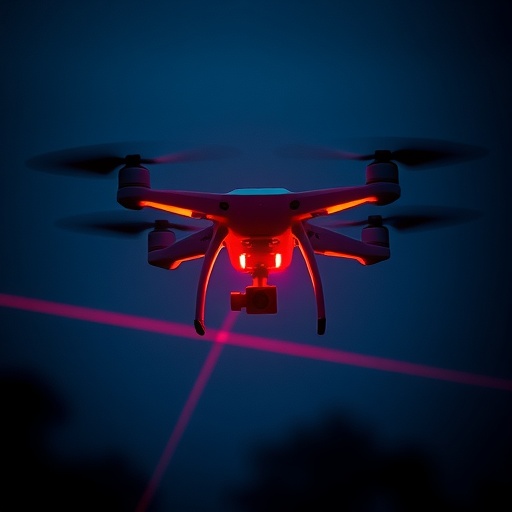
Wireless charging is nothing new for our phones, watches, earbuds, and other tech. Now, researchers want to bring wireless power to the skies—recharging drones mid-flight by beaming a laser under their wings.
Reporting July 29 in the Cell Press journal Matter & Light, researchers engineered a lightweight receiver based on solar cell design that captures energy from a laser beam and turns it into electricity. To keep the device cool, the researchers strategically placed it on the wings of a drone and utilized heat-blocking technology, allowing the receiver to convert more of the laser’s energy into usable power.
“Imagine a future where drones inspecting forests, monitoring disasters, or delivering packages no longer need to land frequently to replace batteries,” says senior author Jianhua Han of Civil Aviation University of China. “As drones take on longer missions, battery life has become one of the biggest barriers.”
The technology relies on a perovskite laser cell-thermoelectric (PLC-TE) tandem device, a type of solar cell optimized for lasers rather than sunlight. The perovskite layer converts laser energy into electricity, while the thermoelectric layer captures energy that would otherwise be lost as heat. The greater the temperature difference between the warmer, laser-facing side and the other, cooler side, the more electricity the thermoelectric layer can generate.
But powerful lasers also heat the device significantly, eroding its efficiency.
“When we tested the device under a high-power laser, the thermal camera showed temperatures of 80 to 90 degrees Celsius,” says Han. “That was much higher than we expected and made us realize that heat buildup was a far more serious problem than we had imagined.”
To keep the device from cooking itself, the researchers embedded specialized nanocrystals into the PLC-TE tandem device. The nanocrystals conduct heat poorly and act as a thermal barrier, slowing the flow of heat and helping the device maintain its performance during prolonged laser exposure. Under a green laser, the system converted 38.49% of the incoming energy into electricity—among the highest efficiencies reported for this class of technology operating under similar conditions.
As a proof of concept, the team also integrated the device beneath the wing of a stationary drone model and carved out air channels through the wing. Shining a green laser on the device successfully powered the model’s propellor blade. Moreover, the airflow further cooled the cold side of the thermoelectric layer, boosting the device’s overall performance.
“Previous studies largely focused on the materials or the device itself,” says Han. “We wanted to think beyond the laboratory, to how the system could actually be integrated into an aircraft, cooled during operation, and made compatible with flight. It isn’t just a materials science problem; it’s an engineering one.”
The device has yet to take flight. Its next test will be aboard a lightweight drone to prove that it can perform reliably outdoors. Researchers will also need to think about how to accurately track moving drones with laser beams and how to ensure the safety of the technology.
“Our work demonstrates the possibility of ‘refueling aircraft with light,’” says Han. “Going from 1 to 100 will require solving many engineering challenges, but we hope this provides a starting point for future development.”
###
This work was supported by funding from the National Natural Science Foundation of China.
Matter & Light, Han et al., “Sb2Se3 nanocrystals enable efficient perovskite-thermoelectric tandem devices for laser-powered unmanned aerial vehicles”
Matter & Light, published by Cell Press, is a journal publishing review articles and research that enhance the understanding of the intricate interactions between light and materials across various scales. The journal aims to advance theoretical understanding of light-matter interactions and push the boundaries of practical applications and technological solutions. To learn more, visit https://www.cell.com/matter-light/home. To receive Cell Press media alerts, please contact press@cell.com.
Journal
Matter & Light
Method of Research
Experimental study
Subject of Research
Not applicable
Article Title
Sb2Se3 nanocrystals enable efficient perovskite-thermoelectric tandem devices for laser-powered unmanned aerial vehicles
Article Publication Date
29-Jul-2026
Julia Grimmett
Cell Press
press@cell.com
Journal
Matter & Light
Method of Research
Experimental study
Subject of Research
Not applicable
Article Title
Sb2Se3 nanocrystals enable efficient perovskite-thermoelectric tandem devices for laser-powered unmanned aerial vehicles
Article Publication Date
29-Jul-2026
Tags
Cite Scienmag News
Denise Maddox. (July 30, 2026). Charging drones mid-flight with lasers. Scienmag. https://scienmag.com/charging-drones-mid-flight-with-lasers/
Denise Maddox. "Charging drones mid-flight with lasers." Scienmag, 30 July 2026, https://scienmag.com/charging-drones-mid-flight-with-lasers/. Accessed 5 September 2026.
Denise Maddox. "Charging drones mid-flight with lasers." Scienmag. July 30, 2026. https://scienmag.com/charging-drones-mid-flight-with-lasers/

