


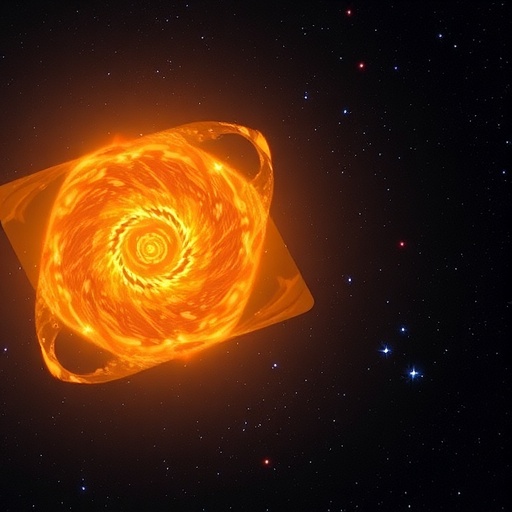
In the vast and enigmatic expanses of the cosmos, the birthplaces of stars are pockets of extraordinary complexity and beauty. These stellar nurseries, known as molecular clouds, are immense, cold aggregations of gas and dust where the seeds of future stars quietly gather. Within these clouds, a remarkable and intricate pattern often emerges: a network of filaments radiating outward like the spokes of a wheel, converging on a dense, luminous hub. These “hub-filament systems” (HFS) have puzzled astronomers for decades, raising central questions about the physical mechanisms behind their formation and their role in star formation.
A groundbreaking study led by researchers from Kyushu University and Nagoya University has unveiled critical insights into the physics governing these striking structures. Using state-of-the-art three-dimensional magnetohydrodynamic simulations run on ATERUI III, the world’s most powerful supercomputer dedicated to astronomy, the scientists have demonstrated how a fast-moving interstellar shockwave interacting with a molecular cloud’s curved magnetic field can naturally give rise to the characteristic hub-and-spoke filamentary patterns that have been a longstanding enigma.
At the heart of this research lies the intricate ballet between magnetic fields, gravitational forces, and shockwaves propagating through a medium of tenuous gas. The molecular cloud, in the initial state, is modeled metaphorically as a “dorayaki,” a traditional Japanese pancake exhibiting a thick center tapering towards thinner edges. Gravity acts inward on the magnetic field embedded within the cloud, pinching it into a distinctive hourglass shape. When a cosmic shockwave—triggered by phenomena such as supernova remnants or the expansion of ionized gas from massive, young stars—collides with this cloud, the interplay of forces gives rise to oblique shocks across different regions of the cloud.
These oblique shocks intensify localized regions of the magnetic field, effectively creating invisible, magnetically guided “channels” that funnel and compress gas along narrow, elongated filaments directed towards the cloud’s dense center. This process was vividly captured in the simulation outcomes, producing filaments remarkably similar in morphology to those observed in space. The dense hub serves as a gravitational well, drawing filamentary gas inward and fostering the conditions ripe for star formation.
Importantly, the simulation revealed that the flow of gas into the central hub is neither uniform nor isotropic. Instead, dense gas streams steadily along these shock-generated filaments, accelerating as it approaches the nexus, whereas the lower-density gas between filaments remains largely stationary. This anisotropic accretion has profound implications for understanding the efficiency of star formation, which has been observed to remain surprisingly low—often less than a few percent—despite the abundance of raw material in molecular clouds.
The study marks a significant advance in decoding the lifecycle of star-forming clouds by elucidating how external shockwaves and internal magnetic geometry shape the formation of proto-stellar environments. It posits that the complex filamentary networks are not merely passive structures but active conduits directing mass flow towards star-forming hubs. This mechanism highlights the pivotal role of magnetic fields and shock interactions in modulating the evolution of molecular clouds and ultimately determining their star-forming potential.
Yet, the researchers acknowledge that the current model focuses on an idealized, symmetric HFS geometry, whereas many observed systems in the galaxy exhibit pronounced asymmetries and irregularities. To deepen the scientific framework, forthcoming studies will systematically vary the parameters governing shock directionality and strength, cloud density distributions, and magnetic field topologies. This comprehensive approach promises to illuminate how different environmental conditions within galaxies influence the birth and clustering of stars, from modest stellar populations to massive, dense clusters.
The broader astrophysical implications of this work also touch on the cyclical nature of star formation. As Dr. Shingo Nozaki, a doctoral student at Kyushu University and lead author of the study, notes, shockwaves themselves stem from stellar birth and death, creating a cosmic feedback loop. Massive stars carve out radiation-driven bubbles that send shock fronts rippling through surrounding gas, while supernova explosions inject energetic disturbances into the interstellar medium. These dynamic processes sculpt the structure of molecular clouds, setting the stage for the next generation of stars to emerge—a celestial dance choreographed by the interplay of gravity, magnetism, and shock physics.
This meticulous investigation not only enhances our understanding of the mechanisms driving molecular cloud fragmentation and star formation but also exemplifies the transformative power of computational astrophysics. By harnessing cutting-edge simulation technology, scientists can probe regions of space and periods in cosmic history inaccessible to direct observation, revealing the underlying physics shaping our universe. The results reported here open new vistas for interpreting a wealth of observational data collected by missions such as the ESA’s Herschel Space Observatory and NASA’s Spitzer Space Telescope, which have captured stunning images of filament networks across star-forming regions.
As the scientific community continues to refine models of hub-filament systems, integrating observational insights with numerical experimentation, the ultimate goal is to forge a comprehensive theory explaining the varied morphologies and efficiencies of star formation across the cosmos. This knowledge holds implications beyond astrophysics, touching on the conditions necessary for planet formation and, by extension, the environments capable of hosting life.
In sum, this pioneering study underscores how the cosmic environment is sculpted by physical processes acting over vast scales and times, where the invisible forces of magnetism and shockwaves play a decisive role in forming the luminous beacons we call stars. It challenges previous simplistic narratives and invites a deeper appreciation of the complexities governing the universe’s ongoing cycle of creation and transformation.
Cite Scienmag News
Grant Pearson. (May 28, 2026). Scientists Reveal How Baby Stars’ Cradles Take on Their Radial Shape. Scienmag. https://scienmag.com/scientists-reveal-how-baby-stars-cradles-take-on-their-radial-shape/
Grant Pearson. "Scientists Reveal How Baby Stars’ Cradles Take on Their Radial Shape." Scienmag, 28 May 2026, https://scienmag.com/scientists-reveal-how-baby-stars-cradles-take-on-their-radial-shape/. Accessed 4 September 2026.
Grant Pearson. "Scientists Reveal How Baby Stars’ Cradles Take on Their Radial Shape." Scienmag. May 28, 2026. https://scienmag.com/scientists-reveal-how-baby-stars-cradles-take-on-their-radial-shape/


