


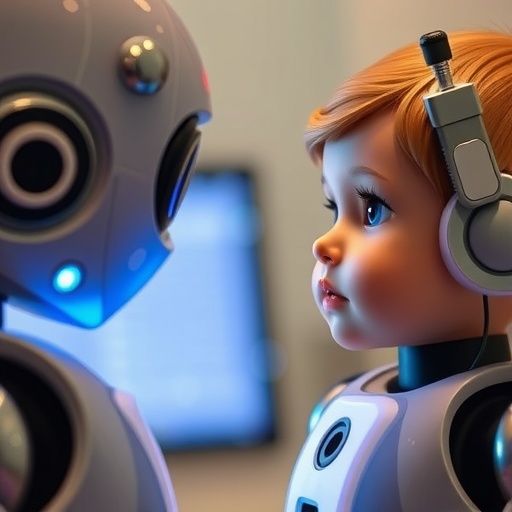
In a groundbreaking study shedding light on early childhood cognitive and social development, researchers have revealed that very young children, even as young as three years old, possess the capacity to interpret human intentions and preferences through subtle eye gaze cues. However, this remarkable perceptual ability does not extend to humanoid robots, despite their increasingly lifelike appearances. Published in the prestigious International Journal of Child-Computer Interaction, this research, spearheaded by Professor Antonella Marchetti of Università Cattolica and the CERITOM Research Center, in collaboration with scholars from Japan and Italy, delves deep into the nuances differentiating human and robotic gaze processing in young minds.
From a developmental psychology standpoint, the capacity to intuit desires, intentions, and preferences through gaze understanding is a cornerstone of early theory of mind development. The study recruited a cohort of Italian children aged 3 to 5 years and engaged them in controlled experimental conditions designed to discern their interpretation of gaze cues. Children were presented with a human agent and a humanoid robot, each gazing at one of several objects. The children were then queried regarding which object they believed the agent preferred, providing a clear metric for understanding gaze-based inference.
The outcomes underscored a profound difference: children consistently accurately inferred preferences when the gaze originated from a human agent. They perceived the human gaze as a meaningful, intentional signal, closely linking the direction of gaze to the agent’s liking of that object. In stark contrast, when the gaze was directed by a humanoid robot—even one exhibiting similar visual cues—children failed to attribute genuine preference or desire based solely on the robotic gaze. This divergence suggests a developmental boundary in how children attribute mental states to artificial agents versus conspecific humans.
Crucially, the experimental results indicate that while human gaze effectively signals preferences, robotic gaze cues alone are insufficient to elicit these inferential processes in children’s minds. This dissociation suggests that children’s social cognition integrates more than mere visual gaze behavior; contextual, reciprocal, and multi-modal interactions likely underpin the attribution of mental states. The robot’s eye movements, devoid of broader social context and shared intentionality, did not activate cognitive mechanisms that ascribe subjective preferences.
Further implications of the study pivot on the understanding that gaze does not necessarily alter a child’s own preferences, human or robotic. Although children use human gaze to gauge what others like, their independent preferences remain largely unaffected by these observations. This subtlety points to a complex cognitive process where recognition of others’ internal states coexists with maintenance of self-driven preferences, a hallmark of sophisticated social cognition development.
Professor Marchetti elaborates on these findings, placing them into the broader landscape of child-robot interactions and artificial intelligence design: “Replicating a single human communicative signal, such as eye gaze, is insufficient to render a humanoid robot truly communicative or socially meaningful in children’s eyes. Effective, developmentally appropriate robotic interfaces must involve richer, more naturalistic interactions that encompass verbal communication, gestures, reciprocity, and shared contextual awareness.”
The research also challenges prevailing narratives surrounding AI and social robotics, emphasizing that language or verbal responses alone do not encapsulate the full spectrum of communication important to children. Embodied artificial intelligence—robots physically integrated into the social environment—is posited as a vital frontier for studying how children ascribe mental states like beliefs, intentions, and desires to technological agents. This focus aligns robotics closely with developmental and psychological sciences, pushing for integrative methodologies that consider cognitive and social processing in children.
Beyond theoretical advancement, these insights have profound practical consequences, especially in therapeutic contexts. Children on the autism spectrum, who often experience difficulties with gaze perception and shared attention, could benefit from tailored robotic interventions. Humanoid robots are increasingly explored as tools in neuropsychomotor and socio-communicative rehabilitation, providing controlled, engaging environments for skill development. Understanding exactly how children perceive robotic gaze as a communicative and intentional signal is pivotal in optimizing these interventions.
From June 2026, this research trajectory will receive a significant boost with the inception of the ROBIN project—ROBot-based Neuropsychomotor INtervention—itself a collaboration between the Don Carlo Gnocchi Foundation and CERITOM. This initiative aims to harness humanoid robotics to enhance imitation skills among young autistic children, focusing heavily on the communicative significance of robot gaze. The project promises to integrate experimental insights directly into applied therapeutic settings, creating more nuanced and developmentally attuned robotic interactions.
The broader dialogue about artificial intelligence and social robotics in childhood underscored by this study urges a paradigm shift. For designers, educators, and psychologists alike, the findings demand that robotic systems intended for children transcend simplistic mimicry. Instead, they must be embedded within dynamic, reciprocal social contexts that mirror the complex, multi-dimensional nature of human communication.
In conclusion, this pioneering study elucidates a fundamental difference in how children interpret communicative signals from humans versus robots. By pinpointing the limitations of robotic gaze as a standalone social cue, the research propels forward the scientific understanding of early social cognition and informs the future design of intelligent, socially-aware robotic companions. The developmental specificity highlighted here forms a crucial foundation for future explorations of embodied AI and fully integrated child-robot social interactions.
Cite Scienmag News
Glenn Wilkins. (May 28, 2026). Children Respond to the Human Gaze but Remain Unmoved by Humanoid Robots, Study Finds. Scienmag. https://scienmag.com/children-respond-to-the-human-gaze-but-remain-unmoved-by-humanoid-robots-study-finds/
Glenn Wilkins. "Children Respond to the Human Gaze but Remain Unmoved by Humanoid Robots, Study Finds." Scienmag, 28 May 2026, https://scienmag.com/children-respond-to-the-human-gaze-but-remain-unmoved-by-humanoid-robots-study-finds/. Accessed 5 September 2026.
Glenn Wilkins. "Children Respond to the Human Gaze but Remain Unmoved by Humanoid Robots, Study Finds." Scienmag. May 28, 2026. https://scienmag.com/children-respond-to-the-human-gaze-but-remain-unmoved-by-humanoid-robots-study-finds/


