


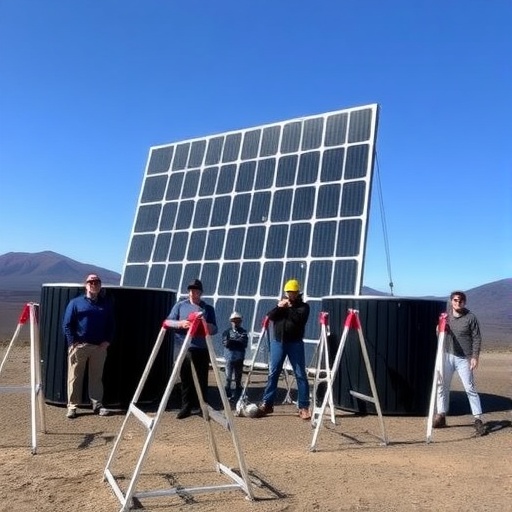
La Palma, Spain — The Cherenkov Telescope Array Observatory (CTAO) is rapidly advancing towards becoming the world’s most extensive and powerful gamma-ray observatory, poised to transform our understanding of the high-energy Universe. On May 28, 2026, a significant milestone was announced at a press conference in Santa Cruz de La Palma, located in the Canary Islands of Spain. The event marked the upcoming inauguration of the first four Large-Sized Telescopes (LSTs) at the CTAO-North site, scheduled for October 15, 2026. This development heralds a new era in gamma-ray astronomy, enabling unprecedented observations of cosmic phenomena at extreme energies.
Gamma-ray astronomy, which probes the Universe in the highest energy regime of electromagnetic radiation, requires highly sensitive and technologically advanced instruments. The CTAO embodies this vision, hosting an array of telescopes designed to detect the faint flashes of Cherenkov light generated when gamma rays interact with Earth’s atmosphere. The LSTs represent the largest class of telescopes within the array, engineered with state-of-the-art optics and detectors to capture the briefest and weakest Cherenkov signals. Their large mirror surface area and sophisticated sensors make them especially adept at observing transient phenomena such as gamma-ray bursts and active galactic nuclei with remarkable time resolution.
The press conference brought together top figures from the CTAO Central Organisation (CTAO ERIC), the LST Collaboration, and local authorities from La Palma, including the Vice-President of the Cabildo de La Palma, Juan Ramón Felipe San Antonio, and the Director of the Instituto de Astrofísica de Canarias (IAC), Valentín Martínez. Their joint participation underscored the collaborative nature of this global scientific venture, which unites more than 10 nations and numerous research institutions. This multinational partnership ensures that CTAO is not only a hub of scientific excellence but also a vector for international collaboration and technology exchange.
La Palma’s role as host of the CTAO-North site owes much to its exceptional atmospheric and geographic conditions. The Roque de los Muchachos Observatory (ORM) benefits from dark skies, minimal atmospheric turbulence, and a legally protected environment that shields it from light pollution and radio interference. These factors create ideal conditions for gamma-ray observations, allowing the LSTs to reach their full potential. Local government officials reaffirmed their unwavering commitment to supporting technological and scientific developments on the island, ensuring that La Palma remains a premier location for cutting-edge astrophysical research.
The LSTs are the product of painstaking design and engineering by over 500 scientists and engineers involved in the LST Collaboration worldwide. These telescopes feature 23-meter diameter mirrors composed of segmented reflectors with ultra-precise alignment systems. Their fast slewing capabilities enable them to rapidly reposition to transient sources, a vital feature for capturing unpredictable cosmic events. The telescope cameras are equipped with high-speed photomultiplier tubes and state-of-the-art electronics, facilitating the detection and digitization of Cherenkov light bursts lasting mere nanoseconds.
Construction of the LSTs not only advances scientific goals but also stimulates the local economy. More than 30 regional companies from La Palma have contributed to this phase, providing specialized components and technical services. The integration of local expertise underscores the socio-economic benefits that accompany large-scale scientific infrastructure projects. Additionally, the CTAO Central Organisation has been recruiting personnel actively on the island, creating skilled job opportunities and nurturing local talent in astrophysics and engineering.
Following the inauguration, the LSTs will undergo rigorous technical validation and calibration tests to ensure their operational readiness. This process includes synchronization with the CTAO-North array and performing joint observations with Medium-Sized Telescopes (MSTs), which will be added subsequently to enhance the observatory’s energy coverage. The integration of different telescope classes allows CTAO to observe gamma rays across several orders of magnitude in energy, from tens of gigaelectronvolts (GeV) up to hundreds of teraelectronvolts (TeV).
The CTAO project exemplifies the forefront of international big science, combining large-scale instrument construction with ambitious scientific goals. Its primary science objectives encompass unraveling key mysteries such as the nature of dark matter, the origin of cosmic rays, and the mechanisms powering extreme astrophysical accelerators. By capturing gamma rays from distant cosmic sources, CTAO will provide insights into physical processes occurring in environments with extreme magnetic fields, high temperatures, and relativistic particle populations.
Outreach and education form a central pillar of the CTAO mission, particularly in engaging the community of La Palma. The Observatory has conducted multiple initiatives, including international schools for doctoral students and vocational training opportunities for local youth. Recent events such as the “Women of CTAO” program demonstrate the project’s commitment to fostering diversity and inclusion in the STEM fields. These efforts cultivate a sense of local pride and involvement, linking advanced scientific endeavors with societal development on the island.
The international CTAO ERIC Council, comprising delegates from various member nations, visited the observatory site following the press conference. The delegation toured the Roque de los Muchachos Observatory and the LST installations, guided by experienced personnel such as CTAO-North Station Manager Patricia Márquez and LST Project Manager Daniel Mazin. Their firsthand exposure to the facilities reinforced the strategic importance of La Palma as a leading center for astroparticle physics research.
Looking ahead, the inauguration of the LSTs marks the beginning of a transformative epoch in gamma-ray astronomy. With the gradual buildup of the full CTAO array, the observatory will open a new observational window to the Universe’s most energetic events, facilitating major discoveries in fundamental physics and astrophysics. Situated atop La Palma’s protected high-altitude sites, CTAO stands ready to unlock secrets of the cosmos while fostering scientific innovation and international cooperation.
As CTAO progresses towards full operation, the scientific community and global stakeholders eagerly anticipate the groundbreaking results that will emerge from this unprecedented facility. The combination of cutting-edge telescope technology, a world-class observational site, and robust international partnership epitomizes the future of astronomical research. With the Large-Sized Telescopes soon operational, the journey into the high-energy Universe has only just begun.
News Publication Date: May 28, 2026
Web References:
- CTAO Organisation Team: https://www.ctao.org/organisation/team/
- CTAO LST Collaboration: https://www.ctao.org/partners/in-kind-contributors/
- Large-Sized Telescopes Overview: https://www.ctao.org/emission-to-discovery/telescopes/lst/
- CTAO North Site Details: https://ctao.org/emission-to-discovery/array-sites/ctao-north/
- CTAO ERIC Governance: https://www.ctao.org/organisation/governance/
- Women of CTAO Event: https://www.ctao.org/news/ctao-and-cabildo-of-la-palma-organise-women-of-ctao-2026/
Keywords
Cherenkov Telescope Array, gamma-ray astronomy, Large-Sized Telescopes, LST Collaboration, Cherenkov radiation, high-energy astrophysics, La Palma, Roque de los Muchachos Observatory, telescope inauguration, cosmic rays, dark matter, international collaboration, astrophysical observatory, gamma-ray bursts, telescope technology
Cite Scienmag News
Grant Pearson. (May 27, 2026). CTAO Progresses Toward Early Science in La Palma with LST Collaboration Unveiling Large-Sized Telescope Sub-Array. Scienmag. https://scienmag.com/ctao-progresses-toward-early-science-in-la-palma-with-lst-collaboration-unveiling-large-sized-telescope-sub-array/
Grant Pearson. "CTAO Progresses Toward Early Science in La Palma with LST Collaboration Unveiling Large-Sized Telescope Sub-Array." Scienmag, 27 May 2026, https://scienmag.com/ctao-progresses-toward-early-science-in-la-palma-with-lst-collaboration-unveiling-large-sized-telescope-sub-array/. Accessed 4 September 2026.
Grant Pearson. "CTAO Progresses Toward Early Science in La Palma with LST Collaboration Unveiling Large-Sized Telescope Sub-Array." Scienmag. May 27, 2026. https://scienmag.com/ctao-progresses-toward-early-science-in-la-palma-with-lst-collaboration-unveiling-large-sized-telescope-sub-array/


