


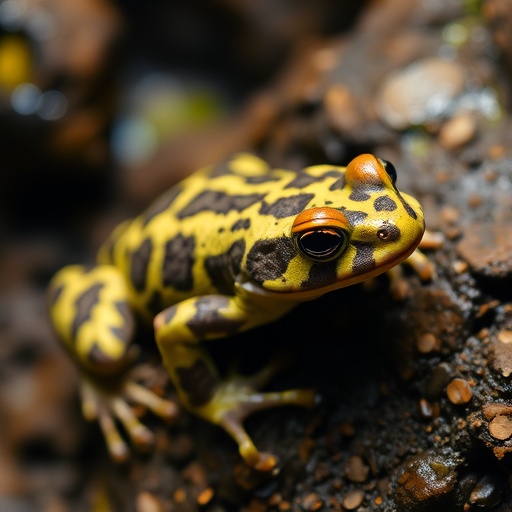
A recent landmark study published in the renowned journal Ecography has shed new light on the complex dynamics governing the diversity of anuran amphibians—frogs and toads—on marine islands worldwide. Despite their global ubiquity, these amphibians face formidable challenges due to their intolerance to saline environments, which renders ocean barriers nearly impassable. This unique biological constraint prompted scientists to investigate how well-established biogeographical theories, traditionally applied to other taxa such as plants, birds, and mammals, hold up when scrutinizing the amphibian populations that inhabit islands separated by saltwater. The research, spearheaded by Raoni Rebouças and Matheus Moroti at the State University of Campinas (IB-UNICAMP), integrates massive global datasets and rigorous ecological modeling to unravel the factors shaping amphibian diversity patterns across thousands of islands with varying sizes, distances from the mainland, and environmental conditions.
Historically, the theory of island biogeography developed by MacArthur and Wilson in the 1960s posited that island size and proximity to a mainland source are critical determinants of species richness. Larger islands closer to continental shores facilitate higher immigration rates and support more sustainable populations, leading to greater species diversity. Conversely, smaller, more isolated islands tend to have diminished species richness due to elevated extinction risks and lower colonization frequency. This dynamic has been successfully validated across many vertebrate and plant groups but had yet to be rigorously tested with amphibians, whose physiological sensitivity to saltwater represents an extreme dispersal limitation.
In parallel, the species-energy theory, formulated by David Wright in the early 1980s, emphasizes the vital role of energy availability—essentially the productivity of organic matter produced within an area—in determining biodiversity. This model proposes that ecosystems endowed with greater energy resources inherently support more individuals and thus a higher number of species, independent of geographic factors such as island size or isolation. The theory suggests that energy availability could be a pivotal driver of community assembly on islands, potentially complementing or even superseding spatial parameters.
By leveraging an unprecedented dataset comprising data from over 5,000 marine islands globally, and information about nearly 2,000 anuran species, the researchers were able to evaluate multiple biodiversity dimensions. Rather than focusing solely on species richness, they extended their analysis to include functional diversity—the variety of ecological roles such as terrestrial, arboreal, aquatic, or fossorial lifestyles—and phylogenetic diversity, which measures the evolutionary distinctness and lineage breadth within amphibian communities on these islands. This multidimensional approach reveals a more nuanced and ecologically relevant picture than taxonomy alone could provide.
A key insight from the study is the revelation that neither island biogeography nor species-energy theory alone can sufficiently explain the patterns of amphibian diversity observed. Instead, these theories operate in a complementary fashion, with their relative influence varying according to climatic zone and the specific aspect of biodiversity considered. For example, in tropical regions, island size strongly correlates with both species and phylogenetic richness, underscoring the classical biogeographical principle. However, in temperate zones, represented by places such as Greenland, this correlation weakens markedly, highlighting the overriding limitation of low energy availability in colder climates.
Functional diversity, as examined across all sampled islands, reveals a strong dependence on climatic factors, especially in temperate zones where environmental harshness constrains the range of viable ecological niches. In contrast, tropical regions boast broader niche diversity, reducing the relative influence of climate on functional diversity metrics. This suggests that energy productivity and climate interact intricately to sculpt the ecological fabric of amphibian communities, influencing their ability to occupy diverse habitat types and functional roles.
Moreover, the study elucidates that productivity, operationalized as the rate of organic matter generation per unit area, is a crucial determinant for supporting viable populations on islands irrespective of their size or distance from the mainland. This immediately becomes evident with Greenland and Borneo—the former, a vast icy expanse with minimal productivity, supports no frog species, while the latter, a tropical biodiversity hotspot, harbors more than 400 amphibian species. These contrasting cases epitomize the interplay between energy availability and spatial constraints.
Importantly, the research underscores the need to consider evolutionary history in biodiversity assessments. High species counts do not automatically equate to high evolutionary or functional diversity. Island populations may consist of numerous species closely related within a single lineage, limiting genetic and adaptive variation. Contrarily, an island with fewer species but spanning multiple evolutionary branches can represent a more robust and functionally varied assemblage. Such insights redefine conservation priorities by highlighting the value of preserving evolutionary lineages and functional roles, beyond mere species tallying.
The methodological strength of this research is amplified by its global scale and the integration of diverse data types, spanning geospatial, climatic, and phylogenetic datasets. Such a comprehensive approach opens avenues for fine-grained analyses, including the assessment of historical biogeographic factors and influences of non-marine island types, such as riverine islands. Incorporating these variables could enhance our understanding of amphibian assemblage formation and resilience in complex insular systems.
Looking forward, the authors advocate for expanding research frameworks to encompass temporal dynamics—how past climatic and geomorphological shifts shaped current biodiversity distributions—and to scrutinize waterbody extents and connectivity on islands. Doing so may unravel hidden corridors or refugia that facilitate amphibian persistence and diversification despite oceanic barriers. Additionally, this knowledge has practical implications for conservation biology, particularly for designing protected areas and managing invasive species on islands where amphibians are both vulnerable and ecologically vital.
By reconciling long-standing ecological theories with modern data analysis applied rigorously in a globally impactful context, this study not only advances theoretical ecology but also informs pragmatic conservation efforts. It vividly illustrates the intricate dance of spatial, climatic, and evolutionary forces that sculpt biodiversity, especially for sensitive taxa like amphibians constrained by their physiological limits. Such insights are invaluable as islands worldwide face escalating anthropogenic pressures and climate-induced transformations, threatening the very fabric of their unique ecosystems.
This transformative research was made possible through generous funding from the São Paulo Research Foundation (FAPESP), underlining the significance of sustained investment in biodiversity science. Collaborative international efforts and open data integration will be critical to advance the frontier of island biogeography and to safeguard amphibian diversity as a cornerstone of global ecological resilience.
News Publication Date: 26-Feb-2026
Web References:
Cite Scienmag News
Margaret Porter. (May 27, 2026). New Study Reveals Key Factors Influencing Amphibian Species Richness on Marine Islands. Scienmag. https://scienmag.com/new-study-reveals-key-factors-influencing-amphibian-species-richness-on-marine-islands/
Margaret Porter. "New Study Reveals Key Factors Influencing Amphibian Species Richness on Marine Islands." Scienmag, 27 May 2026, https://scienmag.com/new-study-reveals-key-factors-influencing-amphibian-species-richness-on-marine-islands/. Accessed 3 September 2026.
Margaret Porter. "New Study Reveals Key Factors Influencing Amphibian Species Richness on Marine Islands." Scienmag. May 27, 2026. https://scienmag.com/new-study-reveals-key-factors-influencing-amphibian-species-richness-on-marine-islands/


