


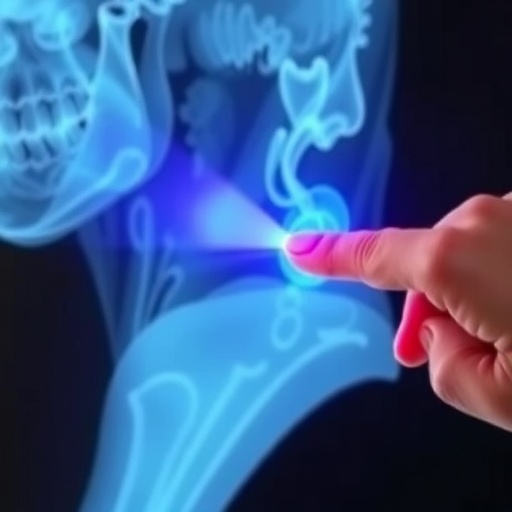
In a groundbreaking advancement poised to transform medical imaging and diagnostic practices, researchers have unveiled a novel glass-based scintillator that significantly enhances X-ray resolution while drastically reducing radiation exposure. This innovative development, documented in a recent publication in ACS Energy Letters, introduces a new paradigm in translating X-rays into visible light, delivering high-definition images with minimal radiation. This advancement holds the promise of safer, more comfortable diagnostic procedures, particularly in fields such as mammography, where patient discomfort and radiation dose have been longstanding hurdles.
X-ray technology has been indispensable across numerous sectors, from medical diagnostics and airport security scans to materials science. The fundamental operation hinges on capturing X-rays that pass through objects and converting them into visible light images for analysis. Traditionally, this conversion occurs via scintillators—materials that intercept X-rays and emit light. However, conventional scintillators often demand higher radiation doses to achieve the desired image clarity, posing potential health risks in medical applications. The new research pivots around engineering a scintillator glass that not only amplifies efficiency but also introduces flexibility and adaptability unprecedented in current technologies.
The team, led by Osman Bakr and Mehmet Bayindir, has engineered a ‘quantum glass’ scintillator by integrating nanoclusters composed of copper, iodine, and a specially designed organic ligand into a glass matrix. This hybrid composition situates itself at the intersection between molecular structures and nanocrystals, optimizing the X-ray to visible light conversion with exceptional efficiency. The meticulous bottom-up design approach allows the scintillator to maintain the rigid imaging capabilities of traditional crystals while bestowing it with the malleability typical of plastics. This dual nature enables the formation of curved screens, a revolutionary feature that could dramatically improve diagnostic tools requiring conformed shapes to human anatomy.
Technically, the enhanced conversion efficiency of the nanocluster glass scintillator means that diagnostic details can now be captured even under significantly lower radiation doses, directly addressing major concerns in repeated and early-stage screening procedures. The researchers demonstrated this by capturing extraordinarily detailed X-ray images of a memory card’s internal structure and a tiny insect, revealing nuances that conventional imaging materials generally miss. Such high-resolution imaging at lower doses points toward applications beyond healthcare into security scanners and industrial non-destructive testing.
One of the most striking achievements of this new scintillator is its performance in aquatic environments, where water typically hampers X-ray penetration and image clarity. Tests involving underwater X-ray imaging of a fish’s tail confirmed that the quantum glass scintillator maintains image quality comparable to that obtained in air. This feature broadens the potential applications for underwater diagnostics and biological studies, ushering in new possibilities across scientific disciplines.
The material’s physical properties further contribute to its versatility. Upon heating to a moderate temperature of approximately 42 degrees Celsius (107 degrees Fahrenheit), the glass transitions to a rubbery state, facilitating the molding of curved surfaces without sacrificing image quality. This pliability can substantially alleviate the discomfort associated with rigid flat-panel mammography machines, which require breast compression to obtain clear images, often causing significant patient anxiety. By adapting to anatomical shapes, these curved X-ray screens could promote a more patient-friendly imaging experience and potentially increase screening adherence.
Such enhancements are critical because they align with an overarching goal: to encourage more frequent and earlier cancer screenings by mitigating the physical and radiological barriers that currently dissuade patients. Lower radiation exposure reduces cumulative health risks, while ergonomic improvements reduce psychological and physical discomfort. The researchers envision that their quantum glass scintillators could catalyze a shift in standard medical imaging protocols, facilitating safer, more accessible early detection strategies.
From a materials science perspective, the innovation exploits the unique properties of nanoclusters, which bridge the gap between discrete molecules and bulk nanocrystals. This allows more precise tunability of optical properties and scintillation efficiency. The organic-inorganic hybrid framework not only optimizes luminescence but also ensures compatibility with existing manufacturing processes, potentially easing the integration of these scintillators into current imaging devices.
Moreover, the ability to maintain high-resolution imaging at low radiation doses could have significant implications for pediatric imaging, where radiation minimization is paramount. The technology might enable frequent monitoring of congenital conditions or treatment responses without exposing young patients to high cumulative radiation levels. Beyond medicine, the durability and adaptability of these glass screens promise advancements in industrial inspection settings where materials must be examined without damage or exposure to harmful ionizing radiation.
The research was notably facilitated by support from the Alexander von Humboldt Foundation and the King Abdullah University of Science and Technology (KAUST), underscoring the collaborative effort and multidisciplinary expertise that converged to achieve this breakthrough. Among the researchers, one author’s affiliation with Quantum Solutions—a company specializing in quantum-dot-based imaging systems—signals an active path toward commercializing these findings, potentially accelerating the dissemination of this technology in clinical and industrial environments.
In summary, this advancement in quantum glass scintillators represents a critical leap forward in X-ray imaging technology. By enabling superior resolution with less radiation and adding physical flexibility, it offers transformative potential for numerous applications, chiefly in healthcare diagnostics. As these materials progress from laboratory research to real-world deployment, they promise to redefine the standards of medical imaging, making procedures safer, more effective, and notably more comfortable for patients worldwide.
News Publication Date: 27-May-2026
Web References: 10.1021/acsenergylett.6c00958
Keywords
X-ray imaging, scintillator, quantum glass, nanoclusters, radiation reduction, mammography, flexible screens, nanomaterials, medical diagnostics, underwater imaging, copper iodine clusters, ACS Energy Letters
Cite Scienmag News
Ophelia Keating. (May 27, 2026). Enhancing X-ray Clarity While Reducing Radiation Exposure. Scienmag. https://scienmag.com/enhancing-x-ray-clarity-while-reducing-radiation-exposure/
Ophelia Keating. "Enhancing X-ray Clarity While Reducing Radiation Exposure." Scienmag, 27 May 2026, https://scienmag.com/enhancing-x-ray-clarity-while-reducing-radiation-exposure/. Accessed 3 September 2026.
Ophelia Keating. "Enhancing X-ray Clarity While Reducing Radiation Exposure." Scienmag. May 27, 2026. https://scienmag.com/enhancing-x-ray-clarity-while-reducing-radiation-exposure/


