


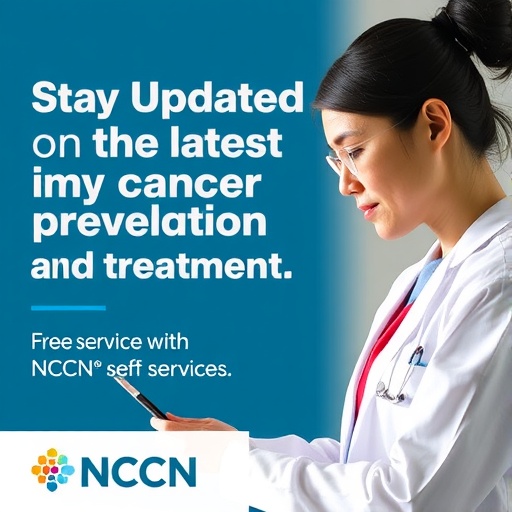
In a pivotal advancement for oncology practice and cancer care, the National Comprehensive Cancer Network® (NCCN®), an esteemed consortium of premier cancer centers, has launched an innovative, no-cost weekly email service designed to relay the latest updates to their Clinical Practice Guidelines in Oncology (NCCN Guidelines®). Recognized globally as the gold standard for evidence-based, expert consensus-driven cancer treatment recommendations, these guidelines are now more accessible than ever before for clinicians, researchers, and all stakeholders engaged in cancer care.
The release of this service addresses a critical demand in oncology: the need for timely, precise dissemination of rapidly evolving clinical guidance to healthcare providers. Cancer treatment paradigms continuously shift as new data emerge from clinical trials, translational research, and real-world evidence. By enabling weekly updates, the NCCN ensures that medical professionals can dynamically incorporate the most current therapeutic strategies, diagnostic criteria, and supportive care measures at the point of care, thereby optimizing patient outcomes.
From breast to hematologic malignancies, lung cancers to rare tumors, the NCCN Guidelines encompass comprehensive recommendations across 91 distinct guidelines. These guidelines extend beyond therapeutic protocols to include prevention, screening modalities, and tailored considerations for specific patient populations with unique needs. The newly implemented email service compiles these weekly amendments, providing subscribers with direct, granular access to the exact pages within the clinical guidelines where modifications have occurred. This targeted approach mitigates the challenge of sifting through voluminous documentation and facilitates a sharper focus on practice-changing updates.
Crystal S. Denlinger, MD, NCCN’s Chief Executive Officer, articulated the strategic intent behind the service: ensuring that the NCCN Guidelines maintain their hallmark status as the most frequently and rigorously updated clinical standards in oncology. She emphasized that while prior subscription models offered daily content alerts across derivative NCCN products, this new, free weekly distribution specifically targets guideline content that directly impacts patient management, enhancing the immediacy and usability for clinicians actively engaged in cancer care.
The service’s utility is magnified in light of the global reach and broad user base of NCCN Guidelines, which recorded over 18 million downloads in the preceding year alone. Users range from oncologists and primary care providers to patients, caregivers, payors, and health information technology developers. Renuka Iyer, MD, Chief Medical Officer at NCCN, highlighted the importance of equitable and efficient access to the latest evidence. She notes that timely updates empower shared decision-making processes between patients and providers, bolstering patient-centered care and informed consent, which are critical for achieving optimal health outcomes.
Subscribers to the weekly updates receive succinct summaries of guideline modifications, accompanied by direct hyperlinks to the updated sections. This level of granularity not only promotes accuracy but also aids in clinical workflow integration, thereby supporting rapid translation of evidence into practice. Although access to the full guidelines requires a complimentary registration, the NCCN site ensures that the barriers to information acquisition remain minimal, fostering widespread adoption.
Complementing this weekly briefing is the longstanding NCCN Flash Updates™ subscription, a paid service delivering daily notifications on new or revised information spanning the entire spectrum of NCCN resources. These include not only the core clinical guidelines but also the NCCN Guidelines Navigator™, evidence blocks, and specialized compendia covering drugs, biomarkers, chemotherapy templates, imaging criteria, radiation therapy, and patient-focused guidelines and translations. This comprehensive resource ecosystem supports multidisciplinary teams by covering diverse facets of oncology care, from granular molecular insights to broad policy frameworks.
The NCCN’s steadfast commitment to regularly updating clinical practice guidelines reflects the dynamic nature of oncology as a discipline grounded in continuous scientific discovery. Indeed, the complexity of cancer biology, the heterogeneity of disease phenotypes, and the advent of personalized medicine demand agile, evidence-reflective guidelines. These guidelines synthesize high-quality randomized controlled trial data, meta-analyses, and expert consensus to provide actionable recommendations tailored by cancer type, stage, patient comorbidities, and emerging biomarkers.
Moreover, the NCCN Guidelines play a critical role beyond clinical management by informing healthcare policy, reimbursement decisions, and clinical trial design. Their authoritative status influences oncological standards globally, with adaptations and translations that promote international applicability. The integration of patient-centered guidelines further enriches this impact by enhancing health literacy and engagement, thereby fostering shared decision-making frameworks essential in contemporary oncology.
This new weekly updates service exemplifies how digital innovation and thoughtful content dissemination strategies can bridge knowledge gaps in fast-evolving medical fields. It is poised to become an indispensable tool for healthcare providers striving to maintain clinical excellence amid the accelerating pace of cancer research. As the landscape of oncology continues to evolve with breakthroughs in immunotherapy, targeted treatments, and supportive care interventions, such timely, accessible guidance will be crucial in translating scientific progress into tangible patient benefits.
Clinicians, researchers, and cancer care stakeholders are encouraged to subscribe to the NCCN Guidelines Weekly Updates via NCCN.org/updates to receive these curated, up-to-date content alerts enhancing the precision and quality of cancer treatment worldwide.
Cite Scienmag News
Nathaniel Bowman. (May 27, 2026). Stay Updated on the Latest Advances in Cancer Prevention and Treatment with NCCN’s Free Service. Scienmag. https://scienmag.com/stay-updated-on-the-latest-advances-in-cancer-prevention-and-treatment-with-nccns-free-service/
Nathaniel Bowman. "Stay Updated on the Latest Advances in Cancer Prevention and Treatment with NCCN’s Free Service." Scienmag, 27 May 2026, https://scienmag.com/stay-updated-on-the-latest-advances-in-cancer-prevention-and-treatment-with-nccns-free-service/. Accessed 3 September 2026.
Nathaniel Bowman. "Stay Updated on the Latest Advances in Cancer Prevention and Treatment with NCCN’s Free Service." Scienmag. May 27, 2026. https://scienmag.com/stay-updated-on-the-latest-advances-in-cancer-prevention-and-treatment-with-nccns-free-service/


