


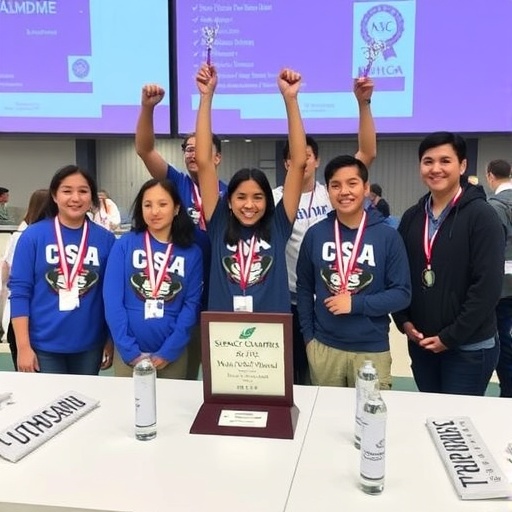
In a thrilling display of scientific rigor and innovation, the 42nd Annual Science Olympiad National Tournament convened at the University of Southern California on May 23, 2026, culminating in unprecedented victories for Monta Vista High School from Cupertino, California, and Sierra Vista Middle School from Irvine, California. Monta Vista High seized the coveted Division C National Champion title, underscoring its ascendancy in STEM education, while Sierra Vista Middle School achieved a consecutive championship, reinforcing its dominance in junior high scientific competition. This event, a pinnacle of nationwide STEM contests, attracted 120 elite teams emerging from rigorous state competitions, each embodying the exceptional but diverse scientific talent permeating American classrooms today.
The Science Olympiad National Tournament is renowned not only for the breadth of topics covered but also for its formidable array of hands-on and laboratory challenges. These competitions span an interdisciplinary spectrum that includes engineering, physics, epidemiology, and advanced robotics, emphasizing the practical application of theoretical knowledge. Experts from diverse sectors—including government agencies such as NASA, premier academic institutions, and industry leaders—collaborate to create a curriculum that tests participants’ problem-solving skills, adaptability, and depth of scientific understanding. This convergence of academia and industry ensures that the tournament remains state-of-the-art in its curriculum, reflecting contemporary scientific challenges and technologies.
Central to the event’s prestige is the collaboration with the University of Southern California, whose esteemed faculty contributes significantly to both the intellectual rigor and hosting logistics. USC Dean James Bullock delivered a compelling keynote address, sharing insights gleaned from his experience with the James Webb Space Telescope project, a landmark endeavor that has revolutionized astrophysics. His speech underscored the critical nexus between educational initiatives like Science Olympiad and frontier research, inspiring the next generation to envision themselves as pioneers in STEM fields. Dean Yannis C. Yortsos of the USC Viterbi School of Engineering also welcomed participants, emphasizing engineering’s transformative role in scientific advancements.
The competitive structure highlights the high school (Division C) and middle school (Division B) distinctions, with Monta Vista High School claiming the top spot among high schools. Following closely were schools with strong STEM pedigrees such as Seven Lakes High School in Texas and Troy High School in California, institutions known for nurturing scientific inquiry and technological innovation. For middle schools, Sierra Vista’s back-to-back victories establish a benchmark of excellence, with schools like Solon Middle School and Basis Cedar Park demonstrating formidable scientific acumen. These results reflect geographic diversity and demonstrate widespread investment in STEM education across the United States.
Beyond competition, the Science Olympiad spirit is embodied in awards recognizing sportsmanship, teamwork, and ethical engagement. The 2026 Spirit Award acknowledged Alston Ridge Middle School and Deering High School, honoring their exemplary demonstration of collaboration and respect—a testament to the organization’s holistic approach to scientific education that values character alongside intellectual achievement. This ethos encourages sustained participation and fosters a community where innovation thrives in an environment of mutual support.
Integral to fostering long-term STEM careers, the Science Olympiad USA Foundation awarded five Founders’ Scholarships, each valued at $10,000, to exemplary high school seniors who excel not only academically but display remarkable initiative in scientific endeavors. These scholarships serve as critical support for students transitioning from high school to higher education, reinforcing the pipeline of talent essential for the nation’s scientific leadership. Recipients hail from various specialized institutions, including Tesla STEM High School in Washington and West Michigan Aviation Academy, highlighting the broad spectrum of specialized STEM education.
The tournament also illustrates a commitment to social responsibility through its partnership with the American Red Cross Los Angeles Region. Their Smart to Be Good initiative mobilizes youth towards philanthropic efforts, leveraging Scientific Olympiad’s platform to encourage volunteerism and community service. The funds raised underpin vital relief efforts addressing environmental crises such as the Eaton and Palisades wildfires, demonstrating how scientific communities can effectively contribute to societal resilience and disaster response.
Sponsorships and partnerships play a pivotal role in sustaining the Science Olympiad’s expansive reach and impact. The initiative is backed by a formidable constellation of organizations including NASA’s Universe of Learning, the United States Air Force, Google, and the Cleveland-Cliffs Foundation, reflecting widespread recognition of STEM education’s importance. Industry leaders contribute resources and expertise that guarantee cutting-edge content and support infrastructure required for this nationwide endeavor. The presence of academic and corporate stakeholders exemplifies a synergistic collaboration critical to advancing STEM education infrastructure.
The competitions span a rich gamut of scientific disciplines. Events challenge students to design and build structures and devices under precise constraints, understand complex biological systems and epidemiology models, and master computational tasks such as coding and robotics engineering. The diversity of these challenges cultivates a multi-dimensional scientific literacy, preparing students to navigate and innovate across the increasingly interdisciplinary domains that characterize modern science and technology careers.
Technical rigor defines the Science Olympiad experience. Events such as the “Disease Detectives” challenge require mastery in epidemiological methods, including data collection, hypothesis formulation, and statistical analysis under time constraints. Engineering challenges demand comprehensive knowledge of physics principles, material science, and mechanical design, pushing students to solve practical problems such as bridge construction or vehicle propulsion using limited resources. This hands-on learning modality eschews rote memorization in favor of experiential understanding, mirroring real-world scientific problem-solving.
Notably, the tournament advances educational equity by including an extensive range of schools across varying geographic regions and community types, promoting accessibility to high-caliber STEM competitions. This national inclusivity enhances the diversity of scientific thought and innovation and counteracts the concentration of STEM opportunities in traditionally advantaged areas. By providing platforms for underrepresented regions and students, Science Olympiad is cultivating a broader base of STEM talent, essential for future scientific and technological advancement.
The University of Southern California’s involvement is emblematic of academia’s critical role in enabling transformative educational experiences. Hosting the event at USC facilitates exposure to leading research environments and resources, expanding participants’ horizons beyond the competition. The university’s multidisciplinary faculties and state-of-the-art facilities offer a unique backdrop that reinforces the conference’s theme of bridging education and cutting-edge scientific exploration.
Science Olympiad’s multifaceted approach demonstrates the powerful synergy of competition, scholarship, mentorship, and community engagement in nurturing scientific excellence. The 2026 tournament not only highlighted outstanding student achievement but also advanced the broader goal of cultivating a scientifically literate, innovative, and socially conscious generation. As the competition’s alumni progress into professional STEM fields, they will carry forward lessons in collaboration, ethical integrity, and scientific curiosity that are foundational to addressing the complex challenges of the modern world.
Cite Scienmag News
Courtney Benton. (May 26, 2026). California Triumph: Monta Vista High and Sierra Vista Middle Dominate 42nd Annual Science Olympiad National Tournament. Scienmag. https://scienmag.com/california-triumph-monta-vista-high-and-sierra-vista-middle-dominate-42nd-annual-science-olympiad-national-tournament/
Courtney Benton. "California Triumph: Monta Vista High and Sierra Vista Middle Dominate 42nd Annual Science Olympiad National Tournament." Scienmag, 26 May 2026, https://scienmag.com/california-triumph-monta-vista-high-and-sierra-vista-middle-dominate-42nd-annual-science-olympiad-national-tournament/. Accessed 3 September 2026.
Courtney Benton. "California Triumph: Monta Vista High and Sierra Vista Middle Dominate 42nd Annual Science Olympiad National Tournament." Scienmag. May 26, 2026. https://scienmag.com/california-triumph-monta-vista-high-and-sierra-vista-middle-dominate-42nd-annual-science-olympiad-national-tournament/


