


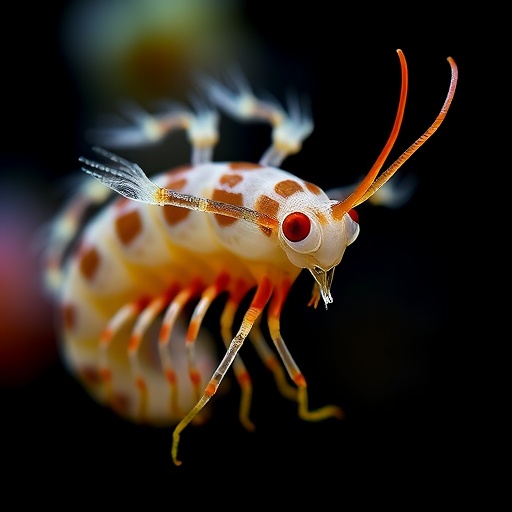
For over four decades, vast collections of marine amphipod records scattered across Italian waters have remained largely unexplored and unpublished. This concealed trove of biodiversity data has now been meticulously gathered and harmonized in a landmark study published in the Biodiversity Data Journal. Spearheaded by researchers at the University of Palermo, this work represents a pioneering effort to unlock the full potential of previously inaccessible datasets, bringing to light a detailed inventory of amphipod species across the Mediterranean basin defined by Italy’s coastal expanse.
Crustaceans known as amphipods might be diminutive in size, usually measuring just a few millimeters, yet their ecological footprint is significant. Acting as crucial detritivores and intermediaries in marine food webs, amphipods recycle organic material, promote nutrient cycling, and sustain populations of larger predators such as fish, seabirds, and marine mammals. Despite their ubiquity and ecological significance, comprehensive knowledge regarding their spatial distribution has been historically fragmented and incomplete, limiting understanding of Mediterranean marine ecosystem health and resilience.
The research team consolidated 4,344 newly digitized and georeferenced records spanning from 1980 to 2025, an achievement born from a collaborative network encompassing Italian universities, governmental environmental bodies, and specialized research institutions. Employing the FAIR principles — ensuring data is Findable, Accessible, Interoperable, and Reusable — the study injects much-needed transparency and accessibility into marine biodiversity knowledge, setting a precedent for future integrative biodiversity assessments.
Through this unprecedented dataset, researchers identified 302 distinct amphipod species dwelling across the diverse marine biomes of the Adriatic, Tyrrhenian, and Ionian Seas. Strikingly, the Tyrrhenian Sea emerges as a nexus of taxonomic richness, hosting 258 species, an insight that redefines previously held assumptions about Mediterranean biodiversity hotspots. Meanwhile, the Adriatic Sea’s preeminence in historical sampling intensity accounts for its dominance in specimen records, illustrating how scientific effort shapes our perception of biodiversity.
Non-indigenous species detection within these records underscores rapid environmental flux triggered by globalization and human activities. Eleven alien amphipod species predominantly inhabit ports, coastal lagoons like the Venice Lagoon, and aquaculture setups, highlighting points of anthropogenic impact facilitating biological invasions. This distribution reflects the emerging challenges posed by maritime traffic, global trade, and aquaculture practices, all acting as vectors for species translocation with potential to destabilize native ecosystems.
The timing of intensified collecting efforts over the past decade coincides with the implementation of European Union environmental frameworks, notably the Marine Strategy Framework Directive. Such policies have galvanized systematic monitoring, leading to an exponential rise in available biodiversity data, thereby unveiling glaring knowledge gaps from prior decades. Researchers emphasize how this surge reaffirms the crucial importance of integrating historical and contemporary data to form a coherent ecological picture.
Prof. Sabrina Lo Brutto, lead coordinator at the University of Palermo’s Department of Earth and Sea Sciences, highlights the strategic significance of the study for conservation science. Detailed, reliable species distribution maps derived from harmonized data are foundational for tracking biodiversity loss amid global change. Without such comprehensive inventories, conservation strategies are handicapped, vulnerable habitats remain unidentified, and the cumulative effects of environmental stressors elude effective management.
Beyond contributing to national biodiversity knowledge, this work synergizes with broader European and global conservation goals, including the ambitious initiative to protect 30% of terrestrial and marine ecosystems by 2030. The dataset serves as an essential baseline against which future monitoring can measure ecological responses to climate change, pollution, habitat alteration, and invasive species dynamics, thereby informing adaptive marine spatial planning and policy formulation.
The technical rigor applied in standardizing and georeferencing diverse legacy datasets into a unified repository through the Global Biodiversity Information Facility (GBIF) further exemplifies a paradigm shift in open science. This movement champions maximum data transparency, cross-institutional collaboration, and technological interoperability, all imperative to overcoming traditional barriers that confine valuable ecological data within siloed institutions.
From a methodological standpoint, the study’s comprehensive approach to synthesis involved meticulous validation to correct historical misidentifications and taxonomic inconsistencies, often pervasive in legacy data. By rectifying these errors, the researchers fortified the dataset’s scientific reliability, enhancing its utility for downstream ecological modeling, biodiversity assessments, and environmental management applications.
The revelation that amphipods can act as sensitive bioindicators amplifies the practical value of the dataset. Due to their rapid response to environmental alterations — including pollution, temperature fluctuations, and habitat degradation — amphipod presence and distribution patterns provide nuanced insights into ecosystem health. Consequently, monitoring these crustaceans could enhance early warning systems and inform targeted mitigation strategies in vulnerable Mediterranean marine habitats.
Looking forward, the study sets a precedent that data unlocking and sharing initiatives can revolutionize biodiversity research globally. The authors advocate for similar mobilization of overlooked datasets from other taxa and geographical regions, envisioning an integrated, accessible framework of marine life inventories that underpin sustainable ocean stewardship amid escalating environmental challenges.
In sum, this research exemplifies the latent power embedded within historic biodiversity records and the transformative impact of open science frameworks. Through collective efforts, the marine amphipod fauna of Italian waters is now illuminated with unprecedented clarity, bolstering conservation science and advancing our stewardship of Mediterranean marine ecosystems on the cusp of accelerating global change.
News Publication Date: 30 April 2026
Web References:
https://doi.org/10.3897/BDJ.14.e189256
https://bdj.pensoft.net/
References:
Badalucco A, Auriemma R, Balistreri P, Baratti M, Bonifazi A, Capillo G, et al. (2026) A contribution to the inventory of marine amphipod species from Italian waters based on unpublished sources and FAIR principles. Biodiversity Data Journal 14: e189256. https://doi.org/10.3897/BDJ.14.e189256
Cite Scienmag News
Violet Maxwell. (May 25, 2026). Four Decades of Hidden Data Uncover Amphipod Diversity in Italian Seas. Scienmag. https://scienmag.com/four-decades-of-hidden-data-uncover-amphipod-diversity-in-italian-seas/
Violet Maxwell. "Four Decades of Hidden Data Uncover Amphipod Diversity in Italian Seas." Scienmag, 25 May 2026, https://scienmag.com/four-decades-of-hidden-data-uncover-amphipod-diversity-in-italian-seas/. Accessed 4 September 2026.
Violet Maxwell. "Four Decades of Hidden Data Uncover Amphipod Diversity in Italian Seas." Scienmag. May 25, 2026. https://scienmag.com/four-decades-of-hidden-data-uncover-amphipod-diversity-in-italian-seas/


