


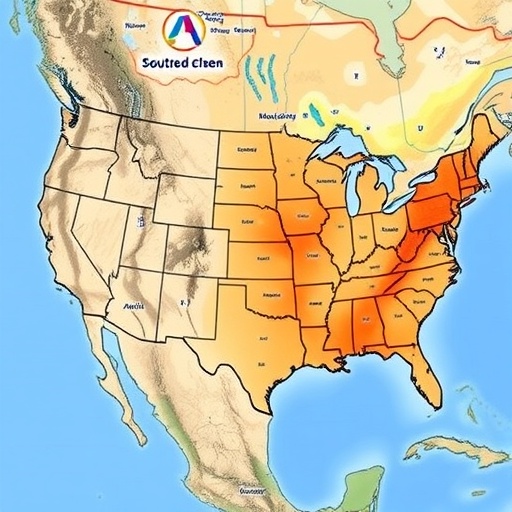
As drought conditions reach historic levels across the United States, wildlife in the American West is experiencing profound ecological stress. A recent comprehensive study led by researchers from the University of Michigan has illuminated the scale and severity of drought’s impact on large mammals inhabiting the southwestern states, specifically Utah and Nevada. This research not only quantifies habitat reductions but also reveals declines in fitness and reproductive success across diverse species, shedding light on the cascading consequences of climate-induced aridity.
The study leverages a robust dataset compiled over 12 years, involving GPS collar tracking of over 3,000 individual animals including mule deer, black bears, and cougars—representing herbivores, omnivores, and carnivores respectively. Through spatial and temporal analyses of habitat selection, the researchers determined that severe drought conditions resulted in at least a 10% contraction in the highly suitable habitat range for each species. This substantial shrinkage portends alarming challenges for the survival and persistence of these mammals as drought frequencies and intensities escalate due to climate change.
At a mechanistic level, the research underscores how drought stress reduces vegetation availability, thus impacting herbivores like mule deer directly by limiting forage resources. The resultant habitat loss impairs feeding efficacy and nutritional intake, exacerbating physiological and reproductive strain. Correspondingly, the decline in mule deer fertility is marked by a 30% reduction in fawn production per doe during extreme drought, highlighting severe fitness consequences. Such reproductive bottlenecks threaten the long-term stability of herbivore populations central to the ecosystem.
Interestingly, the study finds that effects intensify higher up the trophic ladder. Black bears exhibit a 14% reduction in suitable habitat area, while cougars face an 18% decline. This amplification is attributed to the indirect effects of herbivore scarcity, which constrains predator foraging opportunities. Cougars, as obligate carnivores reliant on prey availability, encounter increased energetic costs and limited hunting success under drought stress. This trophic sensitivity magnifies population vulnerabilities, illustrating intricate food web dynamics under climate perturbations.
These findings challenge initial assumptions that herbivores would be the most impacted by vegetation loss. Instead, the pronounced impacts on apex predators like cougars reveal systemic vulnerabilities that could destabilize entire ecological communities. The relatively smaller cougar populations and their higher trophic position mean that losses at the individual level translate rapidly to population and community declines, with potential cascading effects on ecosystem functioning and biodiversity.
Crucially, this research highlights the interconnectivity between climate dynamics, wildlife ecology, and conservation management. The observed interplay of drought with habitat suitability, fitness metrics, and species interactions indicates that traditional management approaches—often species-specific and narrowly focused—may be inadequate amid escalating climate challenges. There is now a pressing need to integrate landscape-level planning that recognizes the compound effects of climate extremes, vegetation shifts, and wildlife behavior.
The study also stresses the value of long-term ecological monitoring and big data integration, having synthesized vast amounts of information from disparate sources. GPS telemetry enabled precise tracking of animal movements and habitat use over extensive geographic ranges and years. Such datasets provide unparalleled insights into how fluctuating environmental conditions impact wildlife populations across spatial and temporal scales, forming a critical knowledge base for adaptive management strategies.
Moreover, the work carries broader implications for conservation policy. As drought conditions worsen on a warming planet, wildlife vulnerability is projected to increase. The research suggests that coordinated efforts addressing both human and wildlife vulnerability to climate change could yield synergistic benefits, yet currently robust planning predominantly focuses on human adaptation. Bridging this gap by incorporating wildlife conservation into climate resilience frameworks emerges as an urgent challenge.
This comprehensive evaluation presents a compelling call to action for scientists, resource managers, and policymakers alike. By demonstrating that drought effects permeate multiple levels of ecosystem structure and function, the study encourages rethinking how climate impacts are assessed and mitigated in wildlife conservation. Interdisciplinary collaboration and integrative management approaches appear paramount to sustain biodiversity and ecosystem health amid rapidly shifting climatic baselines.
In summary, the unprecedented drought conditions in the American West are not only reshaping landscapes but radically transforming animal habitats and their capacity to sustain viable populations. From the decline in suitable herbivore grazing grounds to the constricted hunting territories for predators, the evidence shows a multidimensional crisis triggered by climate extremes. Future research and conservation efforts must grapple with these complexities to safeguard the intricate web of life dependent on these vulnerable ecosystems.
The study’s revelations have profound implications beyond the regional scale, providing a model for understanding climate-driven habitat changes across various ecosystems globally. As such, it reinforces the urgency to integrate cutting-edge technological tools, long-term ecological data, and interdisciplinary expertise to craft resilient conservation strategies in the Anthropocene era.
This investigation, published in the journal Communications Earth and Environment, embodies a significant advancement in ecological climate research by merging species-specific fitness metrics with habitat modeling under real-world drought scenarios. Its pioneering approach and striking findings position it as a critical resource for future efforts to balance human needs with ecological integrity in an era of rapid environmental change.
News Publication Date: 25-May-2026
Web References:
- DOI: 10.1038/s43247-026-03530-y
- University of Michigan Institute for Global Change Biology: https://iws.org/staff-directory/kirby-mills
- University of Michigan School for Environment and Sustainability: https://seas.umich.edu/
- University of Quebec at Chicoutimi: https://portfolio.uqac.ca/martinleclerc/
References:
M. Leclerc et al. (2026). Extreme droughts shrink suitable habitats and reduce fitness for large mammals in the American West. Communications Earth and Environment. DOI: 10.1038/s43247-026-03530-y
Cite Scienmag News
Margaret Porter. (May 25, 2026). Southwest Drought Reduces Habitats Suitable for Wildlife. Scienmag. https://scienmag.com/southwest-drought-reduces-habitats-suitable-for-wildlife/
Margaret Porter. "Southwest Drought Reduces Habitats Suitable for Wildlife." Scienmag, 25 May 2026, https://scienmag.com/southwest-drought-reduces-habitats-suitable-for-wildlife/. Accessed 3 September 2026.
Margaret Porter. "Southwest Drought Reduces Habitats Suitable for Wildlife." Scienmag. May 25, 2026. https://scienmag.com/southwest-drought-reduces-habitats-suitable-for-wildlife/


