


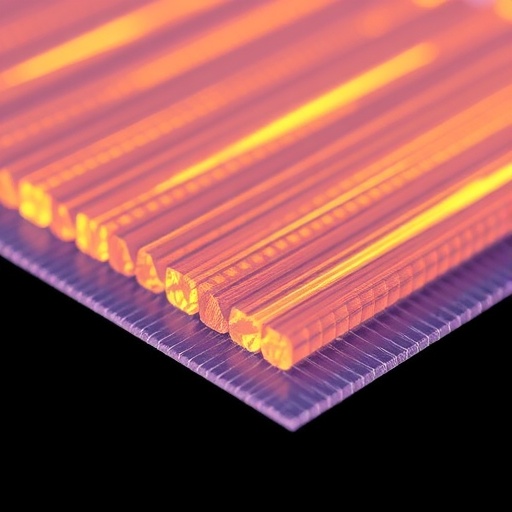
In a transformative breakthrough slated to redefine the landscape of flexible electronics, researchers led by Lee, J., Luong, T.T., Her, N., and colleagues have unveiled a revolutionary method titled “Cladding-free thermal drawing for scalable reel-to-reel manufacturing of piezoelectric coaxial polyvinylidene fluoride fibers.” This innovative technique promises to accelerate the production of high-performance piezoelectric fibers, an advancement poised to catalyze next-generation wearable technologies, soft robotics, and advanced energy harvesting systems.
Piezoelectric materials have long been recognized for their ability to convert mechanical stress into electrical signals, making them indispensable in a wide array of sensing and actuation applications. However, fabricating such materials in fiber form at commercial scales has remained an elusive challenge due to manufacturing complexities and material limitations. The research team addressed this bottleneck by pioneering a cladding-free thermal drawing approach, diverging from conventional methods reliant on rigid protective cladding layers which often impair flexibility and scalability.
At its core, the technique leverages the inherent properties of polyvinylidene fluoride (PVDF), a polymer known for its excellent piezoelectricity, flexibility, and chemical resistance. Through a meticulous thermal drawing process, the team engineered coaxial PVDF fibers that eschew protective cladding, drastically simplifying the fiber architecture without sacrificing mechanical durability or electrical performance. This seamless coaxial geometry enhances the fibers’ piezoelectric response by optimizing the alignment and density of β-phase PVDF crystals essential for piezoelectricity.
What sets this method apart is its compatibility with reel-to-reel manufacturing, a high-throughput fabrication modality that enables continuous production of fibers over extended lengths. This scalability not only reduces production costs but also opens pathways for mass deployment in commercial applications. Unlike previous batch-based processes, the cladding-free thermal drawing allows real-time, consistent control over fiber dimensions and properties, ensuring reproducibility and uniformity critical for industrial viability.
The authors delve into the thermal dynamics governing the drawing process, emphasizing precise temperature profiles that maintain PVDF’s molecular orientation and crystallinity. By carefully tuning heating zones and drawing speeds, the method preserves the structural integrity of the polymer while inducing the piezoelectrically favorable β-phase. This sophisticated thermal management prevents degradation and phase transitions that typically plague conventional fiber fabrication methods.
Mechanically, the coaxial fibers exhibit remarkable flexibility and tensile strength, attributes vital for integration into wearable devices that endure repeated bending and stretching. The absence of cladding layers eliminates potential delamination or mechanical mismatches, enhancing the fibers’ robustness during dynamic use. Electrical characterization reveals enhanced piezoelectric coefficients, validating the superior electromechanical coupling achieved through their novel architecture.
The research also addresses the environmental stability of the fibers, confirming their resistance to humidity, temperature fluctuations, and chemical exposure – parameters essential for real-world deployment. This resilience further augments their appeal for applications ranging from biomedical sensors that contact skin to energy harvesters operating in harsh conditions.
Crucially, the study provides comprehensive insights into the fiber drawing apparatus, detailing how the integration of a controlled preform heating system and synchronized take-up rollers facilitate continuous reel-to-reel operation. This setup embodies an industrially feasible platform adaptable to diverse polymer systems beyond PVDF, suggesting a broad impact on the flexible electronics manufacturing domain.
Additionally, the coaxial design enables multifunctionality; fibers can simultaneously act as sensors and energy harvesters, converting mechanical motion into usable electrical energy to power embedded electronics. Such dual-functionality is a leap toward self-powered electronics, reducing dependence on external power sources and enabling autonomous devices.
While the researchers primarily focus on piezoelectric applications, they acknowledge the broader implications of their thermal drawing technique. The ability to produce polymer fibers with tailored architectures in a scalable manner could accelerate innovations in areas like optoelectronics, bioelectronics, and smart textiles, where the seamless integration of electronic functionalities into flexible substrates is increasingly vital.
From a commercial standpoint, the scalability and cost-effectiveness of the cladding-free thermal drawing method could democratize access to high-performance piezoelectric fibers. This democratization aligns with industry trends favoring flexible, lightweight, and wearable systems, potentially catalyzing a new wave of consumer and industrial products embedded with sophisticated sensing and actuation capabilities.
As the demand for flexible electronics surges, driven by the proliferation of Internet-of-Things devices and wearable health monitors, innovations like this stand at the forefront. This research not only addresses the fabrication challenge but also enhances the functional properties of piezoelectric fibers, suggesting improved device performance and longevity.
Looking forward, the team envisions integrating these fibers into complex sensor arrays and smart fabrics, envisioning ecosystems where mechanical energy from motion or environmental vibrations can be harvested and monitored simultaneously. The potential to weave these fibers into textiles or implantable devices heralds a future where electronics are unobtrusive, seamlessly embedded into everyday life.
Moreover, future research directions highlighted by the authors include exploring variant polymer systems, hybrid material integration, and advanced functionalization techniques. Such endeavors will likely extend the applicability and performance boundaries of thermally drawn piezoelectric fibers, fostering innovation across multiple technological domains.
In conclusion, this pioneering cladding-free thermal drawing technique represents a significant leap in the scalable manufacturing of piezoelectric coaxial PVDF fibers. By elegantly combining material science, thermal engineering, and industrial processing, the research propels the field closer to realizing flexible, high-performance, and affordable piezoelectric fiber-based devices. As these fibers find their way into commercial production lines, the ripple effects across electronics, healthcare, energy, and manufacturing domains promise to be profound and enduring.
Cite Scienmag News
Denise Maddox. (May 21, 2026). Scalable Cladding-Free Thermal Drawn Piezoelectric Fibers. Scienmag. https://scienmag.com/scalable-cladding-free-thermal-drawn-piezoelectric-fibers/
Denise Maddox. "Scalable Cladding-Free Thermal Drawn Piezoelectric Fibers." Scienmag, 21 May 2026, https://scienmag.com/scalable-cladding-free-thermal-drawn-piezoelectric-fibers/. Accessed 4 September 2026.
Denise Maddox. "Scalable Cladding-Free Thermal Drawn Piezoelectric Fibers." Scienmag. May 21, 2026. https://scienmag.com/scalable-cladding-free-thermal-drawn-piezoelectric-fibers/


