


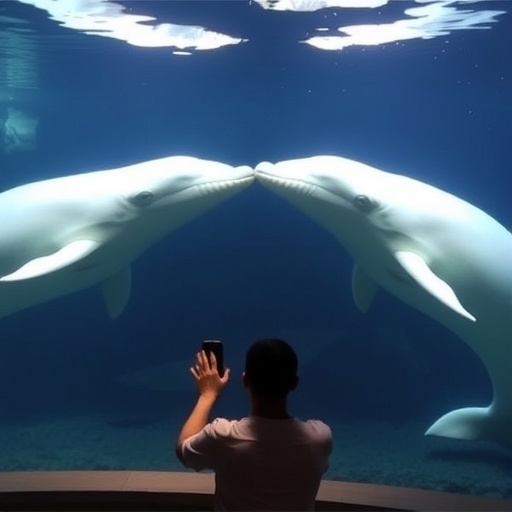
In an extraordinary case study that challenges long-held perceptions of animal cognition, researchers have uncovered compelling evidence suggesting that beluga whales (Delphinapterus leucas) demonstrate the ability to recognize themselves in mirrors. This groundbreaking discovery potentially marks the first documented instance of mirror self-recognition (MSR) within this species, adding them to the exclusive list of animals exhibiting this sophisticated cognitive behavior.
Mirror self-recognition, often considered a hallmark of self-awareness, has been predominantly observed in a small subset of animals, including great apes, elephants, and certain dolphin species. Historically, the presence of MSR has been interpreted as an indicator of higher cognitive functions—such as complex social behaviors and an understanding of the self as distinct from the environment. The new findings, derived from controlled studies involving captive belugas exposed to their mirrored images, elevate these marine mammals into this cognitively elite cadre, prompting a reevaluation of their intellectual and social capacities.
The methodology behind this study incorporated a series of controlled behavioral observations, whereby beluga whales were presented with mirror stimuli in their enclosures. Researchers meticulously recorded and analyzed the animals’ interactions with their reflections, noting behaviors consistent with self-exploration rather than social response to what might otherwise be perceived as another individual. Unlike typical social reactions such as aggression or curiosity directed at conspecifics, the belugas engaged in intricate body postures and movements aimed specifically at parts of their bodies otherwise unseen without the aid of a reflective surface.
Critical to confirming true MSR was the implementation of the “mark test,” a classic experimental protocol used to ascertain self-recognition. In this procedure, a mark is placed on a part of the animal’s body that can only be seen via a mirror. The subject’s response to this mark—whether the animal attempts to investigate or touch the mark in front of the mirror—serves as compelling evidence of self-awareness. The belugas exhibited deliberate and consistent examination of these marked body areas in front of the mirror, behaviors unlikely to be explained by mere curiosity or accidental motions.
From a neuroscientific perspective, these behavioral indicators open fascinating avenues for investigating the cognitive architecture enabling MSR in belugas. The beluga brain is renowned for its large size and complex structure, particularly its highly developed neocortex and limbic system. These regions are associated with executive functions, emotional processing, and social cognition. The presence of MSR further underscores the sophisticated neural mechanisms potentially underlying episodic memory, problem-solving skills, and a form of introspective consciousness in these marine mammals.
This research also invites a broader discussion about the evolution of self-recognition across species and ecological niches. Understanding why and how certain species develop this ability can shed light on the selective pressures and social structures that favor such cognitive traits. Belugas, often referred to as the “canaries of the sea” due to their varied vocalizations, demonstrate complex social interactions in the wild. The newfound evidence of MSR suggests that their cognitive sophistication extends beyond communication to include a nuanced self-concept crucial for social cohesion and environmental adaptability.
Furthermore, these findings bear significant implications for conservation strategies and the ethical treatment of beluga whales. Recognizing the presence of self-awareness necessitates a reassessment of human interactions with these animals, particularly in captivity and industrialized marine settings. Policies that consider their complex cognitive and emotional lives may lead to enhanced welfare standards, ensuring enriched environments that promote natural behaviors and psychological well-being.
The study’s publication in PLOS ONE, an open-access scientific journal, ensures that these insights are widely disseminated, fostering interdisciplinary engagement among marine biologists, cognitive scientists, and conservationists. Though the authors report no specific funding for this work, the implications of their research resonate across diverse fields, sparking new hypotheses and experimental designs aimed at exploring consciousness in non-human animals.
Of particular note is the absence of any competing interests declared by the researchers, reflecting a commitment to unbiased scientific inquiry. Such transparency fortifies the credibility of these pioneering conclusions and sets a positive precedent for future explorations into animal cognition using rigorous experimental frameworks.
In the context of marine mammal research, this discovery aligns with a growing body of evidence revealing advanced mental processes in cetaceans. Dolphins have long been recognized for their intelligence, but extending these cognitive attributes to belugas not only expands the spectrum of recognized intelligent species but also enriches our understanding of the diversity and complexity of cognitive evolution in aquatic mammals.
As scientific interest intensifies in exploring the depth of animal minds, the beluga whale’s demonstrated capacity for self-recognition challenges anthropocentric views of consciousness and compels society to appreciate the sentience residing beneath the ocean’s surface. It serves as a testament to the intricate relationships between brain structure, environmental adaptation, and social behavior that shape the cognition of species inhabiting radically different domains from humans.
Ultimately, this study invites readers and researchers alike to reconsider the boundaries of self-awareness. By transcending traditional species barriers, it contributes to a broader narrative recognizing intelligence as a multifaceted phenomenon expressed through diverse evolutionary paths. The beluga whale, through its reflection in a mirror, not only sees an image but possibly perceives itself—a revelation with profound implications for science and ethics alike.
News Publication Date: 20-May-2026
Web References: http://dx.doi.org/10.1371/journal.pone.0348287
Cite Scienmag News
Violet Maxwell. (May 20, 2026). Beluga Whales Show Signs of Mirror Self-Recognition in Captivity, Study Finds. Scienmag. https://scienmag.com/beluga-whales-show-signs-of-mirror-self-recognition-in-captivity-study-finds/
Violet Maxwell. "Beluga Whales Show Signs of Mirror Self-Recognition in Captivity, Study Finds." Scienmag, 20 May 2026, https://scienmag.com/beluga-whales-show-signs-of-mirror-self-recognition-in-captivity-study-finds/. Accessed 3 September 2026.
Violet Maxwell. "Beluga Whales Show Signs of Mirror Self-Recognition in Captivity, Study Finds." Scienmag. May 20, 2026. https://scienmag.com/beluga-whales-show-signs-of-mirror-self-recognition-in-captivity-study-finds/


