


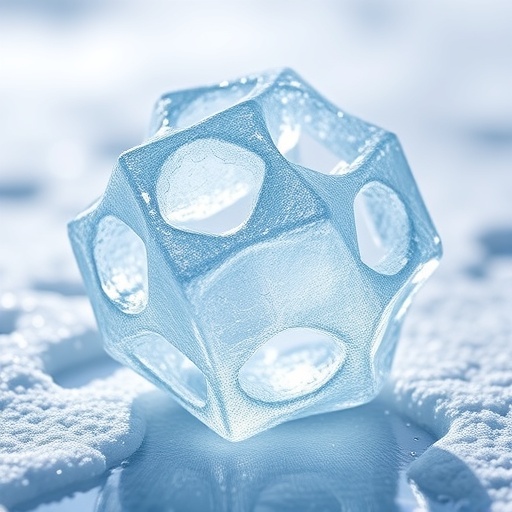
In an unprecedented discovery that intertwines microbiology, materials science, and atmospheric chemistry, researchers have revealed how bacteria-derived ice-nucleating proteins (INPs) can promote ice formation on a broad array of surfaces, including synthetic materials. This breakthrough, stemming from an inquiry into the mechanisms by which specific bacteria catalyze freezing processes, offers transformative potential for advancing technologies in cryopreservation, deicing, and bioinspired material design.
The focus of this investigation is Pseudomonas syringae, a plant-affecting bacterium native to regions spanning the Middle East to beyond, known for its unique ability to initiate ice crystallization. These bacteria possess ice-nucleating proteins that serve as biological ice templates, capable of ordering water molecules into crystalline arrays at temperatures significantly higher than water’s standard freezing point. The natural function of INPs is well-documented on organic substrates like plant cell membranes, but the question remained: could these proteins perform similarly on abiotic, human-made materials?
Addressing this gap, an interdisciplinary team of scientists from Aarhus University in Denmark and Oregon State University applied sophisticated photoelectron spectroscopy techniques to analyze how INPs adhere to and orient themselves on hydrophilic and hydrophobic surfaces. Their findings defy conventional expectations. Instead of necessitating complex chemical mimicry of native environments, the INPs demonstrated a surprising indifference toward the chemical nature of the substrate, adhering tightly and in an organized monolayer to both natural and artificial surfaces.
This affinity results in the proteins laying out with their ice-nucleating face directed outward, strategically positioning themselves to facilitate ice formation atop the substratum. According to Tobias Weidner, one of the primary authors, the propensity of proteins to maintain functional configuration on synthetic surfaces is traditionally low, as many proteins lose structural integrity outside their biological context. The observed stability and functional preservation of truncated versions of INPs on diverse materials present a paradigm shift in protein-surface interactions.
The implications of the proteins’ robust surface-binding behavior reach far beyond academic curiosity. Typically, engineers and scientists face arduous challenges when attempting to immobilize functional proteins on non-biological surfaces, often resorting to elaborate bioengineering techniques to approximate biological conditions artificially. INPs circumvent these hurdles by inherently adhering and organizing, poised for ice nucleation without the need for tedious surface modification or genetic engineering.
By leveraging truncated INPs, which are easier and less costly to produce without compromising functionality, the researchers have paved the way for scalable applications. These fragments have maintained efficacy, yet the team is eager to probe the performance of full-length INPs in future experiments. If full INPs outperform their shortened counterparts on artificial surfaces, this could unlock new frontiers in the design of anti-icing coatings, artificial snow generation systems, and cryogenic tools.
Understanding the molecular orchestration behind ice nucleation is not merely a scientific pursuit but an environmental and technological imperative. The formation of ice is a crucial factor influencing weather patterns, agriculture, and infrastructure. Nature’s ice nucleators like Pseudomonas syringae bacteria contribute to precipitation cycles, with their proteins acting as nucleation sites in clouds, affecting everything from storm development to the global water cycle. Astonishingly, these bacteria have been traced across the globe, from their original habitats in the Middle East to precipitating hailstones in West Africa and driving weather events as far as California.
By elucidating the binding mechanisms and orientation of INPs on various surfaces, the study provides a vital molecular blueprint. The orientation of these proteins, with their functional ice-nucleating domains exposed, maximizes their efficiency. This organized alignment is critical since disordered or random attachment would impede their nucleating function. Thus, the nature of the binding and the uniformity in protein layer thickness are just as essential as the presence of the proteins themselves.
The technical methods employed in this analysis relied heavily on photoelectron spectroscopies, allowing the researchers to probe the elemental and chemical compositions of the protein layers on different substrates. Through these measurements, they quantified coverage, thickness, and molecular arrangement, confirming consistent results irrespective of the hydrophobic or hydrophilic character of the surfaces under study.
These insights herald a new era in bioinspired material sciences where biological molecules can be deployed straightforwardly, retaining their native activities when interfaced with synthetic environments. Potentially, surfaces can be functionalized through passive adsorption of INPs, bypassing the need for extensive chemical treatments or complex fabrication methodologies. This opens avenues in cryo-medicine for targeted freezing, preservation of biological samples, and the mitigation of ice-related hazards on aircraft wings, power lines, and wind turbines.
Future research avenues are ripe with possibilities. Beyond scaling up production and testing the full INP variants, investigations into the long-term stability, environmental durability, and potential customization of these proteins could enhance their utility. The ability to engineer bespoke ice-nucleating surfaces tailored for specific industries—from agriculture protection against frost to enhancing artificial snow in ski resorts—could revolutionize current technologies.
The discovery underscores the profound utility of studying natural phenomena for technological innovation. Harnessing bacterial proteins’ intrinsic properties, originally evolved for survival and ecological functions, offers elegant solutions to complex human engineering challenges. This convergence of biology and materials science invites a reconsideration of surface chemistry paradigms and motivates interdisciplinary collaboration in an era demanding sustainable and efficient technologies.
As the global climate evolves and infrastructures face increasing ice-related stresses, the advent of materials and coatings designed with ice-nucleating proteins could provide adaptive, bio-mimicking responses to mitigate damage and enhance performance. This research not only deepens our understanding of microbial influence on weather but also seeds the future of smart, biologically inspired materials engineered for a frozen world.
News Publication Date: 19-May-2026
Web References: https://doi.org/10.1116/6.0005223
Cite Scienmag News
Ophelia Keating. (May 19, 2026). Ice-forming proteins spark innovative ‘cool’ technologies. Scienmag. https://scienmag.com/ice-forming-proteins-spark-innovative-cool-technologies/
Ophelia Keating. "Ice-forming proteins spark innovative ‘cool’ technologies." Scienmag, 19 May 2026, https://scienmag.com/ice-forming-proteins-spark-innovative-cool-technologies/. Accessed 3 September 2026.
Ophelia Keating. "Ice-forming proteins spark innovative ‘cool’ technologies." Scienmag. May 19, 2026. https://scienmag.com/ice-forming-proteins-spark-innovative-cool-technologies/


