


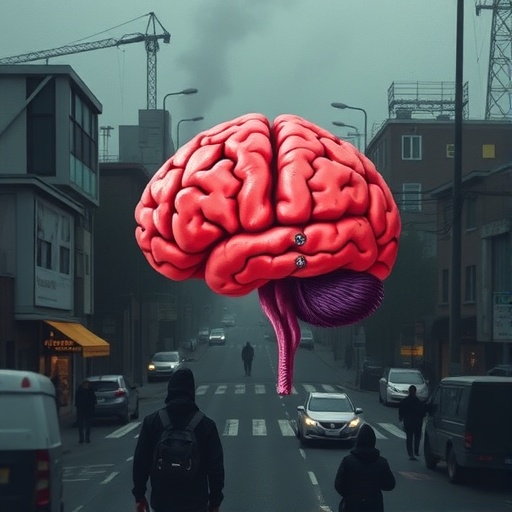
In a groundbreaking study published in Translational Psychiatry, a team of researchers led by Liang, Roeckner, Ely, and colleagues meticulously unravels the complex interplay between residential segregation, ambient air pollution, and the structural characteristics of the hippocampus in individuals who have recently endured traumatic experiences. This investigation ventures beyond traditional social determinants of health to reveal how environmental and societal factors converge at the neural level, particularly impacting a brain region critical for memory and stress regulation.
The hippocampus, a central structure deeply embedded in the brain’s temporal lobe, plays a pivotal role in encoding memories, spatial navigation, and emotional regulation. Its integrity is often compromised in psychiatric conditions such as post-traumatic stress disorder (PTSD), depression, and anxiety. Understanding the factors that influence hippocampal morphology is crucial for deciphering the neurobiological sequelae of trauma. This study uniquely integrates environmental injustice and neuroimaging modalities to illuminate the underappreciated role of community-level air quality and segregation in shaping brain health after trauma.
Residential segregation—the physical and social separation of groups into distinct neighborhoods—continues to drive disparities in exposure to harmful environmental agents, including air pollutants like particulate matter (PM2.5) and nitrogen dioxide (NO2). These pollutants are well-documented neurotoxicants known to provoke systemic inflammation, oxidative stress, and vascular dysfunction, which can collectively degrade neural tissue integrity. By coupling geospatial analyses of segregation indices with precise measurements of air pollution concentrations, the study constructs a detailed environmental profile for each trauma survivor participant.
Crucially, the research team employed high-resolution magnetic resonance imaging (MRI) techniques to extract quantitative metrics of hippocampal volume, shape, and subfield architectures. This level of granularity allowed them to detect subtle yet significant variations in hippocampal morphology that may underlie divergent psychological outcomes post-trauma. The neuroimaging data were rigorously analyzed alongside sociodemographic variables and clinical assessments, enabling a multifaceted understanding of risk factors moderating trauma recovery trajectories.
The results demonstrate a compelling association between higher levels of residential segregation and greater exposure to ambient air pollution, which jointly correlate with alterations in hippocampal structure. Specifically, individuals residing in highly segregated, pollution-intensive neighborhoods exhibit reduced hippocampal volume and aberrant morphometric features, independent of other risk factors. Such neural perturbations may amplify vulnerability to stress-related disorders by impairing the hippocampus’s regulatory control over the hypothalamic-pituitary-adrenal (HPA) axis, thereby exacerbating maladaptive stress responses.
Importantly, this study pioneers a model that contextualizes neurobiological risk within a broader framework of social and environmental determinants, advancing our understanding of how systemic inequities translate into tangible brain changes. Findings imply that mitigating residential segregation and improving air quality are not merely urban planning or public health imperatives but are intimately connected to preserving mental health and resilience in trauma-exposed populations.
The implications extend beyond academic circles, underscoring policy considerations focused on environmental justice. Targeted interventions that address residential segregation-induced disparities in pollutant exposure could attenuate the neurobiological burden experienced by marginalized communities. Furthermore, these insights advocate for integrative trauma treatment paradigms that incorporate environmental context as a dimension influencing patient outcomes.
Methodologically, the study’s strength lies in its rigorous control for confounders, including socioeconomic status, age, gender, and baseline health indicators, ensuring that the observed neuroanatomical changes are robustly linked to environmental variables rather than demographic noise. The longitudinal design, tracking biomarker and clinical changes over time, enriches the reliability of causal inferences drawn from the data.
Notably, the authors leveraged advanced statistical modeling coupled with machine learning algorithms to parse complex nonlinear relationships among variables. This innovation allowed for the identification of interaction effects, revealing that the compounding impact of segregation and pollution on hippocampal structure exceeds the sum of their independent effects. Such synergy highlights the importance of addressing multifactorial exposures in neuroscientific research.
The study also addresses potential biological mechanisms through which air pollution may mediate hippocampal damage. Chronic inhalation of fine particulate matter and toxic gases induces systemic inflammation that crosses the blood-brain barrier, activating microglial cells and precipitating neuroinflammation. This cascade promotes neuronal apoptosis and impairs neurogenesis within the hippocampus, thus compromising cognitive and emotional functions critical for trauma adaptation.
In addition, residential segregation may engender chronic psychosocial stress via resource deprivation, reduced social capital, and exposure to violence, further sensitizing the hippocampus to insult. The convergence of environmental toxins and psychological stress may potentiate hippocampal vulnerability, elucidating a pathway through which social determinants concretely sculpt brain structure.
These findings resonate within the broader context of environmental neuroscience and social epidemiology, emphasizing the necessity for interdisciplinary approaches when examining health disparities. The integration of urban geography, pollutology, neuroimaging, and clinical psychology exemplifies the forward trajectory of research capable of informing equitable health solutions.
Looking forward, the authors advocate for expanded research incorporating larger, more diverse cohorts and the exploration of additional neural circuits implicated in trauma and environmental exposures. Such efforts could refine therapeutic targets and foster the development of community-level interventions tailored to safeguard neural health in vulnerable populations.
In an era marked by escalating urbanization, climate change, and widening socioeconomic divides, this research provides vital evidence that environmental and societal inequalities exert profound biological effects on the brain. Recognizing and acting upon these connections will be instrumental in addressing mental health crises and promoting societal well-being on a global scale.
To fully appreciate the nuances of this study, one must grasp that the hippocampus serves as a neural nexus integrating environmental inputs and modulating stress responsivity—a process that is both biologically and socially contingent. This revelation challenges researchers, clinicians, and policymakers alike to transcend siloed frameworks and embrace holistic perspectives encompassing both brain and environment.
Ultimately, the work of Liang, Roeckner, Ely, and their team catalyzes a pivotal shift towards acknowledging environmental injustice not only as a societal malaise but as a catalyst for neurobiological alteration. This paradigm shift promises to galvanize innovations in precision psychiatry, urban policy, and community advocacy, ushering in a more just and neurologically informed era of public health.
Cite Scienmag News
Glenn Wilkins. (May 18, 2026). Segregation, Pollution Linked to Hippocampus in Trauma. Scienmag. https://scienmag.com/segregation-pollution-linked-to-hippocampus-in-trauma/
Glenn Wilkins. "Segregation, Pollution Linked to Hippocampus in Trauma." Scienmag, 18 May 2026, https://scienmag.com/segregation-pollution-linked-to-hippocampus-in-trauma/. Accessed 3 September 2026.
Glenn Wilkins. "Segregation, Pollution Linked to Hippocampus in Trauma." Scienmag. May 18, 2026. https://scienmag.com/segregation-pollution-linked-to-hippocampus-in-trauma/


