


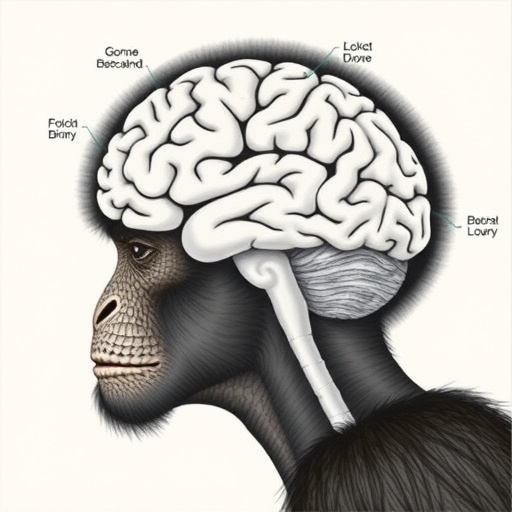
In a groundbreaking study poised to reshape our understanding of human cognition, researchers have uncovered compelling evidence pinpointing the neural underpinnings of metacognition within the brains of other primates. The research, spearheaded by Miyamoto, D’Ambrogio, Harbison, and colleagues, offers unprecedented insights into how brain activity and connectivity patterns grant other primates a form of higher-order cognitive capacities, previously thought to be uniquely human. This revelation could redefine the evolutionary trajectory of self-awareness and cognitive reflection across species, bridging gaps in our comprehension of the biological roots of conscious thought.
Metacognition, the capacity to reflect on one’s own cognitive processes, has long been considered a hallmark of human intelligence. It allows individuals to evaluate and regulate their decision-making, memory, and learning strategies. Until now, the extent to which this ability exists in non-human primates remained a contentious topic within the scientific community, hindered by the lack of direct neural evidence. This new study radically challenges that notion by demonstrating that closely related primates not only perform metacognitive tasks but also exhibit brain activity patterns and connectivity profiles analogous to humans.
To unravel this intricate web of neural correlates, the researchers employed a multi-faceted approach encompassing brain imaging, neurophysiological disruption, and comparative connectivity analyses across different primate species. Functional magnetic resonance imaging (fMRI) methods revealed specific activation patterns in prefrontal and parietal cortices—regions known to be critical for metacognitive processing in humans. Intriguingly, these same areas showed heightened responsiveness during metacognitive tasks in macaques, underscoring a shared neurological mechanism that transcends species boundaries.
The team further introduced targeted neural disruption techniques, such as transient inhibition via transcranial magnetic stimulation (TMS), to ascertain the causal role of these cortical regions. By selectively damping down activity in the identified areas, they observed a marked decline in the primates’ performance on tasks requiring self-monitoring and confidence judgments. This intervention confirmed that not only are these brain regions active during metacognitive engagements but that their functionality is essential for the execution of these complex cognitive processes.
Concurrently, diffusion tensor imaging (DTI) was utilized to map the white matter pathways facilitating communication between critical brain regions. The connectivity analyses spotlighted a conserved network architecture linking the dorsolateral prefrontal cortex to the anterior cingulate cortex and parietal lobes—a neural circuit heavily implicated in introspective assessments and error detection in humans. The presence of this reflexive neural network in other primates suggests an evolutionary continuity of brain systems supporting metacognitive functions.
Researchers also explored whether the observed patterns in brain activity and connectivity correlated with behavioral manifestations of metacognition. Employing elaborate decision-making paradigms, subjects from multiple primate species were tested on their ability to assess their own knowledge and uncertainty. Behavioral evidence aligned strongly with neural data, showcasing that primates demonstrated metacognitive-like behaviors, such as wagering on their answers based on confidence levels and adapting responses after feedback, mirroring strategies found in human cognition.
This pioneering inquiry extends beyond mere identification of brain regions into dissecting the dynamic interplay within these neural systems. The study’s connectivity modeling highlighted how synchronized oscillatory activity and information flow among key regions facilitate the emergence of metacognitive evaluation. These findings underscore the sophisticated neural computations underpinning self-reflective cognition, emphasizing that metacognitive processes stem from the integration of widespread cortical networks rather than isolated brain areas.
The implications of these findings are profound, not only for neuroscientific theories of consciousness but also for the evolving field of comparative psychology. By illustrating that metacognition is neither exclusive to humans nor an all-or-nothing trait but rather exists on a continuum, the research challenges entrenched paradigms regarding cognitive uniqueness. This knowledge may foster new frameworks for understanding cognitive evolution, highlighting the gradual augmentations in neural circuitry that gave rise to advanced self-awareness.
Moreover, the study opens promising avenues for biomedical research and artificial intelligence. By elucidating brain mechanisms of metacognition in primates, scientists can better model disorders of self-awareness, such as schizophrenia or dementia, potentially guiding novel therapeutic interventions. In AI, incorporating principles gleaned from these neural architectures might pave the way for systems capable of self-monitoring and adaptive learning, pushing robotics and machine learning into realms of higher-order cognition.
Indeed, the methodology devised in this study sets a new standard for future investigations into metacognitive phenomena across species. By combining advanced neuroimaging, disruption experiments, and behavioral assays, the researchers provide a comprehensive blueprint for dissecting complex cognitive traits. This integrative approach promises to propel the field beyond descriptive observations into mechanistic comprehension at the neural circuit level.
As with all transformative research, unanswered questions remain. For example, the study’s focus on closely related primates leaves open the extent to which more distantly related species possess rudimentary forms of metacognition. Additionally, the exact evolutionary pressures and environmental contexts that shaped the fine-tuning of metacognitive circuits remain to be elucidated. These questions set an exciting agenda for interdisciplinary collaboration among neuroscientists, evolutionary biologists, and cognitive scientists.
It is also noteworthy how this research reflects a conceptual shift toward appreciating cognition as a neural network property, emphasizing connectivity and integration rather than isolated brain region functions. This perspective aligns with contemporary theories of brain organization, which posit that complex behaviors arise from distributed, interactive systems. The study’s elucidation of how network dynamics underpin self-reflection exemplifies this paradigm and invites further inquiry into the orchestration of cognition across neural assemblies.
In the broader societal context, understanding the biological roots of metacognition bears relevance for education, mental health, and our conception of animal intelligence. Recognizing that metacognitive abilities are not solely human may alter ethical considerations regarding primate welfare and rights. It also impels educators and clinicians to account for the fundamental neural mechanisms governing self-regulation and reflective learning—skills crucial for personal development and psychological resilience.
Ultimately, the work by Miyamoto and colleagues heralds a new era in cognitive neuroscience, bridging gaps between species and unveiling the shared neural foundations of self-awareness. As the field advances, this research will undoubtedly serve as a cornerstone for ongoing explorations into the mind’s most enigmatic faculties, pushing the boundaries of what it means to know oneself.
Cite Scienmag News
Cassandra Pierce. (May 18, 2026). Tracing Human Metacognition Origins Through Primate Brain Studies. Scienmag. https://scienmag.com/tracing-human-metacognition-origins-through-primate-brain-studies/
Cassandra Pierce. "Tracing Human Metacognition Origins Through Primate Brain Studies." Scienmag, 18 May 2026, https://scienmag.com/tracing-human-metacognition-origins-through-primate-brain-studies/. Accessed 6 September 2026.
Cassandra Pierce. "Tracing Human Metacognition Origins Through Primate Brain Studies." Scienmag. May 18, 2026. https://scienmag.com/tracing-human-metacognition-origins-through-primate-brain-studies/


