


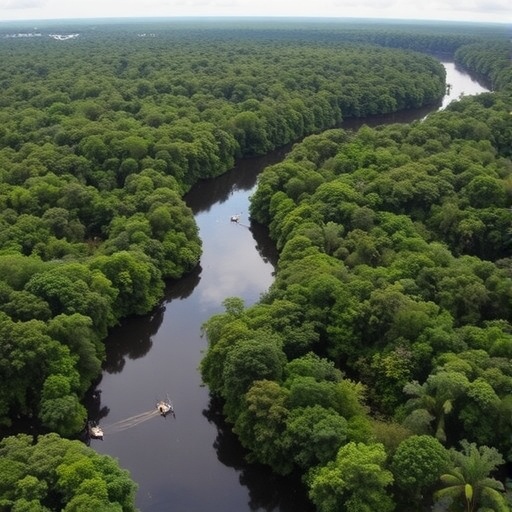
Human activities continue to exert unprecedented pressures on global biodiversity, pushing countless species toward extinction, disrupting essential ecosystem services, and exacerbating climate change. Among the most critical interventions to halt this alarming trajectory has been the establishment and maintenance of protected areas, which serve as refuges for biodiversity and safeguard vital natural resources such as water and soil. However, recent findings from an extensive new study focused on Brazil’s system of federal protected areas shed light on a chronic and systemic shortfall in conservation funding that threatens to undermine the efficacy of these protective measures at a national and global scale.
Brazil, known for its staggering biological megadiversity, harbors some of the world’s most crucial ecosystems—including the Amazon rainforest, vast savannas, and the Atlantic coastal forests. These areas collectively represent nearly 750,000 square kilometers of protected land, crucial not only for local ecological stability but also for global climate regulation. The multidisciplinary team conducting this research, composed of scientists from Brazil’s Federal University of Amapá, Conservation International Brazil, and the University of Miami, meticulously analyzed a decade-long financial dataset from 2014 to 2023, delineating the alignment—or rather, the misalignment—between budgetary allocations and operational costs across 300 federally managed reserves.
The results were nothing short of alarming. Around 72 percent of Brazil’s federally protected areas are grossly underfunded, with a staggering cumulative deficit nearing $1 billion for the year 2023 alone. This funding gap is not uniformly distributed; rather, it disproportionately affects parks in remote and ecologically vital regions, most notably the Amazon basin. Despite a nominal 30 percent increase in conservation budgets over the past decade, the pace of financial infusion has unequivocally lagged behind the continuous expansion of protected territories. Consequently, the operational capacity to manage these lands—including necessary staffing, infrastructure maintenance, and enforcement—is severely compromised.
More specifically, Amazonian reserves receive only a fraction—approximately 20 percent—of the funding required for adequate management, a stark contrast to more urban-proximate conservation units such as those in the Atlantic Forest region, which command nearly three-quarters of their financial needs. The disparity underscores a critical spatial and socioeconomic inequity that reflects underlying patterns of institutional support and political will. Parks located near populous urban centers benefit from more effective lobbying and visibility, thereby garnering higher funding levels. In contrast, areas of immense ecological value but distant from these centers face chronic neglect, leaving them vulnerable to illegal activities such as deforestation, mining, and poaching.
The study also highlights significant temporal fluctuations in funding that correlate with broader policy and economic shifts. The COVID-19 pandemic, in particular, precipitated a dramatic contraction in conservation budgets during 2020 and 2021, exacerbated by political decisions that rolled back environmental priorities. Although there has been some financial recovery in the subsequent years, the rebound remains incomplete, perpetuating uncertainty and instability in the management of protected areas. The authors caution that such volatility in resource allocation hampers long-term conservation planning and undermines the ability of protected areas to sustain ecological integrity over time.
Beyond budgetary shortfalls, the researchers emphasize the critical need to address structural inequities in Brazil’s conservation financing framework. Larger, newer, and geographically isolated parks face the steepest disadvantages not only in funding but also in institutional support and public attention. These areas, often rich in natural capital but poor in traditional economic output, represent untapped opportunities for integrating conservation objectives with sustainable socioeconomic development. The study forwards a vision of conservation as a driver of inclusive growth, whereby properly funded protected areas can catalyze local economies through green jobs, ecotourism, and ecosystem service markets if supported by stable and strategic investment.
To address these persistent challenges, the research team proposes a suite of forward-thinking recommendations designed to catalyze systemic reform. Foremost among these is the urgent prioritization of the Amazon region in national conservation budgets, reflecting its unparalleled ecological significance and current acute funding deficits. Existing initiatives such as the Amazon Region Protected Areas Program (ARPA) and the Fundo Amazônia fund provide valuable models but are insufficient in scale and reach. The authors advocate for scalable augmentation and integration of such initiatives into a coherent national strategy.
Equally vital is the creation of stable and predictable multi-year funding commitments. The researchers underscore that conservation budgets must transcend the vicissitudes of annual political cycles and short-term fiscal pressures. In practical terms, this necessitates developing financial instruments and policies that guarantee long-term resource flows, enabling strategic management planning, infrastructure investment, and resilience-building against emergent threats.
In addition, the study calls for the establishment of a transparent national financing platform that aggregates and publicly disseminates data on investments across all protected area categories—federal, state, and private. Such a platform would facilitate accountability, enhance policy coherence, and empower stakeholders from local communities to international organizations in monitoring and advocating for effective conservation funding.
Finally, targeted support for remote and recently established parks is critical to rectify disparities inherent in the current funding landscape. These areas lack the political influence and institutional networks enjoyed by older and more accessible reserves, necessitating deliberate policy interventions to ensure equitable resource distribution. The authors argue that addressing this “equity gap” is not only a matter of fairness but a pragmatic imperative to safeguard biodiversity across the full complement of Brazil’s ecosystems.
Ultimately, this study provides compelling evidence that while protected areas remain the cornerstone of global conservation goals, without adequate and equitable funding, their potential cannot be realized. The Brazilian experience illustrates how systemic underinvestment jeopardizes not only national but also global biodiversity targets, climate mitigation efforts, and socioeconomic development agendas. As Helenilza Cunha, one of the study’s lead authors, poignantly states, treating protected areas as strategic assets deserving of stable, long-term funding is essential for Brazil’s adaptation to climate change and sustainable economic future.
The detailed statistical and policy analysis presented in this research offers a critical roadmap for governments, conservation organizations, and donors worldwide grappling with the challenge of effectively financing biodiversity protection in megadiverse countries. It underscores the urgent need for innovative financing mechanisms, integrated governance, and robust political commitment to safeguard these irreplaceable natural heritage sites amid growing environmental and societal pressures.
By shining a light on the chronic underfunding that hides beneath Brazil’s global conservation reputation, this study reframes the conversation around protected area management from one of mere designation and expansion to one fundamentally concerned with sustainability, equity, and effectiveness. The scientific rigor paired with a pragmatic policy vision makes this an indispensable reference point for any serious effort aimed at halting biodiversity loss and achieving the ambitious targets of international conservation frameworks.
News Publication Date: 15-May-2026
Web References: http://dx.doi.org/10.1017/S037689292610040X
References: Helenilza Ferreira Albuquerque Cunha, Luís Cláudio Fernandes Barbosa, Alan Cavalcanti da Cunha, and José Maria Cardoso da Silva, Environmental Conservation, Cambridge University Press, 2026.
Cite Scienmag News
Margaret Porter. (May 18, 2026). Chronic Underfunding of Brazil’s Protected Areas Threatens the Amazon. Scienmag. https://scienmag.com/chronic-underfunding-of-brazils-protected-areas-threatens-the-amazon/
Margaret Porter. "Chronic Underfunding of Brazil’s Protected Areas Threatens the Amazon." Scienmag, 18 May 2026, https://scienmag.com/chronic-underfunding-of-brazils-protected-areas-threatens-the-amazon/. Accessed 3 September 2026.
Margaret Porter. "Chronic Underfunding of Brazil’s Protected Areas Threatens the Amazon." Scienmag. May 18, 2026. https://scienmag.com/chronic-underfunding-of-brazils-protected-areas-threatens-the-amazon/


