


A recent breakthrough study led by researchers at the Institute of Cosmos Sciences of the University of Barcelona (ICCUB) and the Institute of Space Studies of Catalonia (IEEC) significantly advances our understanding of the Milky Way’s evolution, focusing on the pivotal role ancient galactic collisions have played in shaping its stellar disc. By leveraging sophisticated simulations and integrating observational data, the research uncovers how the delicate structure of our galaxy’s disc has endured and transformed through cosmic upheavals, revealing new insights into the timing and consequences of its last major galactic interaction.
The stellar disc of the Milky Way, an immense rotating structure characterized by its iconic spiral arms, hosts the majority of the galaxy’s stars, including our own Sun. This vast, pancake-shaped formation spins at a staggering velocity surpassing 220 kilometers per second. Determining when this dynamic disc coalesced into a coherent rotational pattern has long been a central challenge in galactic astronomy. The “spin-up” time—the epoch at which stars unify into an ordered spinning structure—provides a critical window into the galaxy’s early developmental phases.
Despite our galaxy’s seemingly serene appearance from afar, its past is marked by violent galactic collisions. For decades, astronomers postulated that such cataclysmic mergers were instrumental in sculpting the Milky Way’s current form. This hypothesis gained solid footing in 2018 with data from the Gaia space observatory, which identified a stellar population with peculiar kinematics indicative of a sizable merger approximately ten billion years ago. This significant event has been termed the Gaia–Sausage–Enceladus (GSE) merger and is now recognized as a cornerstone in the Milky Way’s evolutionary history.
To delve deeper into these phenomena, the present study utilized the Auriga suite of cosmological magneto-hydrodynamical simulations, which model the formation and evolution of disc galaxies broadly analogous to the Milky Way. These high-resolution simulations incorporate sophisticated physics, capturing gas dynamics, star formation, and feedback processes, facilitating an intricate analysis of how disks assemble, survive, or re-form after mergers. The research reveals a nuanced narrative: the chronological emergence of rotating stellar discs is often far earlier than the observed spin-up signatures, which instead reflect a galaxy’s recovery following disruptive collisions.
A key revelation of the research is that major galactic mergers can partially or completely dismantle existing stellar discs. The observable spin-up time, therefore, does not necessarily correspond to the disc’s initial formation epoch but rather marks the period during which the Milky Way restored its disc-like structure after a tumultuous merger event. This insight challenges previous assumptions and reframes our understanding of the galaxy’s formative timeline.
By aligning simulation data with the distribution and ages of star clusters in the Milky Way, the authors further infer that the GSE merger likely occurred about 11 billion years ago, slightly earlier than many prior analyses suggested. This precise timing is critical, not only for charting the galaxy’s history but also because it coincides with pronounced bursts of star cluster formation, phenomena naturally triggered by the compression of interstellar gas during such cosmic collisions.
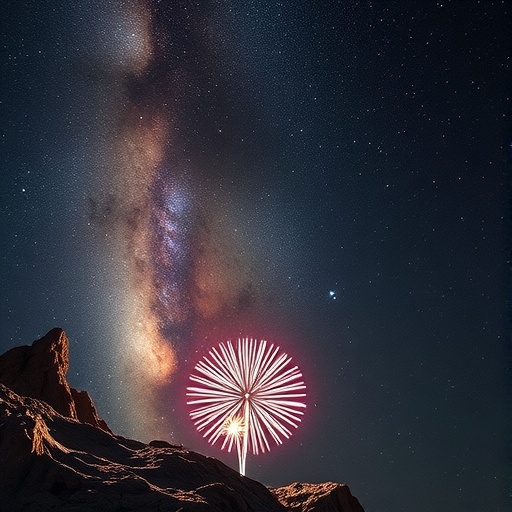
These star formation bursts act as a cosmic “firework” display, a vivid consequence of the turbulent influx of kinetic energy and matter introduced during a collision. The research highlights that major mergers stimulate intense star formation events, generating new globular clusters and reinvigorating the galactic ecosystem. Such processes intricately link the structure and age distribution of stellar populations with the violent episodes that have punctuated a galaxy’s life.
Co-author Chervin F. P. Laporte, a researcher at CNRS, emphasizes, “Models of the Gaia–Sausage–Enceladus merger predict that a galactic firework should have followed the impact, raising star formation and fostering the formation of globular clusters. This is the first time this link has been made.” This marks a significant conceptual advance, forging a direct connection between collateral starburst activity and merger chronology.
Lead author Matthew D. A. Orkney elaborates on the broader implications: “This research highlights the important relationship between galactic structure and ancient collisions, which must be understood in unison in order to understand the history of our galaxy.” The study, therefore, calls for a holistic approach, wherein the morphology, stellar kinematics, and timing of star formation episodes are analyzed collectively to reconstruct galactic histories.
Given the intrinsic impossibility of observing the Milky Way’s early history directly, the study emphasizes the complementary power of observing analogous galaxies in the distant Universe, whose light encodes information from epochs billions of years in the past. Tools like the James Webb Space Telescope (JWST) and the Atacama Large Millimeter/submillimeter Array (ALMA) provide unprecedented observational capabilities to detect and characterize these galactic analogs, offering valuable benchmarks to test and refine galaxy formation models suggested by simulations like Auriga.
Published in Monthly Notices of the Royal Astronomical Society, the paper’s simulation data is publicly accessible, enabling the broader astrophysical community to engage with, validate, and build upon these findings. This transparency promises to accelerate progress in piecing together the Milky Way’s complex saga, fostering synergy between computational modeling, star cluster age-dating, and observational cosmology.
In sum, this groundbreaking study rescripts the narrative of the Milky Way’s assembly, revealing that the galaxy’s stellar disc is not a static relic but a resilient structure sculpted and reshaped by ancient, cataclysmic galactic encounters. The integration of high-fidelity simulations with precise star formation chronologies marks a watershed moment in our quest to unravel the origins and evolution of our cosmic home.
News Publication Date: 7-May-2026
Web References:
https://doi.org/10.1093/mnras/staf2154
References:
Auriga simulation data and findings published in Monthly Notices of the Royal Astronomical Society.
Keywords
Milky Way, Galactic Disc, Gaia–Sausage–Enceladus Merger, Auriga Simulations, Stellar Spin-up, Galactic Collisions, Star Formation Bursts, Globular Clusters, Galaxy Evolution, Cosmological Simulations, JWST, ALMA
Cite Scienmag News
Grant Pearson. (May 18, 2026). Milky Way Lights Up with Stellar Fireworks After Galactic Collision. Scienmag. https://scienmag.com/milky-way-lights-up-with-stellar-fireworks-after-galactic-collision/
Grant Pearson. "Milky Way Lights Up with Stellar Fireworks After Galactic Collision." Scienmag, 18 May 2026, https://scienmag.com/milky-way-lights-up-with-stellar-fireworks-after-galactic-collision/. Accessed 4 September 2026.
Grant Pearson. "Milky Way Lights Up with Stellar Fireworks After Galactic Collision." Scienmag. May 18, 2026. https://scienmag.com/milky-way-lights-up-with-stellar-fireworks-after-galactic-collision/


