


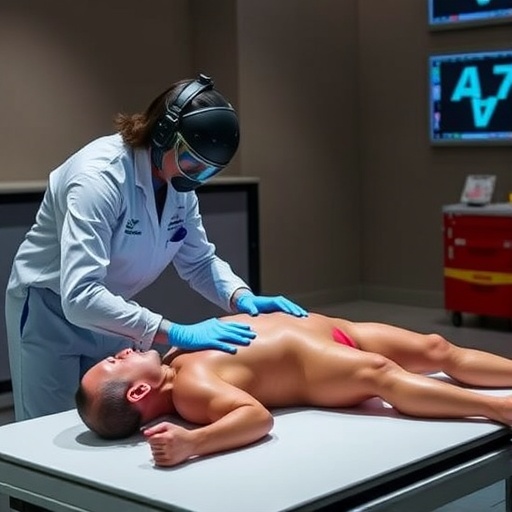
In a groundbreaking development at the intersection of artificial intelligence and emergency medical care, recent research heralds the promise of AI-enabled cardiopulmonary resuscitation (CPR) instruction as a transformative tool for bystanders during out-of-hospital cardiac arrests. This innovative approach aims to bridge critical gaps in emergency response by providing real-time, interactive guidance to individuals who often find themselves unprepared in moments of life-and-death urgency. While traditional CPR training has saved countless lives, barriers such as lack of access to certified courses and panic-induced mistakes during emergencies have limited its widespread efficacy. The advent of AI technology promises to revolutionize this paradigm, offering scalable, immediate, and personalized instruction that may significantly improve survival outcomes.
Central to this research is the capacity of AI algorithms to interpret complex, real-world scenarios and deliver step-by-step CPR instructions tailored to the specific context of the bystander’s environment and proficiency level. By leveraging sophisticated natural language processing and sensor integration, an AI-enabled CPR system can detect when a cardiac arrest occurs and promptly engage the rescuer through voice commands or mobile applications. Such systems can assess the quality of compressions, timing, and ventilation feedback in real time, dynamically adjusting guidance to optimize the resuscitation process. This intelligent feedback loop represents a technological leap beyond static instructional videos or printed manuals, giving laypersons an unprecedented lifeline in critical emergencies.
The implications of this study stretch far beyond incremental improvements in CPR instruction. By democratizing access to high-quality emergency guidance, AI’s intervention could dramatically alter public health trajectories, especially in underserved or rural areas where immediate professional medical assistance is often delayed. Furthermore, the scalability of AI platforms holds promise for incorporation into existing emergency response infrastructures, potentially enabling dispatchers to supplement their verbal instructions with AI-powered tools. Consequently, this confluence of technology and medicine may not only elevate individual readiness but also bolster systemic resilience against the pervasive threat of sudden cardiac arrest, which remains a leading cause of mortality worldwide.
A pivotal aspect of the ongoing investigation involves rigorous validation of these AI-enabled systems across diverse populations and real-world settings. The study underscores the necessity for broad, population-based trials to confirm efficacy, safety, and adaptability under variable conditions, including differing languages, cultural contexts, and infrastructure readiness. Addressing these facets is essential to ensure broad inclusivity and to avoid disparities in healthcare accessibility that new technologies sometimes exacerbate. Moreover, ethical considerations around data privacy, user consent, and algorithmic transparency require careful integration within the deployment frameworks to foster trust and widespread adoption.
Technical innovation underpinning this research relies heavily on advances in machine learning models capable of interpreting biometric data streams, ambient sound, and user inputs simultaneously. Cutting-edge sensor technology embedded in smartphones or wearable devices can capture subtle cues—such as compression depth or rhythm—feeding into AI engines that compare performance against established medical guidelines. This instantaneous appraisal and constructive correction can markedly enhance the quality of CPR delivered, which is a critical determinant of patient survival and neurological outcomes. As AI systems continue to evolve, their capabilities will likely extend to predictive analytics, identifying early risk signs and enabling preemptive action.
The collaboration between multidisciplinary teams encompassing cardiologists, computer scientists, emergency medicine specialists, and public health experts has been instrumental in designing robust AI frameworks suited for high-stakes environments. This synergy ensures that technological solutions are clinically sound and practically deployable. The study’s authors emphasize the importance of user-centered design principles to make interfaces intuitive, minimize cognitive load during emergencies, and accommodate individuals of varying ages and technical literacy. Such ergonomic considerations are as vital as the backend algorithms in translating innovative technologies into tangible life-saving outcomes.
Another fascinating dimension explored is the potential integration of AI CPR instruction with emergency medical services (EMS) dispatch systems. Imagine an AI platform that, once activated by a 911 caller reporting a cardiac arrest, continuously guides the caller through CPR until paramedics arrive, all the while monitoring response quality through connected devices. This extended chain of support could drastically reduce the time to effective resuscitation, which is paramount for survival. Additionally, by documenting the intervention, AI systems could provide valuable data for post-event analysis and EMS optimization.
Despite the demonstrated potential, the research prudently acknowledges limitations and challenges ahead. Variability in hardware availability, internet connectivity, and user willingness to engage with AI during emergencies represent substantial hurdles. The systems must also navigate complex legal and regulatory landscapes, addressing liability concerns and ensuring compliance with medical device standards. Researchers advocate for transparent, ongoing assessment and collaboration with policymakers to create enabling environments that foster innovation while safeguarding public welfare.
In the broader context of healthcare transformation, AI-enabled CPR instruction exemplifies the emerging role of artificial intelligence as an active collaborator rather than a passive tool. By extending expert guidance beyond hospital walls into the hands of everyday citizens, AI has the power to redefine emergency care paradigms. This paradigm shift aligns with global health objectives aimed at reducing premature deaths from cardiovascular diseases and enhancing community resilience through technological empowerment and education.
Looking forward, the successful deployment of AI CPR instruction on a wide scale will depend on continuous improvement informed by real-world user feedback, advances in algorithmic intelligence, and integration with complementary digital health initiatives. Training programs will likely evolve, blending traditional methods with AI-assisted practice to maximize preparedness. Public awareness campaigns and partnerships with emergency response organizations will be crucial to normalize and encourage adoption, ensuring that when cardiac arrest strikes, help is just a voice command away.
In sum, this pioneering study illuminates a promising frontier where technology amplifies human capacity to save lives in emergencies. By harnessing artificial intelligence to guide critical interventions like CPR, we stand on the cusp of a new era in public health—a future where life-saving expertise is universally accessible, timely, and dynamically responsive. As research progresses and validation studies expand, the vision of AI as an indispensable ally in cardiac arrest response draws closer to reality, potentially rewriting the narrative of survival in crises worldwide.
The collaboration and expertise fueling this endeavor underscore the necessity of interdisciplinary efforts to address one of medicine’s most urgent challenges. With further research and thoughtful implementation, AI-enabled CPR instruction may soon become a cornerstone of emergency care, empowering individuals everywhere to act decisively and confidently when seconds literally mean the difference between life and death.
News Publication Date: Information not provided.
Web References: Information not provided.
References: (doi:10.1001/jamainternmed.2026.1552)
Cite Scienmag News
Denise Maddox. (May 18, 2026). AI-Powered Instructor Revolutionizes Cardiopulmonary Resuscitation Training. Scienmag. https://scienmag.com/ai-powered-instructor-revolutionizes-cardiopulmonary-resuscitation-training/
Denise Maddox. "AI-Powered Instructor Revolutionizes Cardiopulmonary Resuscitation Training." Scienmag, 18 May 2026, https://scienmag.com/ai-powered-instructor-revolutionizes-cardiopulmonary-resuscitation-training/. Accessed 3 September 2026.
Denise Maddox. "AI-Powered Instructor Revolutionizes Cardiopulmonary Resuscitation Training." Scienmag. May 18, 2026. https://scienmag.com/ai-powered-instructor-revolutionizes-cardiopulmonary-resuscitation-training/


