


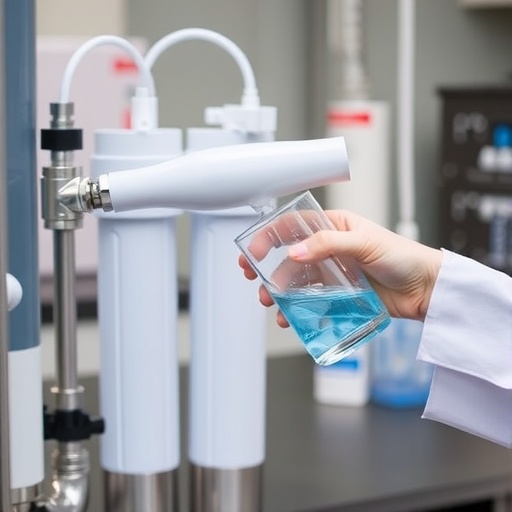
In an era where access to clean drinking water remains a critical global challenge, recent research out of Chennai, India, offers fresh insights into the microbial safety of household reverse osmosis (RO) systems. A team of scientists led by Kagan, Hamilton, and Lichtman conducted an extensive study evaluating how effectively these filtration units protect families from waterborne pathogens in one of India’s most densely populated urban centers. Their findings, published in a leading environmental health journal, shed light not only on the efficacy of RO technology but also on the hidden microbial risks lurking inside systems designed to eliminate contaminants.
Reverse osmosis has long been hailed as a gold standard in residential water purification, employing semi-permeable membranes to strip away dissolved solids, chemicals, and pathogens. However, the reality on the ground, particularly in rapidly developing cities with complex municipal water infrastructures like Chennai, may be far more nuanced. The research team undertook a rigorous investigation to dissect the performance of household RO units, aiming to reveal potential vulnerabilities in microbial defense that conventional laboratory tests may overlook.
Central to their study was the collection of water samples from a wide array of Chennai households using RO systems. By employing advanced microbial assays and next-generation sequencing technologies, the researchers could catalog not only the total bacterial load but also pathogenic strains that evade removal. Their data strikingly revealed that while RO membranes effectively reduce many contaminants, biofilm formation within the system components can lead to microbial regrowth and contamination downstream of the filtration process itself.
This phenomenon is particularly concerning because biofilms—complex aggregations of microorganisms embedded in a protective matrix—can colonize RO membranes, storage tanks, and even taps. These microbial communities create microenvironments where pathogenic bacteria may thrive, shielded from the filtering mechanisms and often impervious to residual disinfectants. Consequently, households relying on RO units without proper maintenance may inadvertently expose themselves to health risks, despite the apparent clarity and taste of purified water.
Moreover, the investigators identified several operational factors that exacerbate microbial risks. Inconsistent maintenance schedules, prolonged water stagnation in storage tanks, and suboptimal system design all contributed to the proliferation of microbes within RO setups. Particularly prevalent was contamination by opportunistic bacteria, including species known to cause gastrointestinal infections and other waterborne illnesses, highlighting a gap between theoretical RO performance and real-world user experience.
The study also explored socio-economic factors influencing user adherence to recommended upkeep protocols. Many households surveyed displayed limited awareness of how critical regular cleaning and component replacement are for the sustained safety of RO systems. The economic burden of maintenance, combined with a lack of regulatory guidelines specific to domestic water treatment technologies in India, compounds the problem and leaves millions vulnerable.
In addition to microbiological testing, the research incorporated a detailed assessment of water quality parameters before and after RO treatment. Parameters such as turbidity, total dissolved solids (TDS), residual chlorine, and heterotrophic plate counts were analyzed. While RO units consistently achieved remarkable reductions in TDS and turbidity, residual chlorine levels typically fell below detection, inadvertently promoting microbial survival in storage tanks where disinfection protection wanes.
By mapping contamination hotspots within the household water distribution chain, the investigators proposed targeted interventions. These included improved user education on the importance of periodic disinfection, design modifications to minimize dead zones where water can stagnate, and the development of integrated monitoring tools to alert users about system efficacy declines. Such innovations have the potential to transform RO systems from reactive solutions into proactive safeguards against microbial contamination.
The implications of this research extend far beyond Chennai’s city limits. As urban populations swell globally and the demand for decentralized water treatment surges, the reliability of household purification technologies will be pivotal in combating waterborne diseases. The revelations that RO systems, while technically advanced, are not infallible underscore a pressing need for regulatory frameworks and quality assurance protocols tailored to the realities of end users.
Intriguingly, the study also signals an emerging frontier for engineered microbiomes in water purification systems. Understanding how microbial communities interact with filtration media could lead to bioengineered membranes designed to resist biofilm formation or even actively degrade pathogens. Such breakthroughs could revolutionize household water safety, merging microbiology, materials science, and public health in unprecedented ways.
The authors emphasize that the mere presence of RO technology does not guarantee microbial safety without vigilant attention to maintenance and system monitoring. Their research advocates for a holistic approach—integrating technology innovation, user behavior modification, and policy interventions—to effectively safeguard drinking water quality in densely populated urban environments where public water infrastructure remains unreliable.
Furthermore, this investigation challenges the common perception that water clarity equals safety. It demonstrates that invisible microbial threats can persist despite physical or chemical water quality indicators showing compliance. This insight calls for expanding water quality monitoring techniques to include molecular and microbiological evaluations in routine household water safety assessments.
Ultimately, this landmark study catalyzes a broader dialogue about sustainable and resilient water provision in emerging economies. It invites stakeholders—policy makers, scientists, manufacturers, and consumers alike—to reconsider how water treatment technologies are deployed, maintained, and regulated. The researchers’ meticulous work in Chennai serves as a case study illuminating the complexities and potential pitfalls embedded in the seemingly simple act of drinking a glass of filtered water.
To translate these findings into public health gains, the authors propose community-based programs combining technical training, subsidy-driven maintenance plans, and awareness campaigns that empower consumers to safeguard their water quality. Such multi-pronged strategies promise to amplify the benefits of household RO systems and mitigate the hidden microbial risks lurking within.
As climate change and urbanization intensify pressures on municipal water systems worldwide, this research arrives at a crucial moment. It underscores that innovation in water purification technologies must be matched by rigorous evaluation of microbial safety under real-world conditions. Only by bridging this gap can we ensure the promise of clean water, a cornerstone of public health, is fully realized for all.
In conclusion, the study’s comprehensive appraisal of household reverse osmosis systems in Chennai unveils critical insights on microbial hazards born from infrastructure aging, user practices, and microbial ecology dynamics. It calls for renewed attention to maintenance, design optimization, and regulatory oversight to truly harness the potential of RO technology in delivering safe drinking water. The findings not only advance scientific understanding but also chart a path toward healthier urban lives across the global South and beyond.
Cite Scienmag News
Morgan Morrow. (May 15, 2026). Testing Reverse Osmosis Systems for Microbial Safety. Scienmag. https://scienmag.com/testing-reverse-osmosis-systems-for-microbial-safety/
Morgan Morrow. "Testing Reverse Osmosis Systems for Microbial Safety." Scienmag, 15 May 2026, https://scienmag.com/testing-reverse-osmosis-systems-for-microbial-safety/. Accessed 4 September 2026.
Morgan Morrow. "Testing Reverse Osmosis Systems for Microbial Safety." Scienmag. May 15, 2026. https://scienmag.com/testing-reverse-osmosis-systems-for-microbial-safety/


